Andrés Saavedra is riding the wave of Mexican modernism. But that’s not all — he’s also surfing sand-churning right barrels off a peninsula in the sun-drenched state of Guerrero. Because MUSA, an eco-minded community of luxury properties and the realised dream of the visionary designer, is the latest jewel to wash up on the west Mexican coast.
Built in a blend of Japanese and Central-American architecture styles, the destination also mixes property types, with a central hotel flanked by more permanent residences. Classic surf shack-style ‘Hideaways’ form the entry level product, with cutting-edge work studios and custom-build lots also available — all sharing amenities and sitting, secluded, a mere 35-minute drive from Ixtapa-Zihuatanejo International Airport.
Here, Saavedra tells us what prompted this incredible self-sustaining ‘tropical modernist’ project — and why he wants everyone to discover the allure of authentic yet ‘new’ Mexican design…
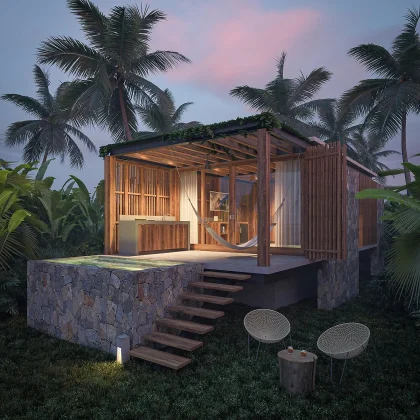
by MUSA, Model H01
Where did the original vision for MUSA come from?
We wanted to build a community that we wanted to live in. A community that had all of the amenities that we felt were important for the lifestyle we were seeking. Everything from art, music, surfing and adventure, to workshops, a school and a farm. This master plan was our vision of what a model community would look like.
What inspired the design of the hotel?
It’s ‘tropical modernist’ — a unique design for the climate, combined with ideologies of barefoot, laidback luxury. In the tropics, architecture embraces the climate. The natural landscape is invited to integrate with interiors designed with a raw authenticity; a sense of understated elegance and functional approach. This enhances elements of the surrounding environment, and the result is spaces made for living — but left open to interpretation.
And how does the design reflect modern Mexico?
It’s unapologetically Mexican — and inspired by Mexico in its most traditional, most authentic form. The design reflects a vision of a ‘new Mexico’, where the combination of art, design, nature and lifestyle that is unique to this part of the world provides a fabric for this contemporary concept. It’s a new-world experience, with pared-back styling, neutral palettes of calming colours and natural materials sourced from artisans across the country. But it’s also very Japanese in the use of light, wood and space — with the craft itself rooted in meticulous dedication to detail in its most natural, imperfect and authentic form.
What Mexican values are at the heart at MUSA?
We want to represent the Mexico that we know exists. Not just the tourist-facing Mexico, or what the world considers to be Mexican, but what Mexico represents for us. And that’s honesty, and integrity, and good people — hard-working, loyal, incredible service-focused people. We’ve also got an incredible natural environment. It’s the beauty of Mexico. It’s the colours, the spiciness, the rawness and the imperfection. It’s all of those things presented in a context that is just so simple and beautiful. Mexico itself is rich in everything. And that’s MUSA.
Why was diversity of guests and buyers so important?
We wanted diversity across all of our product types, and that’s been the underlying factor for how we’ve designed. We never wanted MUSA to feel like a resort, and we didn’t want it to just be one demographic of buyer. It was super important for us to have this diversity, as we want the whole spread of personalities — from each end of the spectrum, and everything in between. Good parties always have that kind of diversity.
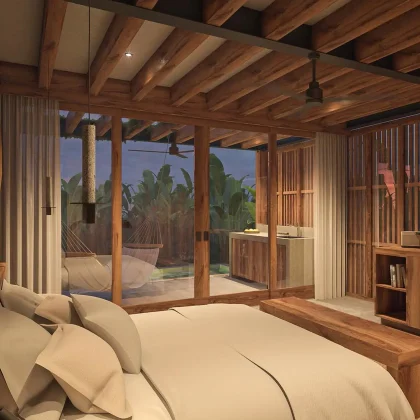
by MUSA, Model H01
How did you position yourself in the marketplace?
AirBnB was the biggest competitor we felt we had. Why would someone buy when they can rent something, then sublet that and travel around the world? Why the headache of ownership? So, as developers, we looked at that as a challenge. The ‘Hideaway’ model was born out of that and, instead of trying to hard sell, we asked people: “Why wouldn’t you buy?” And we found that people didn’t want the headache of owning a property in a country where they didn’t speak the language. So the ‘Hideaway’ is a hybrid, where it’s full ownership — but also managed and operated by the hotel.
And what role does the hotel play at MUSA?
The hotel is the heartbeat of the first phase because of our hospitality-focused service model. What a strictly private, residential model lacks is the ability to shape the elements which will bring everyone together around a complete concept — creating community which, in turn, creates the vibe. We really looked at the hotel as the heart of the project because it services not only its hotel guests, but all of the residents to create a quality standard of living.
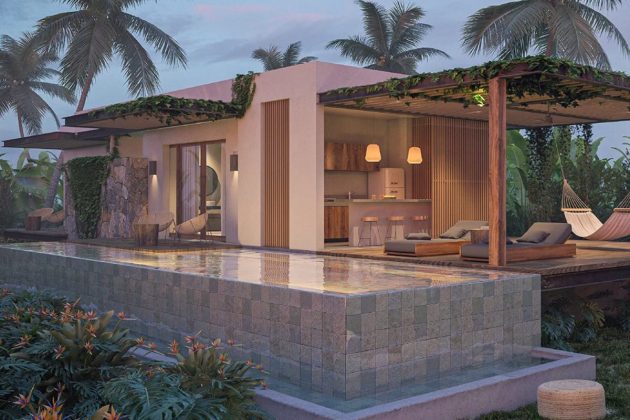
by MUSA, Model H04
And finally, what do you want guests to take away from a stay at MUSA?
I want them to have fun, and to fall in love. I want them to fall in love with the design, the people and the food. Like really, truly! I want them to enjoy it, to want to be a part of it and to want to return. We want all the people that come here to invest, in a way — not necessarily needing to purchase a property, but in that we want to build the community itself, in a way that is authentic and also really meaningful.
Read more about luxury real estate markets in our first issue of The JamesEdition:
Get exclusive access now. Completely free.