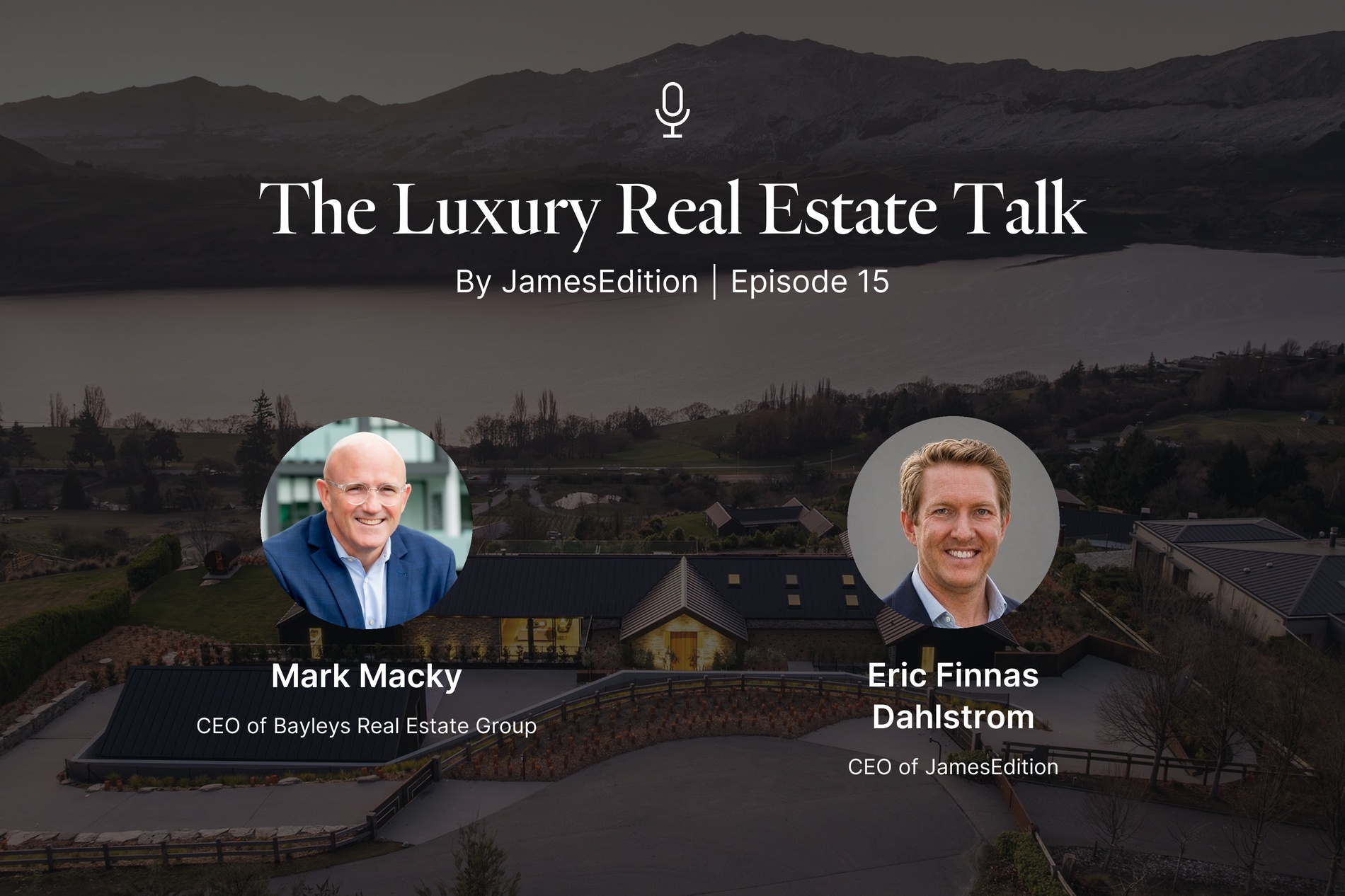
In this episode of the JamesEdition Podcast, Eric Finnas Dahlstrom, CEO of JamesEdition, is joined by Mark Macky, CEO of Bayleys Real Estate Group, New Zealand’s largest full-service real estate agency. Speaking from Auckland, Mark shares a view of the market from one of the most active firms at its upper end.
Key Highlights
- A concentrated top tier: New Zealand records about 150 to 200 sales above NZ$5 million a year, about 1% of total sales volume.
- A new route for global buyers: The Active Investor Plus visa has drawn around 1,000 applications in 18 months, and its holders now account for about 25% of buyers above NZ$5 million.
- Buying optionality: High-net-worth families are looking for a safe, stable base to raise a family, protect wealth and enjoy the lifestyle, often as a second, third or fourth home.
- Two islands, two landscapes: The North Island offers farmland and coastal destinations such as the Bay of Islands and the Coromandel, while the mountainous South Island is home to Queenstown. Across the country, luxury is defined by privacy, land, water access, views and space.
- A straightforward transaction: No capital gains tax, no stamp duty and a Torrens title system keep purchases simple, and international buyers are often pleasantly surprised by the value for money.
 Mark MackyCEO of Bayleys Real Estate Group"We're finding that high net worth families aren't simply buying a house in New Zealand, they're also buying optionality and sometimes it might be second or third or a fourth house, but it's a place where they can raise family, protect wealth, enjoy an exceptional lifestyle and spend time in a stable and safe country."
Listen on Spotify or Apple Podcast
Transcript:
Inside Bayleys and the New Zealand Market
Eric:
I thought we could kick off by you telling us a little bit more about your background and the business you’re running now there in New Zealand.
Mark:
I’ve been with Bayleys for 25 years: I started as marketing director, built up my own franchise group of offices within the brand, joined the board about six years ago and have been CEO for the last two. Bayleys is still primarily owned by the Bayley family.
We have about 120 offices and 2,400 employees across residential, lifestyle, rural and commercial. We’re not the largest by headcount, but we sell more value of property in New Zealand than any other brand, and the luxury segment above five million dollars is an important part of what we do.
Eric:
Are there any numbers you can give us to get a sense of the size of the total market, like the number of transactions per year?
Mark:
New Zealand is a country of only five million people, roughly the size of the UK, split into the North Island and the South Island. The North Island is home to about four million people. It has more farmland and more beaches, with world-class coastal destinations such as the Bay of Islands and the Coromandel. The South Island is larger by land area but has only about a million people. The Southern Alps run from top to bottom, dividing it into east and west coasts, and world-renowned destinations like Queenstown sit among mountains, lakes, rivers and forests.
Last year there were 82,000 residential transactions. We also sell a lot of lifestyle property: land that isn’t big enough to be an economic farming unit, but you’d need a pretty big lawnmower to get around it, anywhere from one to 20 hectares.
Eric:
And how is the market doing today? What is driving the market in general?
Mark:
We were set for a good year of activity, then geopolitical changes brought headwinds through fuel prices, inflation and interest rates. Even so, the market has been pretty resilient. In 2025 we returned to more normal sales volumes; this year activity is slightly below that, but the market is still trading well, with reasonable supply and pretty flat prices.
A New Gateway for International Buyers
Eric:
You also have restrictions on foreign buyers, for example, which have changed a little bit lately?
Mark:
Yes. About eight years ago, a change of government introduced restrictions, and foreign buyers without ties to New Zealand couldn’t buy residential property, with exceptions for Australia and Singapore through free trade agreements.
Eighteen months ago, the government decided to attract good-quality international parties and created the Active Investor Plus Visa, or AIP, which has become known as a kind of golden visa. In the growth category, you invest NZ$5 million into higher-growth New Zealand businesses or funds and spend 21 days in the country over three years, so only seven days a year. You receive residency, and as soon as you’re approved, you can buy a property above NZ$5 million: at current exchange rates, about €2.55 million, £2.1 million or US$2.85 million.
Eric:
So the luxury market in general is predominantly domestic, but do you now see increased international demand because of these changes?
Mark:
Typically there are only about 150 to 200 sales above five million dollars a year: the very pointy end of the market. In the last 18 months, about 25% of those buyers have come through the AIP programme. In that period there have been a thousand applications: 511 fully approved, 285 approved in principle and only 52 withdrawn or declined, so less than 5%. New Zealand is certainly open for business.
Buyers don’t have to reside here; they keep their options open.
Eric:
That is quite a high volume for, as you say, fairly limited transaction volume and supply in general.
Mark:
We’re just starting to see the wave come through. Bayleys has sold four of the five largest residential sales in New Zealand’s history in the last 18 months: three to Kiwi expats and one to a New Zealander living here. Foreign buyers haven’t yet bought at the very top, but we see interest, including from notable Americans such as Peter Thiel, Larry Page and James Cameron. Two of them are citizens, one has residency, and that’s the optionality I mentioned.
Eric:
Apart from Australians and Singaporeans, from what other countries do you see the foreign demand coming?
Mark:
Of those thousand applications, about a third are from the US, a third from Southeast Asia and about 20% from Europe, with the balance from many other countries.
Growing up in New Zealand, there was this concept of the tyranny of distance: that we’re a long way from anywhere. Funnily enough, that distance is now becoming an attraction. We’re a safe country with a low crime rate, stable government and a great lifestyle, and in uncertain times, being a little bit away from some hotspots is not a bad thing.
Eric:
That national split fits very well with what we see at JamesEdition. 80% of the demand on the site for New Zealand is international. Americans lead, followed by domestic New Zealand buyers, then Australians, Germans and Brits.
Mark:
We’re one plane ride away: I’ve taken the direct 18-hour flight to New York a couple of times. I’ve also got a French wife, so we get back to France quite a bit, and I really don’t mind the flying.
Privacy, Land and Water: Luxury the New Zealand Way
Eric:
What would you say defines the typical luxury properties that people buy?
Mark:
In international cities, luxury is often about location, heritage and prestige. In New Zealand, it’s much more about privacy: land, access to the water, views and space.
Auckland, our largest city, has 1.5 million people, and Christchurch, the next largest, has 350,000. People who want big cities typically don’t come here. They come for an escape and a lifestyle that is second to none. Europe has equally beautiful beaches, but in midsummer you might share one with a thousand people. In New Zealand, you can be within an hour of Auckland and be the only person on an absolutely beautiful beach.
One story that comes to mind is a German client who has since become a good friend. He ran a substantial business in Germany and first came here on holiday, riding a motorbike around the country with his wife. He didn’t speak a word of English, had an amazing trip and decided to move here. We sold him his first house, then a more substantial property, and he built the most incredible house on a hill overlooking a beautiful coastal region north of Auckland. He has since bought a farm and more houses, and today he’s very well settled with his family, with some Kiwi turns of phrase that make him sound quite local.
Eric:
Median prices on our side are quite a bit higher around Queenstown. Is that a more premium area?
Mark:
Queenstown has positioned itself as an international destination attractive across all four seasons, not just for skiing, and its market has been robust and resilient over the last five years. Average sale prices are high, and you can buy some unique, stunning property there. As an international playground with a decent airport, it’s a pretty special place.
Buying in New Zealand: Process, Finance and Value
Eric:
When buyers look for properties, do they look across both islands, or zoom in on one island quite early in the search?
Mark:
Buyers often start with a wide remit. A couple of months ago, an American couple came to us wanting to buy in Auckland. They visited Hawke’s Bay, on the east coast of the North Island, fell in love with it and bought a house there for over ten million dollars. For an agent, the key is understanding the buyer’s brief.
Eric:
We see the majority of inquiries on the site are above that roughly three million US dollar mark, and the number of inquiries is up over 50% year on year. What do international buyers notice when they come, things that maybe surprised them?
Mark:
We don’t have a lot of bureaucracy. There’s no capital gains tax and no stamp duty, the rule of law is clean, and with our Torrens title system the transaction itself is very simple. If people are looking at residency in New Zealand but not living here, they should get good advice on tax and tax treaties between countries, and we can introduce them to experienced advisers.
The feedback I typically hear is that you get a lot for your money. Looking from afar, people may compare two properties and ask why one is so much more expensive. A lot of that comes down to location, and a good agent will explain, give context and provide comparable sales to reassure a purchaser. Generally, international buyers are pleasantly surprised by the value for money.
Eric:
How does the purchase process work? I noticed that a lot of properties were advertised without a price.
Mark:
There are four main methods of sale. We auction property, though typically not at the very top end. We run deadline campaigns, by tender or private treaty, without an asking price, inviting offers by a set date. Some properties are marketed by negotiation and some with an asking price. If a property is marketed without a price, we give buyers an indication of comparable sales, and they can commission an independent valuation. Offers are made on a standard sale and purchase agreement, agreeing a price subject to conditions such as a valuation, a building report or a lawyer’s approval, and things typically go through relatively smoothly.
Eric:
Is it similar to the US, with a buyer’s agent and a listing agent?
Mark:
We’re more aligned with the UK and Australia: the vast majority of agents are vendors’ agents who work with the purchaser. Some American clients would like buyer representation, and we can facilitate that.
Eric:
Is getting a mortgage as a foreigner tricky, and approximately where are mortgage rates now?
Mark:
Rates are around 5%, and you can fix for three years at about 5.2%. What might surprise US buyers is that we typically don’t fix for longer than five years. The four major banks are all Australian, with strong balance sheets and good private banking, so securing debt against New Zealand property is pretty simple for foreigners.
Legacy Sales and New Kiwis
Eric:
Are there any specific stories that come to mind of when you’ve helped a buyer find their dream property?
Mark:
We recently helped a Kiwi expat who had been in the US for a long time. He fell in love with a property about an hour and a quarter north of Auckland: a private white sandy beach with several houses on it, a real legacy asset. With a price north of NZ$50 million, we expected it to take a long time. It had a deadline sale date, but within the first couple of weeks he came in with an early offer and said he wanted to own the place. And he did. It became New Zealand’s highest-ever residential sale.
Occasionally someone decides New Zealand isn’t for them, but that’s really the exception. I have international friends who are now proud to call themselves Kiwis.
Eric:
Thanks a lot, Mark. This has been a really interesting and informative session about New Zealand and how the property market works.
Mark:
Fantastic. Really appreciate it.
Listen on Spotify
Explore more listings in New Zealand on JamesEdition.com