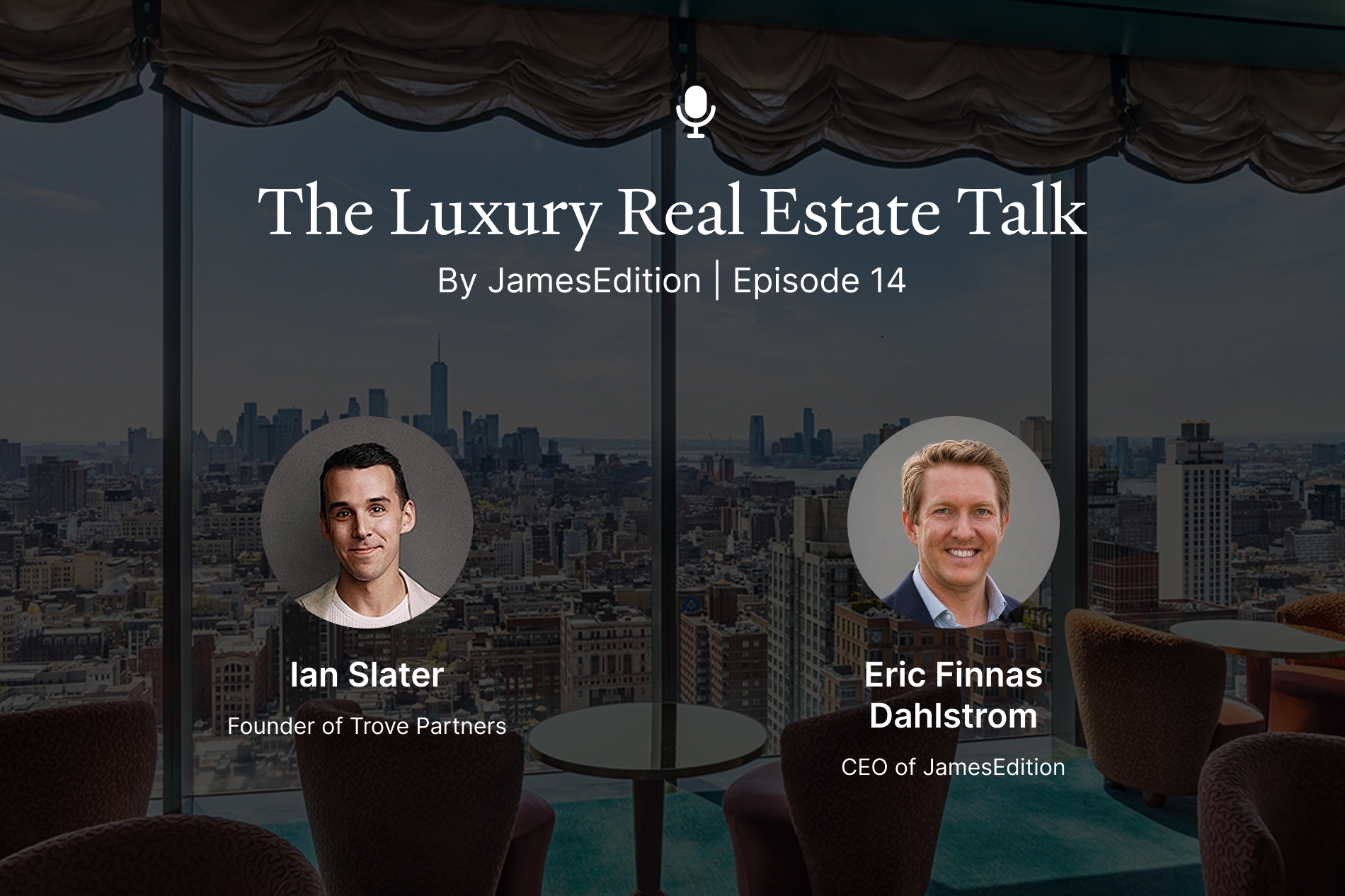
In this episode of the JamesEdition Podcast, Eric Finnas Dahlstrom, CEO of JamesEdition, is joined by Ian Slater, a New York broker of 13 years and founder of Trove Partners, a real estate agency affiliated with Compass. Speaking from the city at the height of summer, Ian shares his perspective from one of New York’s top-performing teams.
Key Highlights
- Relationships drive the business: roughly 90% of Ian’s clients come through direct introductions from other clients.
- Off-market access: at the top end, particularly Upper East Side townhouses, inventory is sourced through a network of brokers, architects, and advisors rather than online.
- A two-speed market: the top of New York’s market is undersupplied and competitive, and has remained resilient despite tax and policy changes.
- Luxury rentals at new levels: Ian is handling multiple leases above $100,000 per month, as some wealthy clients prefer to stay invested in stocks and rent.
- A new buyer profile: AI and tech growth in New York is bringing “pre-buyers” with larger budgets, and Ian expects the buyer pool to become younger.
 Ian SlaterFounder of Trove Partners, a real estate agency affiliated with Compass"The clients I was working with were a new world of buyers and sellers. They didn't necessarily need help finding listings online or setting up appointments. They needed help the way a financial advisor operates: the clients can see the stocks, but they're not going to pick them without an advisor. They needed someone to crunch the data, to understand what was going on, to know whether the investments they were making were correct or incorrect"
Listen on Spotify or Apple Podcast
Transcript:
Eric:
Today we have Ian Slater with us from New York. A very warm welcome, Ian. Could you start by telling us about your background and your team today?
Ian:
I’ve been a broker in New York for 13 years. I started at a big legacy firm, Douglas Elliman, moved to Compass, and two and a half years ago I started Trove. Today our team has 10 agents and four support staff. On average, we sell somewhere between $300 million and $500 million per year, and we’re usually among the top one, two, or three teams in the city.
Early on, I found there’s no school or formal training for brokers, and the barrier to entry is very low, so there aren’t many people who are strong at research and data. That became my strength: writing, corresponding, and analyzing the assets that high-end owners had, and figuring out what those clients wanted to see and hear.
The Broker as Advisor
Eric:
Would you say different brokers have different specialties, such as relationship-building or data, and grow through that?
Ian:
If you sat down with the top 10 highest-performing brokers in New York City, the way each of them got there would be completely different. If you talked to the top hedge fund managers, many of them probably got there in a fairly similar way. Some of the top brokers are incredibly good at mailers. Some leverage social media into a brand and TV shows and essentially become celebrities. Some are highly involved in charity work. Some grew up on Park Avenue and are incredibly connected.
I recognized that my clients were a new world of buyers and sellers. They didn’t necessarily need help finding listings online or setting up appointments. They needed help the way a financial advisor operates: clients can see the stocks, but they’re not going to pick them without an advisor. They needed someone to crunch the data, to understand whether their investments were correct, to help with pricing, and to provide guidance. In the age of the internet, we can’t gatekeep any information anymore; we just have to help them digest it.
Eric:
And what are the typical data sources you use to create that confidence that something is a great purchase?
Ian:
The wealth in New York City is diverse, but the vast majority of it comes from finance, from people who sit behind spreadsheets all day. So even though we are finding people homes, the principal purchaser is very typically extremely analytical. We also have the benefit of usually selling apartments, so our price-per-square-foot and size data tends to be quite reliable. It’s very different from Miami, Los Angeles, or even London, where you have houses, yards, and height differentials.
In 2020, when the market dropped with COVID, we started tracking the recovery month over month and year over year, pulling raw sales data into incredibly long spreadsheets. I hired a data scientist, an NYU student studying economics and data, and we started a weekly client report we still send today, called Trove Trends: a tracker of supply, demand, interest rates, and how news stories are affecting the actual data. Now, with AI, it’s much easier to pull data, and we also rely on partners such as MarketProof and UrbanDigs, which track every segment, neighborhood, and bedroom size. Compass, with 340,000 agents, also releases excellent data.
Eric:
Very interesting. If I compare with Europe, for example, data is a lot more scarce. The US is very rich in data, but depending on the market, that data is more or less reliable, also depending on the type of properties being transacted.
Where Data Meets Interpretation
Ian:
What I love about real estate, and what keeps me confident that I’m going to have a job for a long time, is that so much of how things trade in New York is almost art-adjacent. One building can outstrip another because of the reputation of the architect, the buyer pool, even the doorman.
I always use this example. One Central Park West and 15 Central Park West sit right next to each other at the base of Central Park West. One Central Park West is a Trump building, built as a hotel condominium, with a restaurant, a pool, the same views, the same height, and very nice finishes. 15 Central Park West was built around the same time, with better amenities, a different architect, and no hotel component. It probably trades at three times the price per square foot. If you fed that into a dataset, it would get confused. There’s always a lot you have to interpret that an AI model might not.
Here’s another example. A major trend we’ve started to see is that families with significant wealth and multiple kids now want double-wide townhouses. People are calling them “Frankenhouses.” In London, people dig down; in New York we can’t, because we have granite underneath, so people go wide. Most of our townhouses are 20 to 25 feet wide, so they tend to feel vertical. Put two side by side and you’ve got a 40- or 50-footer with truly grand rooms. Some of the most remarkable transactions in the city on a price-per-foot basis have been these houses. In the past month alone, six of my clients have asked me for one.
Nobody in New York wants to do work; that’s how every search starts. A renovation takes three to four years and the cost is very unpredictable. If you bought right before COVID and renovated during it, it cost two times what you thought. Literally, not an exaggeration.
I was working with a family who wanted to move from downtown to the Upper East Side, and we searched for the better part of a year. At this level, you’re only looking at things that are off market. It’s totally word of mouth and incredibly reliant on the broker. There are a lot of “ghost transactions” in this segment. I heard about a building an institution was going to sell, and when we got the pricing, it was very low for what these houses trade for. Word quickly got around to developers too.
It was 42 feet wide and could become an incredible house. We brought in multiple AD100 architects to understand the costs, and I broke down all the data as if this family were a developer. There was an opportunity to probably make $20 to $25 million right away if the market holds where it is today, so there was a lot of room for error.
We got into a bidding war with a developer, and it became a very contentious deal. But I had known the broker for about 12 years, and I also knew the developer. We went back and forth to about $4 million over asking and secured it on a Friday night at 11pm, because the developer changed one term in the contract and my client was willing to perform very quickly. We closed within one week. I’m still getting so much inbound demand for a house of that size, even totally unrenovated.
Off-Market Deals and the Power of Relationships
Eric:
You mentioned off-market. There’s a broader discussion in the US right now regarding private listings. How do you source those deals?
Ian:
Relationships. Relationships. Relationships. That’s it. It’s talking to brokers every single day, and having relationships with architects, designers, financial advisors, family offices, art advisors, talent advisors, and sports advisors: knowing the people who know the product.
When we get an ultra-wealthy buyer, even though they can see what’s online, there’s a certain lack of allure to the things on the internet. They want to know the things that aren’t available online. So it’s constant conversations, constant texting, constant collection. And it shifts, because an off-market seller is not necessarily always a seller. They may be a seller at a certain number, at a certain time, for a certain reason, and that can change.
A Market Moving at Two Speeds
Eric:
Especially now, with AI, it’s a lot easier to make assumptions regarding price and value, even though the answer you get might not be the truth about what something should be valued at. You mentioned 2013 to 2015 was a liquid market. What is the status of the New York market today?
Ian:
Our market is extremely bifurcated between the very wealthy and the broader market. An unprecedented run-up in the stock market has made the very top of the wealth spectrum extremely wealthy, and that feeds into real estate. The top of the market is significantly undersupplied and very competitive, and you’re seeing bigger and bigger sales. The middle, where buyers are largely salary-based, hasn’t seen the same appreciation over the past decade.
There’s been a lot of talk that the New York luxury market should be struggling because of political and tax shifts. It’s been remarkably resilient. The data does not necessarily follow the news stories.
Back in 2013 to 2015, interest rates were significantly lower, and after 2008 there had been a long period with basically no construction, so there was a lot of pent-up demand. Chinese buyers could get their money across the border much more easily than after 2016, which you don’t really see today. Since then, tax, regulatory, and political changes have made buying and selling much more expensive. Now we have a pied-à-terre tax and a different political regime: back then, Bloomberg was mayor; now Mamdani is mayor. So most of our buyers take a longer-term view. We’re not at London’s level of closing costs, but we’re nowhere near where we were 10 years ago.
Eric:
And approximately what percentage of the purchase price goes to transaction costs?
Ian:
It’s tiered, and it depends on whether you finance, because we have a mortgage tax in New York City. On a $1 million apartment, closing costs are probably around 2%. On a $10 million apartment, they approach 4.5%. And if it’s a pied-à-terre, you now have an annual tax as well.
The Luxury Rental Market
Eric:
Does that move people away from purchasing toward rentals?
Ian:
Yes, this is a major trend. I’ve never seen the luxury rental market like this. I’m doing multiple rentals north of $100,000 per month, and I’ve heard of leases being signed north of $300,000 per month. People have significant wealth. It’s not a wealth problem; it’s a question of the desirability of purchasing.
New York is a great place to be and to work right now. Our office market is thriving, big tech and finance companies are taking more space, and young workers still want to be here. The narrative that everybody is moving out of the city is false. But the economics of purchasing versus renting have separated over time, and many of my clients would prefer to remain invested in the stock market and rent.
At a certain point, rental prices will get high enough that the mindset shifts again. Every time we’ve had a tax change, in every city, there’s an immediate shock where people pull back for a moment, and then things get back to normal. In three to six months, we probably won’t be talking about it much.
Tech Wealth and a New Buyer Profile
Eric:
With the stock market strong and a lot of big IPOs happening, is the US tech sector now a big driver of luxury demand?
Ian:
Absolutely. I have partnerships with top agents in every major financial city in the world. My partner in San Francisco had an extremely tough run between 2020 and 2023. Now they’ve had the most remarkable six-month run of luxury purchases, because so much wealth is being created. I think the record for the most expensive home in San Francisco is being broken almost every week, and the buyer pool is very young.
In New York, we lag a little behind, because the headquarters aren’t necessarily here. What we have is companies upsizing. Anthropic had a small office; now they have a huge office. OpenAI is upsizing. Many of the VCs, hedge funds, and private equity firms invested in these companies are based here. It just hasn’t really happened yet: even if you’re invested in SpaceX, you probably have a lockup period of six months or more, so you’re not really liquid yet.
That’s why I’m starting to see these people come into the rental market in a serious way. I call them “pre-buyers.” They’re not necessarily ready to pull the trigger yet, but they’re coming with bigger and bigger budgets. I know multiple brokers working with very big tech owners who are looking with huge budgets and having trouble finding property.
Eric:
Talking about New York as one market is maybe slightly incorrect. If we look at Manhattan versus Brooklyn, where are people buying now?
Ian:
Brooklyn has become a global brand that people actively seek out, whereas they used to see it as the affordable answer to Manhattan. Eventually, from Greenpoint all the way down to Red Hook, the waterfront is going to be beautiful parkfront property. I think you’ll also see more interest in Queens. The price gap between Manhattan and Long Island City has become much smaller, and Ridgewood, a very cool, artsy, food- and music-oriented area, is seeing a lot of development and younger buyer and rental demand. But Manhattan is eternal. I’m not seeing any degree of drop in Manhattan demand.
New Development and the Supply Question
Eric:
What is being built new right now in Manhattan, and what type of properties are coming to the market?
Ian:
If you speak to most developers, the incentives to build rental or affordable housing are not necessarily in place. Land, carrying costs, construction costs, and approvals are all so expensive, and most of the demand is at the ultra-high end. So in most prime neighborhoods, they build very high-end properties and try to sell them for $3,000, $4,000, or $5,000 per square foot. In Midtown, overlooking the park, some of the new buildings are talking about $10,000 a foot.
Eric:
Wow.
Ian:
There are buildings going up on Fifth Avenue, in Midtown, in the West Village, in Hudson Square, where many of the tech companies are, and in Tribeca. All of the ones on the horizon, many not even publicized yet, are hyper-luxury buildings. We don’t have many shovels in the ground, so the amount of inventory being delivered isn’t as high as it used to be. Historically, our demand is relatively constant; our prices rise dramatically when we have a supply problem.
International Buyers and Global Capital Flows
Eric:
You mentioned Chinese buyers disappearing. Is something else coming into the US from abroad?
Ian:
I see significantly fewer international buyers than I did before the Trump administration, and some of my international clients say they don’t necessarily want to be here. However, in New York, the investment value, the stability of the market, the schooling, and the career opportunities still attract the global elite. There’s a direct line between areas of instability and people seeking stability.
To give you an example, a huge amount of wealth has left London in the past five years and moved to Dubai. I have so many broker friends in London who have moved to Dubai. Then the conflict arrived in the region, and I started to get people who had moved to Dubai coming to look at property in New York and thinking of moving their kids from schools there. British families are considering the US when they weren’t before, because suddenly the US, with an ocean between us and them, becomes a more stable option. There will always be flows of capital because of global events; it’s just unpredictable where they’ll come from each year.
Eric:
What other cities do you think are pulling buyers away from New York?
Ian:
Miami, massively. Miami and the significant office development in West Palm Beach have drawn a lot of Wall Street south. Before COVID, you couldn’t really operate a major fund out of Florida, because the investors, the LPs, were here. Now it’s much more possible, so a larger buyer pool has moved to Miami and stayed. People have also moved to Texas for the tax benefits. Some people leave New York for San Francisco, but only for a couple of years, to focus on tech. They come back.
Building a Boutique Brand
Eric:
How do you work with different marketing channels to attract buyers, and how do you grow the team?
Ian:
When we started Trove, we always wanted to keep it boutique and high-end. We realized early on that, because data is so public and our clients are so savvy, relationships were the thing to focus on. Our clients want one-to-one relationships. But we also have to have a brand, because people understand your brand before they even reach out to you. So PR, social media, the color scheme and font on our website, how we communicate: all of that is extremely important.
Similar to how you interact with a luxury hotel from the moment you’re picked up from the airport, the experience drives how you feel about that brand. So I’m almost obsessive about every pitch, every email, every negotiation, and how we interact with other brokers. If one relationship goes well, it becomes three. The difficult thing is, as one becomes three and three become nine, how do you maintain the same level of one-to-one relationship? So every quarter, we check in on each vertical and understand whether it’s contributing to the main goal. If it’s not, we stop focusing on it as much.
Eric:
And how do you measure that?
Ian:
Sometimes it’s untrackable. Does PR actually help? Does Instagram? But I just ask people how they found me, straight up. Ninety percent of the time, it’s a direct introduction from another client. You can spend all the time in the world sending cold emails; it’s never going to account for more than that 10%.
For example, from around 2014 to 2022, Instagram was really important, and many brokers became very focused on followers. Now it’s a lot more video, and it’s people you don’t follow. It doesn’t work as well for what we do, so we’ve stopped leaning into it as much. That’s not anyone’s fault; it’s an algorithm shift and a culture shift.
Eric:
So in principle, creating great experiences for every client, and over time you start getting those referrals and building value.
Ian:
It’s not rocket science. Young brokers ask me every day how to build a client base. It’s one sentence: just do what you say you’re going to do. Follow through, do not mislead, and people will refer you. In this age of so many overwhelming advertisements, wealthy people are looking for quiet referrals and quiet handholding. They’re not looking for the stranger on the other side of the email.
Looking Ahead
Eric:
Lastly, where do you think the New York market is heading in the coming years?
Ian:
We shall see. There’s a clear political shift to the left in the city, which could lead some business people to leave. The taxes don’t seem to have pushed people away in any meaningful way, but I can’t see them not affecting the market at all. Most of the buildings on the horizon are going to be hyper-luxury, and I’m hoping the demand can sustain them.
My biggest concern is a sharp drop in the stock market, because we are now in the longest run-up in history, and our market is closely tied to it. The counter to that is that the rental market is so strong that you’ll probably see investors shifting from stocks into real estate, because they can now make a decent return renting out apartments. I also think the buyer pool will get a lot younger, with very different tastes, moving from the typical finance buyer toward the tech buyer.
You might also see more of the luxury buildings historically built as condos become hyper-luxury rental buildings. If taxes, carrying costs, and closing costs are all very high, a hyper-luxury rental might ultimately be the way to go. Today, if you build a hyper-luxury building here, it’s almost invariably a condo.
Eric:
Very interesting. Thank you very much, Ian. It’s been a great discussion.
Ian:
My pleasure. Thanks for having me on.
Listen on Spotify
Explore more listings in New York on JamesEdition.com