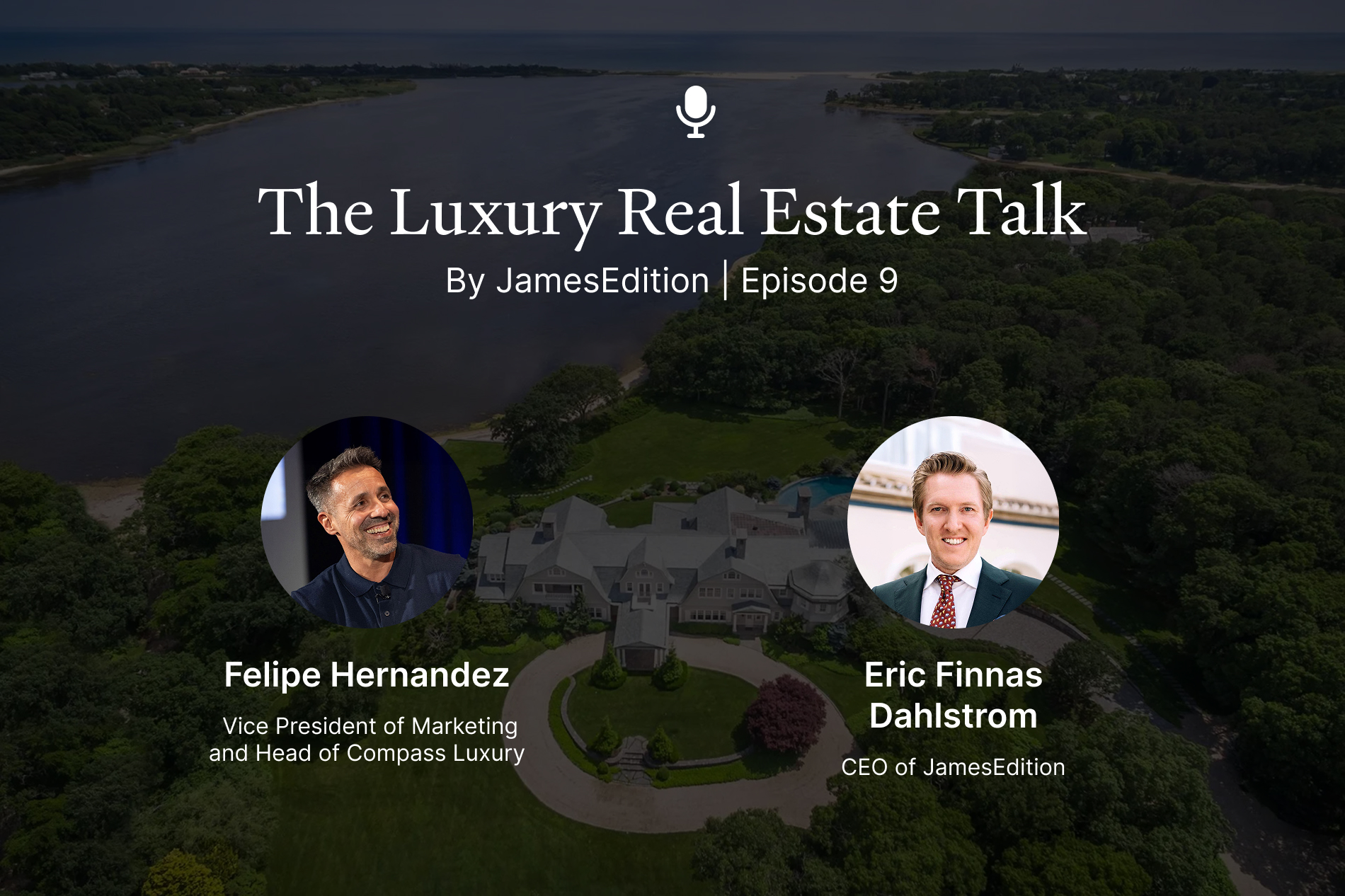
In the latest JamesEdition Podcast, CEO Eric Finnas Dahlstrom sits down with Felipe Hernandez, Vice President of Marketing and Head of Compass Luxury. With more than a decade shaping high-end brand strategy, Hernandez brings a refined understanding of buyer psychology, positioning, and demand creation into U.S. ultra-luxury real estate.
In this conversation, he explains why marketing nine-figure homes is never about scale, how Compass targets the top 5 percent of buyers in each market, and why execution, detail, and emotional connection determine success when only a handful of buyers are relevant. Drawing on real-world examples, from branded Beverly Hills estates to private islands, Hernandez breaks down how Compass Luxury collaborates with agents to market the world’s most exclusive homes.
Key Highlights
- Defining Luxury by the Top 5%: Why Compass defines luxury market by market, and how the top 5 percent framework adapts to local realities from Beverly Hills to emerging secondary cities.
- Precision Over Scale: How ultra-luxury marketing prioritizes narrow targeting, lifestyle analysis, and disciplined outreach over mass exposure.
- Property as a Brand: How Compass creates bespoke identities for nine-figure listings, sometimes stepping back from corporate branding to let the home itself become the hero.
- Lifestyle-Led Targeting: How yacht ownership, car collectors, and cultural affinities shape buyer outreach for waterfront estates, mega-garages, and resort-style properties.
- Video, Detail, and the ‘Wow’ Factor: Why high-quality video, craftsmanship details, and emotional storytelling drive engagement when buyers are global and often remote.
 Felipe HernandezVice President of Marketing & Head of Compass LuxuryWe define luxury mathematically by looking at the top 5 percent of each market. Our approach to marketing these top-tier homes is highly strategic and grounded in precise target analysis. We develop bespoke marketing plans tailored to each property.
Listen on Spotify or Apple Podcast
Targeting the Top 5% in Luxury Real Estate
Eric
Welcome to the JamesEdition Podcast. Today I’m speaking with Felipe Hernandez, Vice President of Marketing and Head of Compass Luxury. I’m really looking forward to this discussion.
Felipe
Thank you for inviting me. I’m honored to be here.
Eric
You lead the luxury division at Compass. Can you tell us what that role involves?
Felipe
I started at Compass in 2016, and as the company grew, we saw the need to better support our luxury agents. Around six years ago, we formed the Luxury Division at Compass, which I oversee. We’re a national team working with the top luxury agents across various forms of support. We have a luxury platform where we promote listings, assist with pitch presentations, and collaborate with great partners like JamesEdition to reach more targeted profiles for our listings.
Eric
We often get asked this at JamesEdition. How do you define luxury?
Felipe
We define luxury mathematically by looking at the top 5 percent of each market. Luxury fluctuates depending on location. What qualifies as luxury in Beverly Hills is very different from what qualifies in Philadelphia or a smaller market.
Eric
You support your agents in different ways. What do you provide in terms of technology?
Felipe
Our luxury agents have access to all tools developed by the company and available to our agent network. One tool we use frequently in luxury is the Network Tool. It allows us to use compass.com to find agents working within the same price point. When you have a listing, you can enter the price point of the property, and it will show you which agents in each market operate in that category. It makes it easier for our agents to connect with similar agents.
Obviously, the biggest advantage is the Luxury Platform, which we created to provide additional exposure for luxury listings: luxury.compass.com. It features the top 5% of our properties. That’s the platform that works with JamesEdition and other advertising channels.
Technology, Agent Branding, and Collaboration
Eric
The agent has a very strong brand in the US. How does Compass think about the balance between Compass as a support platform and the individual brand of the agent?
Felipe
We are very supportive of individual branding. Our company strongly believes we are here to support our agents and grow their business — that’s our number one goal. Our marketing team works closely with agents to promote their brands. Clients today are interested in knowing more about agents in this age of social media. They want to understand your personality, your likes and dislikes, who they will be working with, and how you build trust. We believe branding allows agents to communicate that clearly.
We want them to be able to tell their community and clients: “These are the services I offer. This is what I believe as an agent. This is what I’m willing to deliver to you.” We create beautiful logos and custom materials and help refine their messaging. Agents have different personalities, target groups, and specialties in real estate, and we help bring that to life.
Eric
In the end, the agents will always be there, and what’s interesting is the person behind the business.
Felipe
When we developed our tools, the main goal was to give agents more time to interact with their clients. Not to remove that interaction, but to create tools so they’re not sitting at a computer all day — instead, they’re out working with clients, engaging with their community, and building their brand. I love technology for that reason: it gives you more space to focus on what you’re best at and what you love doing.
Eric
That’s a great definition of the role of technology — not to remove communication, but to give agents the opportunity to have even more personal interaction with clients.
Felipe
One thing I truly love about working at Compass is that it’s one of the most collaborative companies I’ve ever worked at. Our agents are eager to connect with each other, work across state lines, and collaborate to maximize exposure for their clients. Because the company is so large, that connection actually makes it feel smaller. We maintain a boutique feel, even though we’re very large.
Strategic Marketing for Ultra-Luxury Homes
Eric
How do you market homes when we’re talking $20, $30 million and above?
Felipe
Working with properties that surpass $20, $30 million and sometimes reach $100 million, we focus on a highly strategic approach to marketing, centered on target analysis. We create custom marketing plans.
If a property has a yacht dock, we look for yacht owners and people attending boating shows or regattas. If a home has an enormous 20-car garage, we think about car collectors and events like the Pebble Beach Concours d’Elegance.
We also do property branding for these significant estates. We had a beautiful historic home in Beverly Hills, listed at over $100 million, called Owlwood. We created a sketch drawing of the home for its logo, curated materials, and produced a coffee table book. We built an entire brand around the home. The Compass branding stepped back so the house could shine. Giving it that personality elevates the cachet of the property.
We launched a private island in South Florida called Pumpkin Key and branded it almost like a resort, highlighting features such as the tennis court and private beach.
Eric
How do you balance broad visibility with narrow targeting?
Felipe
We do both. Brand awareness matters. Many people love seeing beautiful homes, even if they’re not buyers. Platforms like YouTube perform extremely well for that. At the same time, we run very targeted campaigns aimed only at potential buyers. These approaches work together.
Eric
How do you think about social media in general?
Felipe
Video has become the strongest asset across YouTube, Instagram, and Facebook. That’s where we see the most engagement. But it’s also more competitive now. Production quality is rising, and it’s costly. Agents are investing significantly to make sure their videos stand out.
We’ve noticed a clear trend: luxury properties with expansive land and greenery perform extremely well. Homes in Colorado or mountain resorts generate strong engagement because of their aspirational quality. We’ve seen this trend remain strong since COVID. Anything with a view — sunsets, skylines, mountains — performs exceptionally well.
I always tell agents to create a video that delivers a “wow” effect. When we walk through a house, we identify the top three things that made us say “wow.” Those are the elements the video should focus on.
International Buyers and Emerging Markets
Eric
What do you hear from agents about working with international buyers?
Felipe
We’re seeing strong interest in US luxury real estate from abroad. It’s becoming a very significant audience. Our website, compass.com, has a large international following already. Access to properties is impressive. The United States does luxury extremely well, and international clients appreciate the quality, size, and “wow” factor of US homes.
Eric
New York, Los Angeles, Miami are always popular among international buyers. What other markets?
Felipe
Florida is huge right now. We’re seeing a strong surge of international buyers. The movement is driven by several factors: political climate, financial considerations, weather, and the international community. For example, the South American community feels very comfortable in Miami because of the language.
Eric
You are releasing an ultra-luxury report. Any sneak peek into the insights?
Felipe
What we’ve seen recently is the growth of emerging luxury markets. The top markets will continue to be LA, New York, Miami, and California more broadly. But some secondary markets are gaining prestige. Some luxury clients are looking for something less traditional — a little more new or private. Naples, Florida, for example, has seen significant international luxury growth.
Eric
What are the drivers of the luxury market right now?
Felipe
Affluent buyers operate under different financial conditions and have different access to capital. We are also entering a major wealth transfer period. As wealth passes from one generation to the next, many millennials are acquiring significant assets. That will likely drive future demand.
We’re observing whether this generation prefers traditional markets or is driving growth in emerging destinations. Many are looking for more space, more outdoor living, and new locations beyond where their parents or grandparents settled.
Eric
Are people more interested in adding second homes?
Felipe
Many affluent buyers already own multiple homes, so the second, third, and fourth home market will continue. They remain interested in vacation or escape homes. We’re seeing greater flexibility in where they spend their time. The quality of homes across markets is becoming more consistent, allowing them to maintain their lifestyle as they move from one property to another. They can go to Florida and still enjoy the same restaurants and shopping they have in New York — their lifestyle doesn’t need to change significantly.
Lessons from Luxury Fashion and Leadership
Eric
You worked in luxury fashion before. What insights have carried over?
Felipe
The biggest similarity is quality and attention to detail — even in how we approach marketing, photography, and video. In fashion, we would spend tremendous time finding the best angle to show the handbag, the logo, the stitching. Affluent customers want to see that level of quality.
We try to apply the same thinking in real estate. What are the details in a home that make someone say, “That’s quality”? We aim to highlight craftsmanship and special attention — to show that this isn’t just another home, but something created with care. We tell photographers not to simply document the house, but to capture the details — whether it’s the expansive view or architectural molding and design elements. That makes a difference for clients.
Eric
What leadership lessons have shaped you at Compass?
Felipe
Collaboration has been key. One of the reasons I’ve been at Compass for nearly ten years is the people. It’s a very strategic environment, and we’re not afraid to think outside the box. Everyone shares the mindset of “How can we do it better?”
We also don’t build anything without consulting our agents first. Before developing new tools, we ask them: “Is this important? Would you use it?” They are very vocal. We’ve built strong relationships, and that feedback loop has been a winning formula. We don’t operate from ego — we sit down, listen, and focus on what truly helps them grow their business.
The Transfer of Wealth and the Future of Luxury
Eric
What’s driving the luxury market right now?
Felipe
Affluent buyers operate under different financial conditions, and many transactions are cash-based. We’re also seeing the beginning of a significant transfer of wealth. A new generation of buyers is entering the market with different preferences, more flexibility, and a stronger lifestyle focus. That will continue to reshape luxury real estate in the years ahead.
Eric
I think that’s a great point. You shared so many valuable insights across the full spectrum of marketing luxury property. Thank you for your time, Felipe. This has been a great discussion.
Felipe
Thank you. I’m a huge fan of JamesEdition and the entire team. Always a pleasure.