


$6,643,253
Prestigiosa Villa A Carmignano
- 15 Camere
- 15 Bagni
- 17,223 Sqft
- 37,674 Sqft lot
- Aggiornato: Marzo 27
- 3
Informazioni sulla proprietà
La descrizione è stata tradotta automaticamente.
La descrizione viene visualizzata nella lingua originale.
La proprietà in questione si trova sulla collina denominata «Castello», dove un tempo sorgeva il borgo medievale fortificato di Carmignano.
Parte del complesso sviluppato attorno alla storica Villa è l’edificio padronale di forma allungata che conserva ancora forme cinquecentesche con una bella facciata tardo cinquecentesca, caratterizzata da cornici in pietra serena al piano nobile e tip
Parte del complesso sviluppato attorno alla storica Villa è l’edificio padronale di forma allungata che conserva ancora forme cinquecentesche con una bella facciata tardo cinquecentesca, caratterizzata da cornici in pietra serena al piano nobile e tip
The property in question is located on the hill called ”Castello,” where the fortified medieval village of Carmignano once stood.
Part of the complex developed around the historic Villa is the elongated manor building that still retains sixteenth-century forms with a beautiful late sixteenth-century facade, featuring pietra serena stone frames on the main floor and typical ”kneeling” wind
Part of the complex developed around the historic Villa is the elongated manor building that still retains sixteenth-century forms with a beautiful late sixteenth-century facade, featuring pietra serena stone frames on the main floor and typical ”kneeling” wind
La proprietà in questione si trova sulla collina denominata «Castello», dove un tempo sorgeva il borgo medievale fortificato di Carmignano.
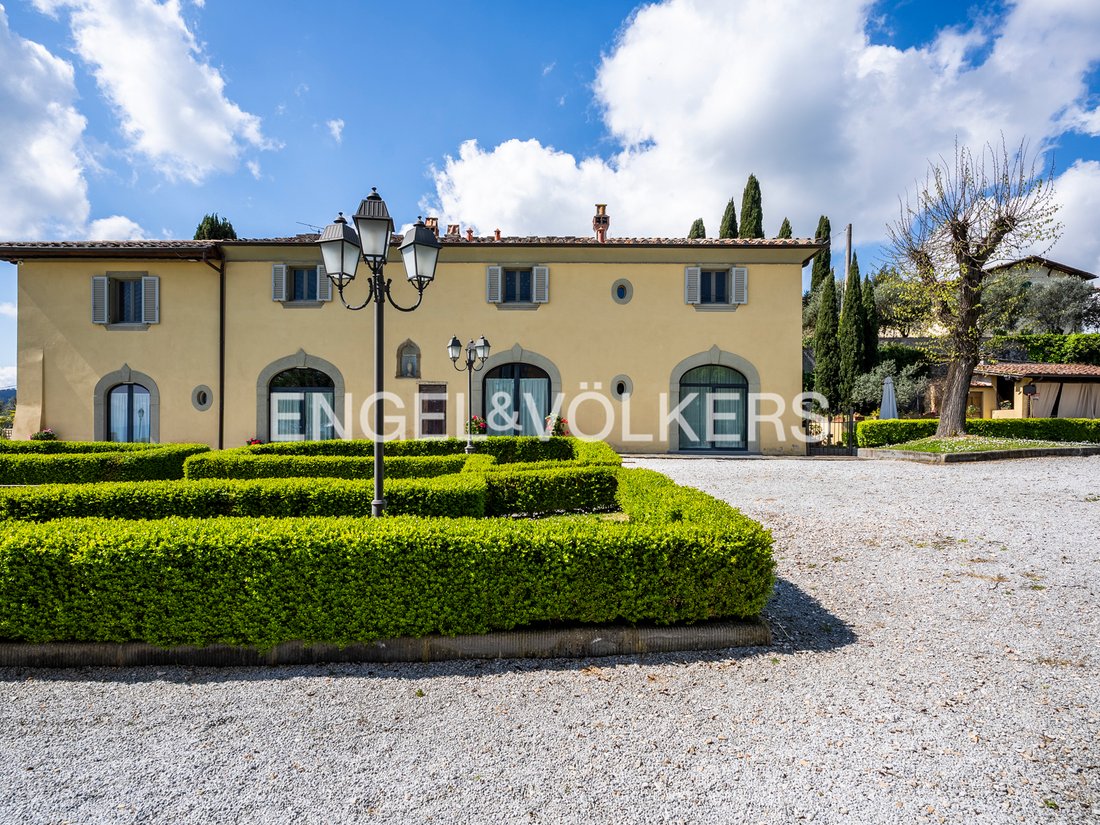
Parte del complesso sviluppato attorno alla storica Villa è l’edificio padronale di forma allungata che conserva ancora forme cinquecentesche con una bella facciata tardo cinquecentesca, caratterizzata da cornici in pietra serena al piano nobile e tipiche finestre «inginocchiate» al piano terra.
Agli inizi del 1800, con l’istituzione della masseria, alla struttura cinquecentesca furono aggiunte le ali laterali, che furono utilizzate come cantine per l’invecchiamento e la conservazione del vino.
Le proprietà in questione, destinate ad uso residenziale, sono la porzione laterale della villa che comprende anche un annesso quattrocentesco, inizialmente utilizzato come stalle e successivamente come frantoio. Sono disposti su due piani fuori terra suddivisi in quattro porzioni immobiliari, di cui le tre principali hanno un seminterrato.
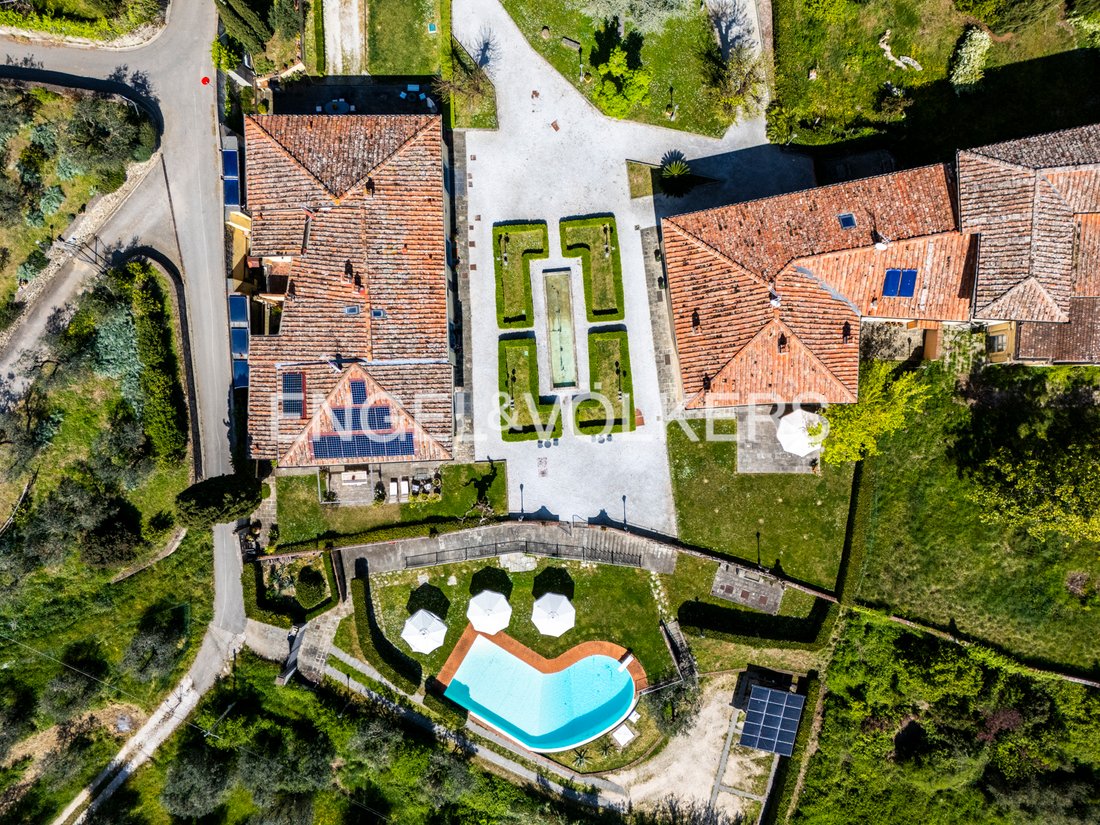
Il complesso gode di una vista straordinaria sulle zone di Firenze, Prato e Pistoia ed è inserito in un elegante parco di 3.500 mq su tre livelli: l’area comune all’ingresso è allestita con un giardino all’italiana con fontana centrale, ma ogni unità ha il suo giardino; al secondo livello, il giardino ospita la piscina panoramica, e al terzo livello, l’area riservata al parcheggio è nascosta e non visibile dalle case.
Il restauro degli edifici, eseguito dagli attuali proprietari, è durato oltre due anni, è stato radicale e rigoroso ed è documentato in ogni fase. Il restauro conservativo ha privilegiato materiali tipicamente toscani di altissima qualità come il cotto e la pietra serena, con parquet in legno nelle camere da letto, infissi moderni...
Le quattro porzioni immobiliari sono in ottime condizioni e abitabili da subito mantenendo la disposizione attuale, ma con pochi interventi, possono essere unite in un’unica porzione.
Due di esse sono ville indipendenti con giardino privato e una superficie interna di circa 450 mq.
La terza, invece, è una villa anch’essa di 450 mq ma divisa internamente in due appartamenti composti ciascuno da due camere da letto, collegati da una scala interna.
La quarta porzione, la più piccola, è suddivisa in due appartamenti per un totale di circa 250 mq e un cortile di pertinenza.
Nel complesso, all’interno del complesso immobiliare, troviamo, suddivisi tra le varie porzioni, 15 camere da letto e 15 bagni.
Questa importante villa è potenzialmente perfetta per chi necessita di una proprietà unica nel cuore delle colline toscane, con spazi ampi e ben suddivisi perfettamente utilizzabili sia per l’ospitalità che per l’uso residenziale.
I veri punti di forza di questa residenza esclusiva sono senza dubbio l’attenta e sapiente ristrutturazione, la piscina, gli splendidi giardini e la vista mozzafiato.
Una villa di prestigio pronta a vivere il meglio che questo magnifico territorio può offrire.
La collina di Carmignano - un’altura panoramica dominante, situata tra la pianura che collega Firenze con Prato e Pistoia e la bassa valle dell’Arno, con viste che si estendono fino agli Appennini e alle Alpi Apuane - ha sempre avuto un ruolo significativo nella storia della Toscana ed è stata un crocevia di Storia, Arte e Agricoltura innovativa nel corso dei secoli.
Una vasta area, immersa nel verde delle colline del Montalbano, è molto apprezzata sia dal punto di vista viticolo che di notevole importanza storica, che oggi è considerata anche molto preziosa — dal punto di vista residenziale — per la sua «naturalezza» e la vicinanza alle città di Prato e Firenze, da cui dista solo poche decine di minuti.
Fu proprio la posizione logistica di questo territorio ad attrarre gli insediamenti prima etruschi e poi romani — di cui si trovano ancora tracce nell’antica Fortezza — ma fu nel Medioevo, come avamposto per il controllo del passaggio degli eserciti, da e verso l’Italia settentrionale, che divenne area di aspre contese tra la contea pistoiese e quella fiorentina, passando infine definitivamente sotto il dominio di quest’ultima nel XV secolo.
La famiglia Medici - e la sua rete di nobili Ville-Fattorie che rifornivano la corte, ma erano anche piacevoli luoghi di residenza e studio e cura del paesaggio - diede un grande impulso alla zona con la costruzione dell’affascinante Villa di Artimino (nota anche come la «Villa dei 100 camini» e oggi patrimonio dell’UNESCO) e la creazione della monumentale «Bandita del Barco Reale», una tenuta di caccia di oltre 4000 ettari racchiusa da un muro perimetrale in pietra di oltre 50 km., con accesso protetto da porte e cancelli per sorvegliare il gioco e separare l’area dal campi coltivati adiacenti.
Nel 1716, un illuminato Cosimo III de’ Medici stabilì norme restrittive, volte a migliorarne la qualità, per la produzione di vino all’interno della bandita: si tratta del primo e più antico esempio al mondo di regolamento DOC, addirittura un secolo prima della francese «AOC - App»Ellation d’Origine Controlée.»
Oggi, il territorio di Carmignano è una zona pregiata per la produzione di vini certificati .DOC e DOCG, con vigneti panoramici che coprono le pendici delle sue colline.
Fu nel 1792 che il Granduca Pietro Leopoldo di Lorena dichiarò la «sbandita», disattivando la riserva e destinando i terreni dell’area ad altri usi.
La Fortezza di Carmignano, originariamente parte della più grande fortificazione che domina il vasto territorio, è di proprietà del Comune dal 1990, che ha destinato i locali a spazi espositivi e sedi per eventi culturali.
Distanze
Autostrada A1 21 km - 28’
Aeroporto di Firenze 20 km — 28’
Ospedale 15 km — 23’
Centro di Prato 13 km - 25’
Centro di Firenze 27 km - 45’
Aeroporto di Pisa 66 km — 56’
Centro di Pisa 75 km - 60’
*Le presenti informazioni e planimetrie sono meramente indicative e non costituiscono elementi contrattuali.
Parte del complesso sviluppato attorno alla storica Villa è l’edificio padronale di forma allungata che conserva ancora forme cinquecentesche con una bella facciata tardo cinquecentesca, caratterizzata da cornici in pietra serena al piano nobile e tipiche finestre «inginocchiate» al piano terra.
Agli inizi del 1800, con l’istituzione della masseria, alla struttura cinquecentesca furono aggiunte le ali laterali, che furono utilizzate come cantine per l’invecchiamento e la conservazione del vino.
Le proprietà in questione, destinate ad uso residenziale, sono la porzione laterale della villa che comprende anche un annesso quattrocentesco, inizialmente utilizzato come stalle e successivamente come frantoio. Sono disposti su due piani fuori terra suddivisi in quattro porzioni immobiliari, di cui le tre principali hanno un seminterrato.
Il complesso gode di una vista straordinaria sulle zone di Firenze, Prato e Pistoia ed è inserito in un elegante parco di 3.500 mq su tre livelli: l’area comune all’ingresso è allestita con un giardino all’italiana con fontana centrale, ma ogni unità ha il suo giardino; al secondo livello, il giardino ospita la piscina panoramica, e al terzo livello, l’area riservata al parcheggio è nascosta e non visibile dalle case.
Il restauro degli edifici, eseguito dagli attuali proprietari, è durato oltre due anni, è stato radicale e rigoroso ed è documentato in ogni fase. Il restauro conservativo ha privilegiato materiali tipicamente toscani di altissima qualità come il cotto e la pietra serena, con parquet in legno nelle camere da letto, infissi moderni...
Le quattro porzioni immobiliari sono in ottime condizioni e abitabili da subito mantenendo la disposizione attuale, ma con pochi interventi, possono essere unite in un’unica porzione.
Due di esse sono ville indipendenti con giardino privato e una superficie interna di circa 450 mq.
La terza, invece, è una villa anch’essa di 450 mq ma divisa internamente in due appartamenti composti ciascuno da due camere da letto, collegati da una scala interna.
La quarta porzione, la più piccola, è suddivisa in due appartamenti per un totale di circa 250 mq e un cortile di pertinenza.
Nel complesso, all’interno del complesso immobiliare, troviamo, suddivisi tra le varie porzioni, 15 camere da letto e 15 bagni.
Questa importante villa è potenzialmente perfetta per chi necessita di una proprietà unica nel cuore delle colline toscane, con spazi ampi e ben suddivisi perfettamente utilizzabili sia per l’ospitalità che per l’uso residenziale.
I veri punti di forza di questa residenza esclusiva sono senza dubbio l’attenta e sapiente ristrutturazione, la piscina, gli splendidi giardini e la vista mozzafiato.
Una villa di prestigio pronta a vivere il meglio che questo magnifico territorio può offrire.
La collina di Carmignano - un’altura panoramica dominante, situata tra la pianura che collega Firenze con Prato e Pistoia e la bassa valle dell’Arno, con viste che si estendono fino agli Appennini e alle Alpi Apuane - ha sempre avuto un ruolo significativo nella storia della Toscana ed è stata un crocevia di Storia, Arte e Agricoltura innovativa nel corso dei secoli.
Una vasta area, immersa nel verde delle colline del Montalbano, è molto apprezzata sia dal punto di vista viticolo che di notevole importanza storica, che oggi è considerata anche molto preziosa — dal punto di vista residenziale — per la sua «naturalezza» e la vicinanza alle città di Prato e Firenze, da cui dista solo poche decine di minuti.
Fu proprio la posizione logistica di questo territorio ad attrarre gli insediamenti prima etruschi e poi romani — di cui si trovano ancora tracce nell’antica Fortezza — ma fu nel Medioevo, come avamposto per il controllo del passaggio degli eserciti, da e verso l’Italia settentrionale, che divenne area di aspre contese tra la contea pistoiese e quella fiorentina, passando infine definitivamente sotto il dominio di quest’ultima nel XV secolo.
La famiglia Medici - e la sua rete di nobili Ville-Fattorie che rifornivano la corte, ma erano anche piacevoli luoghi di residenza e studio e cura del paesaggio - diede un grande impulso alla zona con la costruzione dell’affascinante Villa di Artimino (nota anche come la «Villa dei 100 camini» e oggi patrimonio dell’UNESCO) e la creazione della monumentale «Bandita del Barco Reale», una tenuta di caccia di oltre 4000 ettari racchiusa da un muro perimetrale in pietra di oltre 50 km., con accesso protetto da porte e cancelli per sorvegliare il gioco e separare l’area dal campi coltivati adiacenti.
Nel 1716, un illuminato Cosimo III de’ Medici stabilì norme restrittive, volte a migliorarne la qualità, per la produzione di vino all’interno della bandita: si tratta del primo e più antico esempio al mondo di regolamento DOC, addirittura un secolo prima della francese «AOC - App»Ellation d’Origine Controlée.»
Oggi, il territorio di Carmignano è una zona pregiata per la produzione di vini certificati .DOC e DOCG, con vigneti panoramici che coprono le pendici delle sue colline.
Fu nel 1792 che il Granduca Pietro Leopoldo di Lorena dichiarò la «sbandita», disattivando la riserva e destinando i terreni dell’area ad altri usi.
La Fortezza di Carmignano, originariamente parte della più grande fortificazione che domina il vasto territorio, è di proprietà del Comune dal 1990, che ha destinato i locali a spazi espositivi e sedi per eventi culturali.
Distanze
Autostrada A1 21 km - 28’
Aeroporto di Firenze 20 km — 28’
Ospedale 15 km — 23’
Centro di Prato 13 km - 25’
Centro di Firenze 27 km - 45’
Aeroporto di Pisa 66 km — 56’
Centro di Pisa 75 km - 60’
*Le presenti informazioni e planimetrie sono meramente indicative e non costituiscono elementi contrattuali.
The property in question is located on the hill called ”Castello,” where the fortified medieval village of Carmignano once stood.
Part of the complex developed around the historic Villa is the elongated manor building that still retains sixteenth-century forms with a beautiful late sixteenth-century facade, featuring pietra serena stone frames on the main floor and typical ”kneeling” windows on the ground floor.
In the early 1800s, with the establishment of the farm, the lateral wings were added to the sixteenth-century structure, which were used as cellars for aging and storing wine.
The properties in question, intended for residential use, are the lateral portion of the villa that also includes a fifteenth-century annex, initially used as stables and later as an oil mill. They are arranged on two above-ground floors divided into four real estate portions, of which the three main ones have a basement.
The complex enjoys an extraordinary view of the areas of Florence, Prato, and Pistoia, and is set in an elegant 3,500 square meter park over three levels: the common area at the entrance is set up with an Italian garden with a central fountain, but each unit has its own garden; at the second level, the garden hosts the panoramic swimming pool, and at the third level, the area reserved for car parking is hidden and not visible from the houses.
The restoration of the buildings, carried out by the current owners, lasted over two years, was radical and rigorous, and is documented at every stage. The conservative restoration favored typically Tuscan materials of the highest quality such as terracotta and pietra serena stone, with wooden parquet in the bedrooms, modern fixtures....
The four real estate portions are in excellent condition and immediately habitable while maintaining the current layout, but with few interventions, they can be combined into a single portion.
Two of them are independent villas with their own garden and an internal area of about 450 square meters.
The third, however, is a villa also of 450 square meters but internally divided into two apartments each consisting of two bedrooms, connected by an internal staircase.
The fourth portion, the smallest, is divided into two apartments with a total of about 250 square meters and a pertinent courtyard.
Overall, within the real estate complex, we find, divided among the various portions, 15 bedrooms and 15 bathrooms.
This important villa is potentially perfect for those who need a unique property in the heart of the Tuscan hills, with large, well-divided spaces perfectly usable for both hospitality and residential use.
The real strengths of this exclusive residence are undoubtedly the careful and skillful renovation, the pool, the splendid gardens, and the breathtaking view.
A prestigious villa ready to experience the best that this magnificent territory can offer.
The hill of Carmignano – a panoramic dominant height, located between the plain that connects Florence with Prato and Pistoia and the lower Arno valley, with views extending to the Apennines and the Apuan Alps - has always played a significant role in the history of Tuscany and has been a crossroads of History, Art, and innovative Agriculture over the centuries.
A vast area, immersed in the greenery of the Montalbano hills, is highly esteemed both from a viticulture perspective and of considerable historical importance, which today is also considered very valuable – from a residential point of view – for its “naturalness” and proximity to the cities of Prato and Florence, from which it is just a few tens of minutes away.
It was precisely the logistical position of this territory that attracted the first Etruscan and then Roman settlements – traces of which are still found in the ancient Fortress - but it was in the Middle Ages, as an outpost for controlling the passage of armies, to and from northern Italy, that it became an area of fierce disputes between the Pistoian and Florentine counties, eventually passing definitively under the dominion of the latter in the 15th century.
The Medici family – and its network of noble Villa-Farms that supplied the court, but were also pleasant places of residence and study and landscape care - gave a great impulse to the area with the construction of the fascinating Villa of Artimino (also known as the “Villa of the 100 Chimneys” and today a UNESCO heritage site) and the creation of the monumental “Bandita del Barco Reale,” a hunting estate of over 4000 hectares enclosed by a perimeter stone wall of over 50 km., with access protected by doors and gates to guard the game and separate the area from the adjacent cultivated fields.
In 1716, an enlightened Cosimo III de’ Medici established restrictive rules – aimed at improving its quality - for wine production within the bandita: this is the world’s first and oldest example of a DOC regulation, even a century before the French “AOC - Appellation d’Origine Contrôlée.”
Today, the territory of Carmignano is a prized area for the production of certified . DOC and DOCG wines, with panoramic vineyards covering the slopes of its hills.
It was in 1792 that the Grand Duke Peter Leopold of Lorraine declared the “sbandita,” decommissioning the reserve and allocating the land of the area to other uses.
The Fortress of Carmignano, originally part of the larger fortification overlooking the vast territory, has been owned by the Municipality since 1990, which has allocated the premises to exhibition spaces and venues for cultural events.
Distances
Highway A1 21 km - 28’
Florence Airport 20 km – 28‘
Hospital 15 km – 23‘
Prato center 13 km - 25’
Florence center 27 km - 45’
Pisa Airport 66 km – 56‘
Pisa center 75 km - 60’
*The present information and floor plans are merely indicative and do not constitute contractual elements.
Part of the complex developed around the historic Villa is the elongated manor building that still retains sixteenth-century forms with a beautiful late sixteenth-century facade, featuring pietra serena stone frames on the main floor and typical ”kneeling” windows on the ground floor.
In the early 1800s, with the establishment of the farm, the lateral wings were added to the sixteenth-century structure, which were used as cellars for aging and storing wine.
The properties in question, intended for residential use, are the lateral portion of the villa that also includes a fifteenth-century annex, initially used as stables and later as an oil mill. They are arranged on two above-ground floors divided into four real estate portions, of which the three main ones have a basement.
The complex enjoys an extraordinary view of the areas of Florence, Prato, and Pistoia, and is set in an elegant 3,500 square meter park over three levels: the common area at the entrance is set up with an Italian garden with a central fountain, but each unit has its own garden; at the second level, the garden hosts the panoramic swimming pool, and at the third level, the area reserved for car parking is hidden and not visible from the houses.
The restoration of the buildings, carried out by the current owners, lasted over two years, was radical and rigorous, and is documented at every stage. The conservative restoration favored typically Tuscan materials of the highest quality such as terracotta and pietra serena stone, with wooden parquet in the bedrooms, modern fixtures....
The four real estate portions are in excellent condition and immediately habitable while maintaining the current layout, but with few interventions, they can be combined into a single portion.
Two of them are independent villas with their own garden and an internal area of about 450 square meters.
The third, however, is a villa also of 450 square meters but internally divided into two apartments each consisting of two bedrooms, connected by an internal staircase.
The fourth portion, the smallest, is divided into two apartments with a total of about 250 square meters and a pertinent courtyard.
Overall, within the real estate complex, we find, divided among the various portions, 15 bedrooms and 15 bathrooms.
This important villa is potentially perfect for those who need a unique property in the heart of the Tuscan hills, with large, well-divided spaces perfectly usable for both hospitality and residential use.
The real strengths of this exclusive residence are undoubtedly the careful and skillful renovation, the pool, the splendid gardens, and the breathtaking view.
A prestigious villa ready to experience the best that this magnificent territory can offer.
The hill of Carmignano – a panoramic dominant height, located between the plain that connects Florence with Prato and Pistoia and the lower Arno valley, with views extending to the Apennines and the Apuan Alps - has always played a significant role in the history of Tuscany and has been a crossroads of History, Art, and innovative Agriculture over the centuries.
A vast area, immersed in the greenery of the Montalbano hills, is highly esteemed both from a viticulture perspective and of considerable historical importance, which today is also considered very valuable – from a residential point of view – for its “naturalness” and proximity to the cities of Prato and Florence, from which it is just a few tens of minutes away.
It was precisely the logistical position of this territory that attracted the first Etruscan and then Roman settlements – traces of which are still found in the ancient Fortress - but it was in the Middle Ages, as an outpost for controlling the passage of armies, to and from northern Italy, that it became an area of fierce disputes between the Pistoian and Florentine counties, eventually passing definitively under the dominion of the latter in the 15th century.
The Medici family – and its network of noble Villa-Farms that supplied the court, but were also pleasant places of residence and study and landscape care - gave a great impulse to the area with the construction of the fascinating Villa of Artimino (also known as the “Villa of the 100 Chimneys” and today a UNESCO heritage site) and the creation of the monumental “Bandita del Barco Reale,” a hunting estate of over 4000 hectares enclosed by a perimeter stone wall of over 50 km., with access protected by doors and gates to guard the game and separate the area from the adjacent cultivated fields.
In 1716, an enlightened Cosimo III de’ Medici established restrictive rules – aimed at improving its quality - for wine production within the bandita: this is the world’s first and oldest example of a DOC regulation, even a century before the French “AOC - Appellation d’Origine Contrôlée.”
Today, the territory of Carmignano is a prized area for the production of certified . DOC and DOCG wines, with panoramic vineyards covering the slopes of its hills.
It was in 1792 that the Grand Duke Peter Leopold of Lorraine declared the “sbandita,” decommissioning the reserve and allocating the land of the area to other uses.
The Fortress of Carmignano, originally part of the larger fortification overlooking the vast territory, has been owned by the Municipality since 1990, which has allocated the premises to exhibition spaces and venues for cultural events.
Distances
Highway A1 21 km - 28’
Florence Airport 20 km – 28‘
Hospital 15 km – 23‘
Prato center 13 km - 25’
Florence center 27 km - 45’
Pisa Airport 66 km – 56‘
Pisa center 75 km - 60’
*The present information and floor plans are merely indicative and do not constitute contractual elements.
-
Tipo di proprietà
Villa
-
Piani
2
-
Anno di costruzione
1500
-
Prezzo/piede²
$385
-
Emissioni
D
-
Consumo
D
Caratteristiche
Esplora la zona
Via del Castello, 59015 Carmignano PO, Italy, Centro - La Rocca, Toscana
Visualizza su Google Maps
Prezzo per sqft
Basso
Alto
Situata nel pittoresco paese toscano di Carmignano, questa squisita proprietà offre uno stile di vita idilliaco. Circondata da colline di vigneti e uliveti, garantisce tranquillità e bellezza scenica. Con Firenze a soli 30 minuti, si può godere di arte, cultura e esperienze gastronomiche rinomate. La vicina regione del Chianti arricchisce ulteriormente l’attrattiva con i suoi vini pregiati e tradizioni culinarie.
Ottieni luoghi vicini
Attrazioni
Scuole
Aeroporto di Firenze
Aeroporto
28 min
Stazione di Prato Centrale
Stazione
20 min
Centro storico di Firenze
Cultura & Patrimonio
40 min
Regione vinicola del Chianti
Natura & Attività all'aperto
30 min
Scuola Internazionale di Firenze
Scuola Internazionale
45 min
Liceo Classico Cicognini
Scuola pubblica
18 min
Hai chiesto informazioni su questa proprietà
L'agente La contatterà al più presto
Pubblicato da
51
Annunci
2025
Iscritto
Prenota una visita con Engel & Völkers
Scegli una data e indica se preferisci un tour virtuale o di persona con l’agente.
Data preferita
Tipo di tour

Engel & Völkers Firenze
Lungarno Guicciardini 25R, 50125, Firenze, Firenze, Italy
Visualizza profilo agenzia
Ultimo aggiornamento
Marzo 27
Prima pubblicazione
Maggio 21, 2025
Riferimento annuncio
W-02Z325
Proprietà simili nelle vicinanze
Nuovi annunci a Centro - La Rocca


Esplora più immobili in vendita
tipi di proprietà Centro - La Rocca, Carmignano, Toscana
- Ville in vendita in Centro - La Rocca, Carmignano, Toscana
- Case di campagna in vendita in Centro - La Rocca, Carmignano, Toscana
- Appartamenti in vendita in Centro - La Rocca, Carmignano, Toscana
- Tenute agricole in vendita in Centro - La Rocca, Carmignano, Toscana
- Case in vendita in Centro - La Rocca, Carmignano, Toscana
Centro - La Rocca, Carmignano, Toscana ricerche popolari
- Proprietà immobiliari Vista panoramica / Scenica a Centro - La Rocca, Carmignano, Toscana
- Proprietà immobiliari con Terrazza a Centro - La Rocca, Carmignano, Toscana
- Proprietà immobiliari con Bar a Centro - La Rocca, Carmignano, Toscana
- Proprietà immobiliari con Sala giochi a Centro - La Rocca, Carmignano, Toscana
- Proprietà immobiliari con Ufficio a Centro - La Rocca, Carmignano, Toscana
- Proprietà immobiliari con Ascensore a Centro - La Rocca, Carmignano, Toscana
- Proprietà immobiliari Vista sulle montagne a Centro - La Rocca, Carmignano, Toscana
- Proprietà immobiliari con Giardino a Centro - La Rocca, Carmignano, Toscana
- Proprietà immobiliari Comunità recintata a Centro - La Rocca, Carmignano, Toscana
- Proprietà immobiliari Privacy a Centro - La Rocca, Carmignano, Toscana
- Proprietà immobiliari Collina a Centro - La Rocca, Carmignano, Toscana
- Proprietà immobiliari Investimento immobiliare a Centro - La Rocca, Carmignano, Toscana
- Proprietà immobiliari con Centro Fitness / Palestra a Centro - La Rocca, Carmignano, Toscana
- Proprietà immobiliari con Libreria a Centro - La Rocca, Carmignano, Toscana
- Proprietà immobiliari con Aria condizionata a Centro - La Rocca, Carmignano, Toscana
- Proprietà immobiliari con Cantina a Centro - La Rocca, Carmignano, Toscana
- Proprietà immobiliari con Idromassaggio a Centro - La Rocca, Carmignano, Toscana
- Proprietà immobiliari con Camino a Centro - La Rocca, Carmignano, Toscana
- Proprietà immobiliari con Piscina a Centro - La Rocca, Carmignano, Toscana
- Proprietà immobiliari con Garage a Centro - La Rocca, Carmignano, Toscana
- Proprietà immobiliari con Balcone a Centro - La Rocca, Carmignano, Toscana
- Proprietà immobiliari Residenza a Centro - La Rocca, Carmignano, Toscana
- Proprietà immobiliari con Cucina aperta a Centro - La Rocca, Carmignano, Toscana
- Proprietà immobiliari Rinnovato a Centro - La Rocca, Carmignano, Toscana
- Proprietà immobiliari Vista sull'acqua a Centro - La Rocca, Carmignano, Toscana
Guide e storie correlate
La fiducia dei migliori broker del mondo
Gli agenti dietro le proprietà più straordinarie del mondo pubblicano su JamesEdition.
- Annunci di Sotheby's, Christie's, BARNES ed Engel & Völkers
- Ogni annuncio è verificato prima della pubblicazione
- Si metta in contatto diretto con agenti verificati
Continuando, accetta i nostri Termini e la nostra Informativa sulla privacy.