

$1,151,640
ABBAYE Restaurée du XIIe Siècle + MAISON EN PIERRE Hors Réseau dans 580 hectares de BOIS et de PRAIRIES
- 3 Chambres
- 4 SdB
- 2,907 Sqft
- 57,328.4 Ac lot
- Mis à jour: Octobre 8
- 12
À propos de la propriété
La description a été traduite automatiquement.
La description est affichée dans la langue d'origine.
Une abbaye du XIIe siècle au cœur préservé de l’Ombrie
Nichée dans un domaine privé de 232 hectares de forêts préservées, cette abbaye historique du XIIe siècle entièrement restaurée constitue l’un des trésors architecturaux et spirituels les plus rares actuellement disponibles dans le centre de l’Italie.
Le cœur du domaine est l’ancienne ABBAYE : une structure imprégnée d’h
A 12th-Century Abbey in the Unspoiled Heart of Umbria
Nestled within a private estate of 232 hectares of unspoiled woodlands, this historic, fully restored 12th-century ABBEY stands as one of the rarest architectural and spiritual treasures currently available in central Italy.
The heart of the estate is the ancient ABBEY: a structure steeped in medieval history, characterized by
Une abbaye du XIIe siècle au cœur préservé de l’Ombrie
Nichée dans un domaine privé de 232 hectares de forêts préservées, cette abbaye historique du XIIe siècle entièrement restaurée constitue l’un des trésors architecturaux et spirituels les plus rares actuellement disponibles dans le centre de l’Italie.
Le cœur du domaine est l’ancienne ABBAYE : une structure imprégnée d’histoire médiévale, caractérisée par des murs en pierre d’origine, des plafonds voûtés et une pureté architecturale qui crée une retraite privée nichée dans le cœur verdoyant de l’Ombrie, entourée de plus de 230 hectares de forêts et de pâturages.
Pour ceux qui aiment l’intimité et la beauté de la nature ;
pour ceux qui aiment le silence et la tranquillité.
Les montagnes Martani divisent l’Ombrie du nord au sud, créant la ligne de partage des eaux entre la vallée du Tibre et la vallée de Spolète.
Considérée comme une « terre intermédiaire », cette région très remarquable de l’Ombrie rappelle l’atmosphère et les légendes du passé, de toutes les personnes qui auraient pu y vivre ou qui venaient de passer.
Au sommet de ces montagnes, sur un plateau à plus de 1000 mètres d’altitude, se trouve l’abbaye bénédictine de San Pietro. L’ancienne structure est située à flanc de montagne d’une beauté naturelle et d’un grand charme, surplombant de vastes champs d’herbe ondulée, des bois et forêts anciens, des arbres centenaires et des panoramas à couper le souffle sur la plus belle Ombrie.
Le site est entouré de prairies, d’une haute forêt et de hêtres géants, dont certains ont entre 450 et 500 ans.
Le complexe est accessible par une route privée de 3,5 km et la propriété s’étend sur 575 hectares répartis sur le versant ouest de la montagne, qui s’élève de 600 à 1 100 mètres. Le sommet offre une vue imprenable sur les deux côtés (vallée du Tibre avec les villes de Pérouse, Todi et Orvieto et vallée de la Flaminia avec les villes d’Assise, Montefalco, Trevi, Spello, Spolète et Foligno).
Construit avant l’an 1000 et érigé sur les vestiges d’un temple romain, le vénérable monastère était un site stratégique important et permettait le contrôle total des cols de montagne.
L’ABBAYE est très ancienne (IXe siècle) et a été détruite à plusieurs reprises.
Des fondations, émergeant ici et là, marquent toujours son ancien périmètre. La première restauration a été entreprise avant la Première Guerre mondiale.
L’établissement a été une résidence d’été pendant de nombreuses générations avant de consolider les structures et de moderniser les installations en 2005.
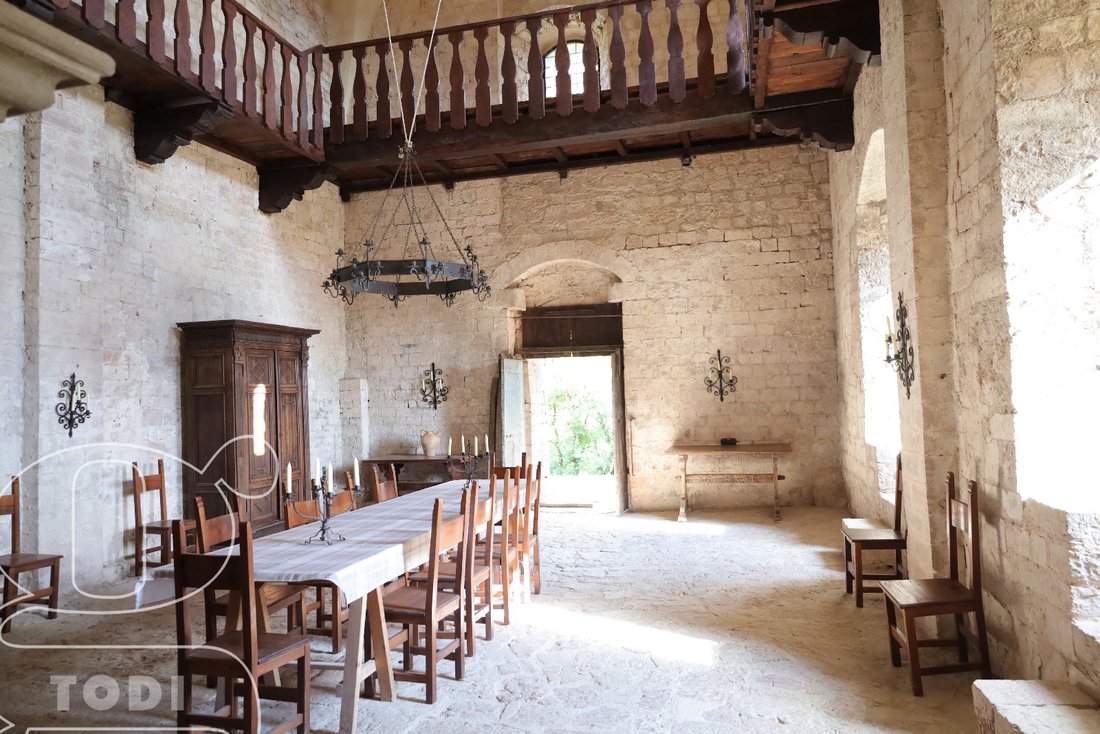
La CHAPELLE (ancienne sacristie) est consacrée tandis que l’ÉGLISE fait office d’immense salle des fêtes (avec deux toilettes).
À côté de l’abbaye, à une distance convenable et adossée à la colline, se trouve la MAISON EN PIERRE, initialement construite avec des restes de pierres pour le gardien de San Pietro, et aujourd’hui restaurée avec goût, offrant un refuge et une ambiance pour une vie entourée par la beauté de la nature.
La MAISON EN PIERRE comprend un salon avec cheminée, une cuisine, une chambre avec toilettes, deux autres chambres, une salle de bain avec baignoire, une véranda et des rangements.
Les installations comprennent l’eau courante HORS RÉSEAU dans les deux bâtiments (eau), l’électricité (générateur avec possibilité d’installation éolienne/photovoltaïque), le chauffage (radiateurs en fonte avec réservoir de gaz liquide enterré).
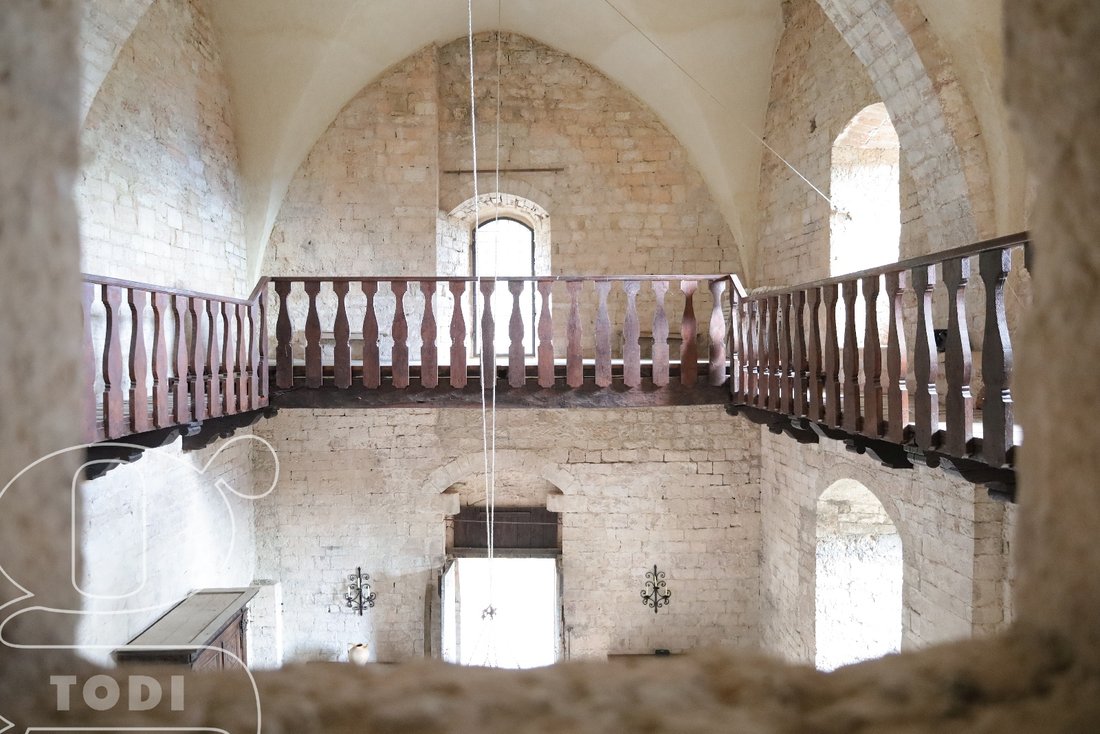
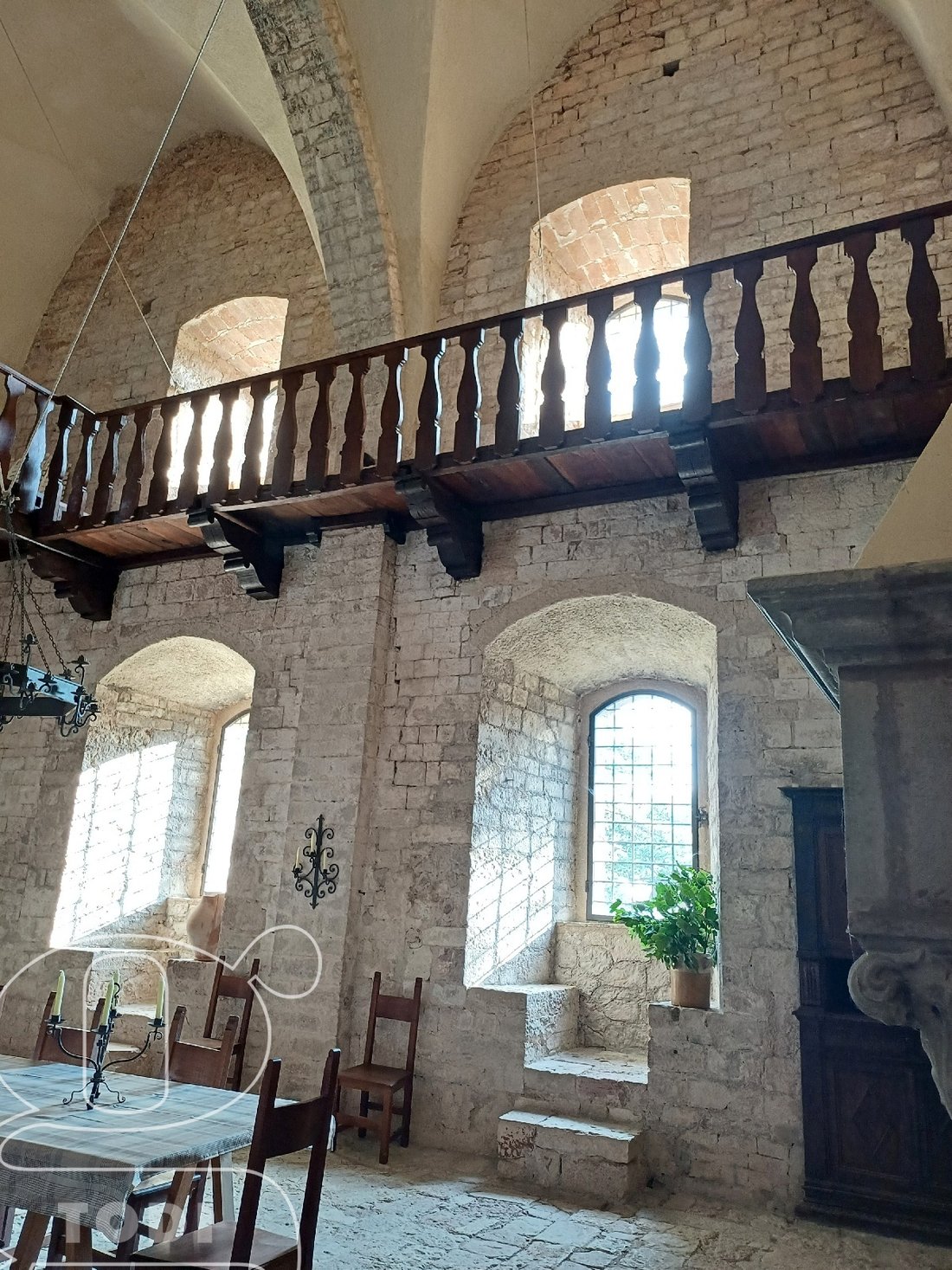
La grande salle de l’abbaye, avec ses voûtes gothiques, sa cheminée de la Renaissance florentine et sa haute galerie de ménestrels, est une structure d’une beauté et d’une pureté architecturale époustouflantes.
Au rez-de-chaussée, une cheminée en grès gris de douze pieds de haut occupait l’emplacement où se trouvait probablement l’autel. Dans la sacristie, qui a été convertie en chapelle familiale, se trouve une stèle funéraire d’une jeune fille romaine nommée Massellia, confiée aux dieux des enfers à vingt et un ans, la même dalle (rien d’inhabituel dans les églises de la fin du Moyen Âge) utilisée par les moines comme base de l’autel d’origine.
Au sommet de San Pietro se trouve un long pâturage sans arbres habité par des chevaux et des troupeaux de moutons. De là, la vue s’étend sur la vallée orientale de l’Ombrie, avec une vue sur la ligne de villes qui parsèment la crête des Apennins du sud au nord : Spolète, Trevi, Montefalco, Foligno, Spello, Assise. Ici poussent trois énormes hêtres, emblématiques de l’Ombrie, qui peuvent être distingués et identifiés d’aussi loin que Todi.
D’ici, il est facile de localiser Todi, à une douzaine de kilomètres à vol d’oiseau, avec le clocher de San Fortunato pointant le ciel comme un crayon pointu vers le ciel, jusqu’aux lueurs lointaines de Pérouse ou le sommet du Duomo d’Orvieto, vu de l’autre côté de la gorge grise du Tibre.
L’électricité n’est arrivée que récemment à San Pietro, sous la forme d’un générateur et d’une multitude de batteries de stockage astucieusement dissimulées.
Tous les services sont facilement accessibles à 6 km et l’autoroute donnant accès à la vie moderne n’est qu’à 11 km.
Distances : Massa Martana (6 km), Todi (22 km), Montefalco (31 km), Foligno (38 km), Terni (38 km), Spolète (40 km), Assise (56 km), Orvieto (66 km), Pérouse (68 km), Rome (128 km), Florence (216 km).
Aéroport Perugia San Francesco (68 km), aéroport Roma Ciampino (142 km), aéroport Roma Fiumicino (155 km).
A 12th-Century Abbey in the Unspoiled Heart of Umbria
Nestled within a private estate of 232 hectares of unspoiled woodlands, this historic, fully restored 12th-century ABBEY stands as one of the rarest architectural and spiritual treasures currently available in central Italy.
The heart of the estate is the ancient ABBEY: a structure steeped in medieval history, characterized by original stone walls, vaulted ceilings, and an architectural purity that creates a private RETREAT nestled in the green heart of Umbria, surrounded by over 230 hectares of FORESTS and PASTURES.
For those who love privacy and the beauty of nature;
for those who love silence and tranquility.
The Martani Mountains divide Umbria from north to south, creating the watershed amid the Valley of the Tiber and the Valley of Spoleto.
Considered a “land in between” this very remarkable part of Umbria recalls the atmosphere and the legends of past times, of all the people who might have lived here or just passed through.
At the very top of these mountains, on a plateau over 1000 meters altitude is found the Benedictine Abbey of San Pietro. The ancient structure is set on a mountainside of natural beauty and great charm, overlooking wide fields of billowing grass, ancient woods and forests, century old trees and breath taking panoramas of most beautiful Umbria.
The site is surrounded by meadows, a high forest and giant beech trees, some of them between 450 and 500 year’s old.
The complex is accessible by private road of 3.5km and the property extends over 575 acres spread over the western slope of the mountain rising from 600 to 1,100 mt. The summit offers a breathtaking view of both sides (Tiber valley with the cities of Perugia, Todi and Orvieto and valley of the Flaminia way with the cities of Assisi, Montefalco, Trevi, Spello, Spoleto and Foligno).
Built before the year 1000 and erected atop the remains of a Roman Temple, the venerable monastery was an important strategic site and permitted total control of the mountain passes.
The ABBEY is very old (9th century) and was destroyed several times.
Foundations, emerging here and there, still mark its former perimeter. The first restoration has been undertaken before the First World War.
The property was a summer residence for many generations before consolidating the structures and upgrading the facilities in 2005.
The CHAPEL (Old Sacristy) is consecrated while the CHURCH acts as a huge party room (with two toilets).
Next to the ABBEY, at a properly servile distance and leaning against the hill, you find the STONE HOUSE initially built with leftover stones for San Pietro’s guardian and now tastefully restored offering refuge and ambience for a life surrounded by the beauty of nature.
The STONE HOUSE offers a living room with fire place, kitchen, one bedroom with toilet, two further bedrooms, a bathroom with bathtub, porch and storage.
Facilities include OFF-GRID running water in both buildings (water), electricity (generator with possibility of wind / photovoltaic system), heating (cast iron radiators with buried liquid gas container).
The Great Hall of the Abbey, with its gothic vaults, the Florentine Renaissance fireplace and the lofty minstrel gallery is a structure of soaring beauty and architectural purity.
On the ground floor, a twelve-foot-high grey sandstone fireplace occupied the site where the altar probably once stood. In the sacristy, which was converted to a family chapel, you find a funerary stele of a Roman girl named Massellia, entrusted to the gods of the underworld at twenty-one, the same slab (not anything unusual in late-medieval churches) used by the monks as the base of the original altar.
At the summit of San Pietro there is a long, treeless pasture inhabited by horses and flocks of sheep. From there the vista sweeps across Umbria’s eastern valley, with a view of the line of cities dotting the ridge of the Apennines from south to north: Spoleto, Trevi, Montefalco, Foligno, Spello, Assisi. Here grow three enormous beech trees, in their own right landmarks of Umbria, able to be singled out and identified from as far away as Todi.
As easy as it is from here to locate Todi, no more than a dozen miles away as the crow flies, with the bell tower of San Fortunato pointing at the sky like a sharp pencil, even the distant glimmering of Perugia, or the very top of the Duomo of Orvieto, from beyond the grey gorge of the Tiber.
Electricity has only recently arrived at San Pietro—in the form of a generator and a multitude of cleverly concealed storage batteries.
All services are within easy reach of 6 km and the motorway with access to modern life is only 11 km away.
Distances: Massa Martana (6 km), Todi (22km), Montefalco (31km), Foligno (38km), Terni (38km), Spoleto (40km; ), Assisi (56km), Orvieto (66km), Perugia (68km), Roma (128km’), Firenze (216km).
Airport Perugia San Francesco (68km), Airport Roma Ciampino (142km), Airport Roma Fiumicino (155km).
-
Type de propriété
Château
-
Étages
2
-
Année de construction
2005
-
Prix/pied²
$396
-
Émissions
G
Caractéristiques
- Jardin
- Terrasse
- Cheminée
- Haute altitude
- Colline
- Rénové
- Vue panoramique / panoramique
- Vie privée
- Espace de vie extérieur
Explorez le secteur
Strada Senza Nome, 06049 Spoleto PG, Italy, Ombrie, Italie
Voir sur Google Maps
Prix par sqft
Faible
Élevé
Située à Spoleto, cette propriété permet un accès rapide aux sites historiques tels que le Théâtre romain et la Cathédrale de Spoleto, tous deux à 5 minutes en voiture. L’aéroport de Perugia San Francesco d’Assisi est à 40 minutes de route. La région allie nature paisible et patrimoine italien vivant, offrant confort et commodité aux résidents.
Voir à proximité
Attractions
Écoles
Aéroport international de Pérouse San Francesco d'Assise – Ombrie
Aéroport
40 min
Gare de Spoleto
Gare
6 min
Cathédrale de Spolète
Culture & Patrimoine
5 min
Théâtre romain de Spolète
Culture & Patrimoine
5 min
Antica Hostaria
Restauration & Vins
6 min
Istituto Comprensivo Spoleto 1
École publique
5 min

Inscrit il y a 1 an
Vous vous êtes renseigné sur ce bien
L'agent vous contactera bientôt par
Publié par
5
Annonces
2025
Inscrit
Réserver une visite avec Beatrice Forstner-Lorenzetti
Choisissez une date et si vous souhaitez une visite virtuelle ou en personne avec l’agent.
Date préférée
Type de visite

We live and breathe real estate.
For two decades, we have built our client relationships on COMPETENCE, TRANSPA
For two decades, we have built our client relationships on COMPETENCE, TRANSPA
We live and breathe real estate.
For two decades, we have built our client relationships on COMPETENCE, TRANSPARENCY, and TRUST, consistently delivering exceptional results and long-term satisfaction.
We bring our extensive EXPERIENCE to the table with absolute transparency and confidentiality, ensuring every transaction is completed smoothly, securely, and profitably for all parties involved.
Through continuous professional development, our TEAM remains at the top of its game, fully equipped to navigate every facet of negotiation, resolve complex real estate challenges, and provide comprehensive guidance.
Our deep-rooted knowledge of the region and its market allows us to deliver accurate valuations and strategic advice at every stage.
With us, you have a single, dedicated partner by your side every step of the way — from initial consultation to the final notarial deed and long after.
Every property is unique — let’s talk about yours
Dernière mise à jour
Octobre 8
Première mise en ligne
Octobre 8
Référence de l’annonce
FC103a
Propriétés similaires à proximité
Nouvelles annonces à Spoleto



Explorez plus de biens à vendre
Spoleto, Ombrie, Italie types de propriétés
Spoleto, Ombrie, Italie Recherches populaires
- Vue panoramique / panoramique propriétés à Spoleto, Ombrie, Italie
- Haute altitude propriétés à Spoleto, Ombrie, Italie
- Immobilier d’investissement propriétés à Spoleto, Ombrie, Italie
- Propriétés avec Terrain de tennis à Spoleto, Ombrie, Italie
- Propriétés avec Vignoble / Cave à Spoleto, Ombrie, Italie
Guides et histoires connexes
La confiance des plus grands courtiers du monde
Les agents des propriétés les plus exceptionnelles du monde publient sur JamesEdition.
- Des annonces de Sotheby's, Christie's, BARNES et Engel & Völkers
- Chaque annonce est vérifiée avant sa mise en ligne
- Contactez directement des agents vérifiés
En continuant, vous acceptez nos Conditions et notre Politique de confidentialité.