Preis auf Anfrage
Historisches Anwesen Zum Verkauf In Florenz Chianti
- 50 Schlafz.
- 30 Bäder
- 175,226 Sqft
- 44.73 Ac lot
- Aktualisiert: August 7
- 10
Über die Immobilie
Beschreibung wurde automatisch übersetzt.
Die Beschreibung wird in der Originalsprache angezeigt.
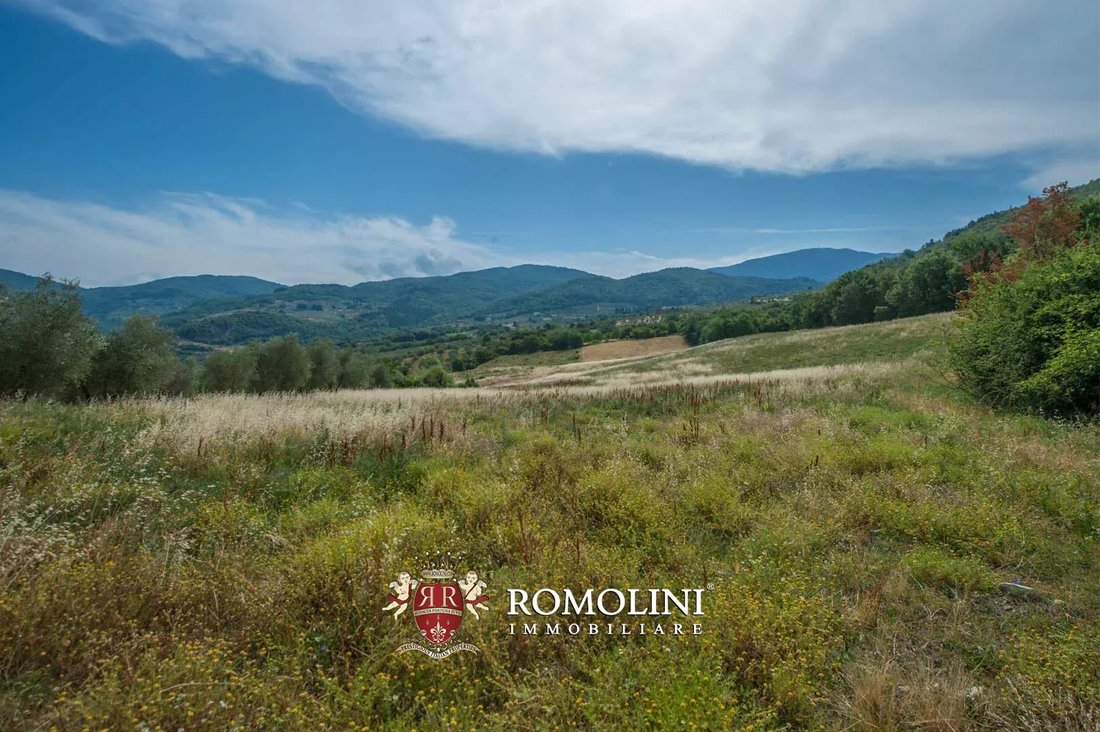
In der Provinz Florenz, auf den Chianti-Hügeln, prestigeträchtiges historisches Anwesen mit Herrenhaus und Weingut.
In einer leicht zugänglichen Lage, nicht weit von einem Zentrum mit allen Dienstleistungen (6 km; 10 Minuten) entfernt, bietet das Anwesen einen schnellen und ausgezeichneten Zugang zur gesamten Toskana: das wunderschöne Florenz (25 km; 40 Minuten), das turmreiche San Gimignano (
In einer leicht zugänglichen Lage, nicht weit von einem Zentrum mit allen Dienstleistungen (6 km; 10 Minuten) entfernt, bietet das Anwesen einen schnellen und ausgezeichneten Zugang zur gesamten Toskana: das wunderschöne Florenz (25 km; 40 Minuten), das turmreiche San Gimignano (
In the province of Florence, on the Chianti Hills, prestigious historical estate with manor villa and winery.
In an easily accessed location, not far from a center with all the services (6km; 10’), the property grants a quick and excellent access to the whole Tuscany: the beautiful Florence (25km; 40’), the turreted San Gimignano (76km; 1h 20’), Siena (84km; 1h 25’), the renowned Montepul
In an easily accessed location, not far from a center with all the services (6km; 10’), the property grants a quick and excellent access to the whole Tuscany: the beautiful Florence (25km; 40’), the turreted San Gimignano (76km; 1h 20’), Siena (84km; 1h 25’), the renowned Montepul
In der Provinz Florenz, auf den Chianti-Hügeln, prestigeträchtiges historisches Anwesen mit Herrenhaus und Weingut.
In einer leicht zugänglichen Lage, nicht weit von einem Zentrum mit allen Dienstleistungen (6 km; 10 Minuten) entfernt, bietet das Anwesen einen schnellen und ausgezeichneten Zugang zur gesamten Toskana: das wunderschöne Florenz (25 km; 40 Minuten), das turmreiche San Gimignano (76 km; 1 Stunde 20 Minuten), Siena (84 km; 1 Stunde 25 Minuten), das berühmte Montepulciano (95 km; 1 Stunde 15 Minuten) und Montalcino (122 km; 1 Stunde 45 Minuten) und die päpstliche Pienza (102 km; 1 Stunde 25 Minuten).
Die Flughäfen, um das Hotel in angemessener Zeit zu erreichen, sind Firenze Peretola (49 km; 45 Minuten), Pisa Galilei (109 km; 1 Stunde 25 Minuten), Bologna Marconi (130 km; 1 Stunde 35 Minuten), Perugia Sant’Egidio (145 km; 1 Stunde 40 Minuten), Roma Ciampino (273 km; 2 Stunden 45 Minuten) und Roma Fiumicino (288 km; 2 Stunden 50 Minuten).
BESCHREIBUNG DER GEBÄUDE
Das Anwesen besteht aus zahlreichen Gebäuden (17 mit einer Gesamtfläche von 15.500 m²), die auf die verschiedenen Farmen aufgeteilt sind. Das Tüpfelchen auf dem i ist die historische Herrenhausvilla, die den älteren Kern des Anwesens aus dem 11. und 14. Jahrhundert bildet. Dieser Weiler hinter der Villa umfasst eine Kirche aus dem Spätmittelalter, eine Olivenmühle, mehrere Kellerräume, ein Büro für das Geschäft, eine Werkstatt und einen der Bauernhöfe.
Zu den anderen fünf Farmen gehören mehrere Gebäude, die für landwirtschaftliche und private Zwecke bestimmt sind. Sie müssen teilweise restauriert werden, teilweise bereits restauriert und sind fast bewohnbar.
Zusammenfassend lässt sich sagen, dass das Anwesen über 11.000 m² (118.360 Quadratfuß) an Wohngebäuden, 3.000 m² (32.280 Quadratfuß) an landwirtschaftlichen Schuppen und 1.500 m² (16.140 Quadratfuß) an ländlichen Gebäuden verfügt.
GESCHICHTE, ZUSTAND UND AUSSTATTUNG
Das Anwesen liegt auf einem Land, das seit der Vorgeschichte bewohnt ist, aber die erste echte Zivilisation, die die Region erbaute und nutzte, waren die Etrusker ab dem 7. Jahrhundert vor Christus. Die Römer griffen dann das Erbe der Etrusker auf, indem sie beeindruckende Villen und Bauernhöfe in der Region errichteten. Es war ein wohlhabendes Zeitalter für die Einwohner, denen ein gutes Maß an Autonomie gewährt wurde. Dies sollte jedoch nicht von Dauer sein: Die Ankunft der Germanen aus Nordeuropa nach dem Fall Roms im 5. Jahrhundert n. Chr. veränderte die Situation dramatisch.
Die von den Langobarden auferlegte feudale Organisation schränkte die Unabhängigkeit der Menschen in der Region stark ein und zwang sie, sich den neuen Eroberern zu beugen.
Nach dem Ende der Langobardenherrschaft wurde die Toskana von den Franken (und dann von den Deutschen im Heiligen Römischen Reich) erobert und verwaltet. Im 10. Jahrhundert begann in der Gegend von Florenz und dort, wo sich die Villa heute befindet, ein umfassender Prozess der Kastellation.
Die Burg erscheint zum ersten Mal in einem Dokument aus dem Jahr 1080 n. Chr. und dann in mehreren anderen Papieren aus den Jahren 1102, 1123 und 1171 n. Chr. Die Besitzer des Schlosses beschlossen, es aufzugeben, als Florenz zwischen 1140 und 1153 begann, sich in Mittelitalien zu einer Supermacht zu entwickeln. Sicher ist, dass das Volk des Lehens 1145 unter der Flagge von Guido Guerra II am Zweiten Kreuzzug teilnahm. Im zweiten Jahrzehnt des 13. Jahrhunderts beschloss die Familie, das Schloss endgültig aufzugeben, indem sie es der nahe gelegenen Abtei von Vallombrosa schenkte. Danach wurde die Burg wahrscheinlich von den Armeen der Ghibellinen nach ihrem Sieg in der Schlacht von Montaperti 1260 n. Chr. zerstört (oder zumindest schwer beschädigt) (daran erinnert sich Dante in den berühmten Versen „[...] das Gemetzel und das große Gemetzel/die Arbia mit Purpur befleckt haben“).
Wie aus einem Dokument aus dem Jahr 1427 hervorgeht, war das Schloss in diesem Jahr bereits vollständig abgerissen und die Überreste dienten als Basis für ein neues Gebäude (heute ein Bauernhof), das zwischen 1260 und 1420 erbaut wurde. Das Gebäude befand sich jedoch bereits in einem fortgeschrittenen Ruinenzustand und im 17. Jahrhundert beschlossen die neuen Besitzer, den nördlichen Teil des Komplexes, zu dem auch der alte Turm (das einzige Überbleibsel des Schlosses) gehörte, zu restaurieren und eine Villa zu erwerben. Als das Anwesen im 19. Jahrhundert erneut den Besitzer wechselte, wurde das Pfarrhaus der Kirche erweitert, was die Verbindung der Villa mit dem Bauernhof ermöglichte. Die letzte Änderung (die den Komplex so aussehen ließ, wie er heute ist) war die Verlegung des Glockenturms von der linken auf die rechte Seite der Kirche.
Das Anwesen ist derzeit größtenteils verlassen und nur wenige der Gebäude wurden baulich verstärkt und restauriert. Insbesondere die Villa ist ein echtes Juwel, da sie mit Fresken und Dekorationen geschmückt ist. Sie bedarf jedoch einer Menge Arbeit, um wieder zu ihrem ursprünglichen Glanz zurückzukehren. Die Kirche ist ebenfalls in einem schlechten Zustand, da das Dach teilweise eingestürzt ist.
Die anderen Farmen bestehen hauptsächlich aus ländlichen und landwirtschaftlichen Gebäuden (die sich nach den Richtlinien für historische Gebäude leichter restaurieren und restaurieren lassen).
Der Keller ist derzeit in Betrieb, ebenso die Olivenmühle, und beide sorgen für die regelmäßige Produktion von Olivenöl und Weinen.
AUSSEN
Das Anwesen besteht aus einem 236,2 Hektar großen Grundstück, aufgeteilt in Weinberge (18,1 ha), Olivenhain (47,7 ha), Ackerland (82,2 ha), Weideland (7,8 ha), Obstgarten (2,6 ha) und gemischtes Land Wald (77,8 ha).
Das Weingut ist potenziell um weitere 27 Hektar erweiterbar, wobei den Ackerflächen etwas Land weggenommen wird (12 Hektar davon wurden in der Vergangenheit als Weinberg genutzt). Das Gleiche gilt für den Olivenhain, der dank des Programms zur Entwicklung des ländlichen Raums, das bis zu 80% der Gesamtkosten decken könnte, um weitere 8 Hektar erweitert werden sollte.
Die Olivenproduktion erfolgt vollständig biologisch (mit Zertifizierung), ohne den Einsatz von Pestiziden und chemischen Düngemitteln. Der Weinberg hat die Zertifizierung noch nicht erhalten, auch wenn die Ernte ohne Verwendung chemischer Substanzen erfolgt. Die manuelle Ernte und Sortierung der Trauben tragen zur ausgezeichneten Qualität des Weins bei.
EINZELHEITEN ZUR WEINHERSTELLUNG
- Rebfläche: 18,1 Hektar (+ 27,0 ha stehen für Anpflanzungen zur Verfügung)
- Sorten: Sangiovese, Cabernet Sauvignon, Canaiolo, Syrah, Malvasia und Trebbiano
- Jahr der Pflanzung: 1957 — 2011
- Höhe: 280 — 330 m
- Ausrichtung: Süden, Südosten, Südwesten
- Dichte: 3.500 — 5.000 Rebstöcke/ha
- Durchschnittsertrag: 4,5 — 7,0 Tonnen/ha
- Anbau: Reben mit beschnittenen Spornen und Kordongewächsen
- Ernte: manuell
- Bodenbeschaffenheit: kalkhaltig, mergelig, lehmig
- Jahresproduktion: 350,0 hl (46.700 Flaschen)
- Maximales Produktionspotenzial: 1.425,0 hl (190.000 Flaschen)
- Maximale Weinkapazität: 1.870,0 hl
PRODUZIERTE WEINE
- Chianti Colli Fiorentini DOCG: 100% Sangiovese
- Chianti Colli Fiorentini DOCG Riserva: 90% Sangiovese, 10% Cabernet Sauvignon
- Rosso Toscano IGT: 40% Sangiovese, 30% Canaiolo, 20% Malvasia, 10% Trebbiano
- Rosso Toscano IGT: 50% Cabernet Sauvignon, 25% Merlot, 25% Syrah
- Bianco Toscano IGT: 50% Cabernet Sauvignon, 50% Chardonnay
EINZELHEITEN ZUR ÖLPRODUKTION
- Fläche: 47,7 Hektar (+ 8,0 ha stehen für Plantagen zur Verfügung)
- Sorten: Frantoio, Moraiolo, Leccino, Pendolino und Peranzana
- Höhe: 300 — 350 m
- Bodenbeschaffenheit: kalkhaltig, mergelig, lehmig
- Jahresproduktion: 90,0 hl (12.000 Flaschen)
NUTZUNG UND EINSATZMÖGLICHKEITEN
Das Anwesen wird derzeit ausschließlich als Wein- und Ölproduktionsbetrieb genutzt. Die jährliche Produktion beträgt rund 46.700 Flaschen Wein (350 hl) und 12.000 Flaschen Öl (90 hl). Die Gebäude wurden teilweise restauriert und sind ohne jegliche Arbeiten nutzbar.
Das Anwesen ist perfekt für jemanden, der etwas sucht, das er parallel zum Öl- und Weingeschäft entwickeln kann. Nach einer vollständigen Restaurierung könnte man in der Tat darüber nachdenken, ein qualitativ hochwertiges Hosting-Unternehmen zu gründen, vor allem dank der zahlreichen verfügbaren Schlafzimmer und der Panoramalage.
Ein Umbauprojekt wurde bereits genehmigt und sieht die Realisierung eines Hotels mit Restaurant, Konferenzsaal, Ölmuseum, Wellnesscenter, Geschäft für lokale Produkte, Sportanlagen und die Umwandlung einiger Bauernhöfe in Wohnungen vor.
Was Sportanlagen anbelangt, so besteht die Möglichkeit, Pools und Tennisplätze zu bauen, mit einer Beschränkung auf einen pro Gebäudegruppe, mit Ausnahme der Hauptvilla, die ausreichend groß ist, um sowohl den Bau eines Pools als auch eines Tennisplatzes in der Nähe zu ermöglichen.
NÄCHSTGELEGENE STÄDTE UND GEMEINDEN†S
Stadt mit Dienstleistungen (6 km; 10 Minuten), Figline e Incisa Valdarno (14 km; 20 Minuten), Florenz (25 km; 40 Minuten), San Gimignano (76 km; 1 Stunde 20 Minuten), Siena (84 km; 1 Stunde 25 Minuten), Montepulciano (95 km; 1 Stunde 15 Minuten), Pienza (102 km; 1 Stunde 25 Minuten), Montalcino (122 km; 1 Stunde 45 Minuten)
NÄCHSTGELEGENE FLUGHÄFEN
Firenze Peretola (49 km; 45 Minuten), Pisa Galilei (109 km; 1 Stunde 25 Minuten), Bologna Marconi (130 km; 1 Stunde 35 Minuten), Perugia Sant’Egidio (145 km; 1 Stunde 40 Minuten), Rom Ciampino (273 km; 2 Stunden 45 Minuten), Rom Fiumicino (288 km; 2 Stunden 50 Minuten)
In einer leicht zugänglichen Lage, nicht weit von einem Zentrum mit allen Dienstleistungen (6 km; 10 Minuten) entfernt, bietet das Anwesen einen schnellen und ausgezeichneten Zugang zur gesamten Toskana: das wunderschöne Florenz (25 km; 40 Minuten), das turmreiche San Gimignano (76 km; 1 Stunde 20 Minuten), Siena (84 km; 1 Stunde 25 Minuten), das berühmte Montepulciano (95 km; 1 Stunde 15 Minuten) und Montalcino (122 km; 1 Stunde 45 Minuten) und die päpstliche Pienza (102 km; 1 Stunde 25 Minuten).
Die Flughäfen, um das Hotel in angemessener Zeit zu erreichen, sind Firenze Peretola (49 km; 45 Minuten), Pisa Galilei (109 km; 1 Stunde 25 Minuten), Bologna Marconi (130 km; 1 Stunde 35 Minuten), Perugia Sant’Egidio (145 km; 1 Stunde 40 Minuten), Roma Ciampino (273 km; 2 Stunden 45 Minuten) und Roma Fiumicino (288 km; 2 Stunden 50 Minuten).
BESCHREIBUNG DER GEBÄUDE
Das Anwesen besteht aus zahlreichen Gebäuden (17 mit einer Gesamtfläche von 15.500 m²), die auf die verschiedenen Farmen aufgeteilt sind. Das Tüpfelchen auf dem i ist die historische Herrenhausvilla, die den älteren Kern des Anwesens aus dem 11. und 14. Jahrhundert bildet. Dieser Weiler hinter der Villa umfasst eine Kirche aus dem Spätmittelalter, eine Olivenmühle, mehrere Kellerräume, ein Büro für das Geschäft, eine Werkstatt und einen der Bauernhöfe.
Zu den anderen fünf Farmen gehören mehrere Gebäude, die für landwirtschaftliche und private Zwecke bestimmt sind. Sie müssen teilweise restauriert werden, teilweise bereits restauriert und sind fast bewohnbar.
Zusammenfassend lässt sich sagen, dass das Anwesen über 11.000 m² (118.360 Quadratfuß) an Wohngebäuden, 3.000 m² (32.280 Quadratfuß) an landwirtschaftlichen Schuppen und 1.500 m² (16.140 Quadratfuß) an ländlichen Gebäuden verfügt.
GESCHICHTE, ZUSTAND UND AUSSTATTUNG
Das Anwesen liegt auf einem Land, das seit der Vorgeschichte bewohnt ist, aber die erste echte Zivilisation, die die Region erbaute und nutzte, waren die Etrusker ab dem 7. Jahrhundert vor Christus. Die Römer griffen dann das Erbe der Etrusker auf, indem sie beeindruckende Villen und Bauernhöfe in der Region errichteten. Es war ein wohlhabendes Zeitalter für die Einwohner, denen ein gutes Maß an Autonomie gewährt wurde. Dies sollte jedoch nicht von Dauer sein: Die Ankunft der Germanen aus Nordeuropa nach dem Fall Roms im 5. Jahrhundert n. Chr. veränderte die Situation dramatisch.
Die von den Langobarden auferlegte feudale Organisation schränkte die Unabhängigkeit der Menschen in der Region stark ein und zwang sie, sich den neuen Eroberern zu beugen.
Nach dem Ende der Langobardenherrschaft wurde die Toskana von den Franken (und dann von den Deutschen im Heiligen Römischen Reich) erobert und verwaltet. Im 10. Jahrhundert begann in der Gegend von Florenz und dort, wo sich die Villa heute befindet, ein umfassender Prozess der Kastellation.
Die Burg erscheint zum ersten Mal in einem Dokument aus dem Jahr 1080 n. Chr. und dann in mehreren anderen Papieren aus den Jahren 1102, 1123 und 1171 n. Chr. Die Besitzer des Schlosses beschlossen, es aufzugeben, als Florenz zwischen 1140 und 1153 begann, sich in Mittelitalien zu einer Supermacht zu entwickeln. Sicher ist, dass das Volk des Lehens 1145 unter der Flagge von Guido Guerra II am Zweiten Kreuzzug teilnahm. Im zweiten Jahrzehnt des 13. Jahrhunderts beschloss die Familie, das Schloss endgültig aufzugeben, indem sie es der nahe gelegenen Abtei von Vallombrosa schenkte. Danach wurde die Burg wahrscheinlich von den Armeen der Ghibellinen nach ihrem Sieg in der Schlacht von Montaperti 1260 n. Chr. zerstört (oder zumindest schwer beschädigt) (daran erinnert sich Dante in den berühmten Versen „[...] das Gemetzel und das große Gemetzel/die Arbia mit Purpur befleckt haben“).
Wie aus einem Dokument aus dem Jahr 1427 hervorgeht, war das Schloss in diesem Jahr bereits vollständig abgerissen und die Überreste dienten als Basis für ein neues Gebäude (heute ein Bauernhof), das zwischen 1260 und 1420 erbaut wurde. Das Gebäude befand sich jedoch bereits in einem fortgeschrittenen Ruinenzustand und im 17. Jahrhundert beschlossen die neuen Besitzer, den nördlichen Teil des Komplexes, zu dem auch der alte Turm (das einzige Überbleibsel des Schlosses) gehörte, zu restaurieren und eine Villa zu erwerben. Als das Anwesen im 19. Jahrhundert erneut den Besitzer wechselte, wurde das Pfarrhaus der Kirche erweitert, was die Verbindung der Villa mit dem Bauernhof ermöglichte. Die letzte Änderung (die den Komplex so aussehen ließ, wie er heute ist) war die Verlegung des Glockenturms von der linken auf die rechte Seite der Kirche.
Das Anwesen ist derzeit größtenteils verlassen und nur wenige der Gebäude wurden baulich verstärkt und restauriert. Insbesondere die Villa ist ein echtes Juwel, da sie mit Fresken und Dekorationen geschmückt ist. Sie bedarf jedoch einer Menge Arbeit, um wieder zu ihrem ursprünglichen Glanz zurückzukehren. Die Kirche ist ebenfalls in einem schlechten Zustand, da das Dach teilweise eingestürzt ist.
Die anderen Farmen bestehen hauptsächlich aus ländlichen und landwirtschaftlichen Gebäuden (die sich nach den Richtlinien für historische Gebäude leichter restaurieren und restaurieren lassen).
Der Keller ist derzeit in Betrieb, ebenso die Olivenmühle, und beide sorgen für die regelmäßige Produktion von Olivenöl und Weinen.
AUSSEN
Das Anwesen besteht aus einem 236,2 Hektar großen Grundstück, aufgeteilt in Weinberge (18,1 ha), Olivenhain (47,7 ha), Ackerland (82,2 ha), Weideland (7,8 ha), Obstgarten (2,6 ha) und gemischtes Land Wald (77,8 ha).
Das Weingut ist potenziell um weitere 27 Hektar erweiterbar, wobei den Ackerflächen etwas Land weggenommen wird (12 Hektar davon wurden in der Vergangenheit als Weinberg genutzt). Das Gleiche gilt für den Olivenhain, der dank des Programms zur Entwicklung des ländlichen Raums, das bis zu 80% der Gesamtkosten decken könnte, um weitere 8 Hektar erweitert werden sollte.
Die Olivenproduktion erfolgt vollständig biologisch (mit Zertifizierung), ohne den Einsatz von Pestiziden und chemischen Düngemitteln. Der Weinberg hat die Zertifizierung noch nicht erhalten, auch wenn die Ernte ohne Verwendung chemischer Substanzen erfolgt. Die manuelle Ernte und Sortierung der Trauben tragen zur ausgezeichneten Qualität des Weins bei.
EINZELHEITEN ZUR WEINHERSTELLUNG
- Rebfläche: 18,1 Hektar (+ 27,0 ha stehen für Anpflanzungen zur Verfügung)
- Sorten: Sangiovese, Cabernet Sauvignon, Canaiolo, Syrah, Malvasia und Trebbiano
- Jahr der Pflanzung: 1957 — 2011
- Höhe: 280 — 330 m
- Ausrichtung: Süden, Südosten, Südwesten
- Dichte: 3.500 — 5.000 Rebstöcke/ha
- Durchschnittsertrag: 4,5 — 7,0 Tonnen/ha
- Anbau: Reben mit beschnittenen Spornen und Kordongewächsen
- Ernte: manuell
- Bodenbeschaffenheit: kalkhaltig, mergelig, lehmig
- Jahresproduktion: 350,0 hl (46.700 Flaschen)
- Maximales Produktionspotenzial: 1.425,0 hl (190.000 Flaschen)
- Maximale Weinkapazität: 1.870,0 hl
PRODUZIERTE WEINE
- Chianti Colli Fiorentini DOCG: 100% Sangiovese
- Chianti Colli Fiorentini DOCG Riserva: 90% Sangiovese, 10% Cabernet Sauvignon
- Rosso Toscano IGT: 40% Sangiovese, 30% Canaiolo, 20% Malvasia, 10% Trebbiano
- Rosso Toscano IGT: 50% Cabernet Sauvignon, 25% Merlot, 25% Syrah
- Bianco Toscano IGT: 50% Cabernet Sauvignon, 50% Chardonnay
EINZELHEITEN ZUR ÖLPRODUKTION
- Fläche: 47,7 Hektar (+ 8,0 ha stehen für Plantagen zur Verfügung)
- Sorten: Frantoio, Moraiolo, Leccino, Pendolino und Peranzana
- Höhe: 300 — 350 m
- Bodenbeschaffenheit: kalkhaltig, mergelig, lehmig
- Jahresproduktion: 90,0 hl (12.000 Flaschen)
NUTZUNG UND EINSATZMÖGLICHKEITEN
Das Anwesen wird derzeit ausschließlich als Wein- und Ölproduktionsbetrieb genutzt. Die jährliche Produktion beträgt rund 46.700 Flaschen Wein (350 hl) und 12.000 Flaschen Öl (90 hl). Die Gebäude wurden teilweise restauriert und sind ohne jegliche Arbeiten nutzbar.
Das Anwesen ist perfekt für jemanden, der etwas sucht, das er parallel zum Öl- und Weingeschäft entwickeln kann. Nach einer vollständigen Restaurierung könnte man in der Tat darüber nachdenken, ein qualitativ hochwertiges Hosting-Unternehmen zu gründen, vor allem dank der zahlreichen verfügbaren Schlafzimmer und der Panoramalage.
Ein Umbauprojekt wurde bereits genehmigt und sieht die Realisierung eines Hotels mit Restaurant, Konferenzsaal, Ölmuseum, Wellnesscenter, Geschäft für lokale Produkte, Sportanlagen und die Umwandlung einiger Bauernhöfe in Wohnungen vor.
Was Sportanlagen anbelangt, so besteht die Möglichkeit, Pools und Tennisplätze zu bauen, mit einer Beschränkung auf einen pro Gebäudegruppe, mit Ausnahme der Hauptvilla, die ausreichend groß ist, um sowohl den Bau eines Pools als auch eines Tennisplatzes in der Nähe zu ermöglichen.
NÄCHSTGELEGENE STÄDTE UND GEMEINDEN†S
Stadt mit Dienstleistungen (6 km; 10 Minuten), Figline e Incisa Valdarno (14 km; 20 Minuten), Florenz (25 km; 40 Minuten), San Gimignano (76 km; 1 Stunde 20 Minuten), Siena (84 km; 1 Stunde 25 Minuten), Montepulciano (95 km; 1 Stunde 15 Minuten), Pienza (102 km; 1 Stunde 25 Minuten), Montalcino (122 km; 1 Stunde 45 Minuten)
NÄCHSTGELEGENE FLUGHÄFEN
Firenze Peretola (49 km; 45 Minuten), Pisa Galilei (109 km; 1 Stunde 25 Minuten), Bologna Marconi (130 km; 1 Stunde 35 Minuten), Perugia Sant’Egidio (145 km; 1 Stunde 40 Minuten), Rom Ciampino (273 km; 2 Stunden 45 Minuten), Rom Fiumicino (288 km; 2 Stunden 50 Minuten)
In the province of Florence, on the Chianti Hills, prestigious historical estate with manor villa and winery.
In an easily accessed location, not far from a center with all the services (6km; 10’), the property grants a quick and excellent access to the whole Tuscany: the beautiful Florence (25km; 40’), the turreted San Gimignano (76km; 1h 20’), Siena (84km; 1h 25’), the renowned Montepulciano (95km; 1h 15’) and Montalcino (122km; 1h 45’) and the papal Pienza (102km; 1h 25’).
The airports to reach the property in reasonable time are Firenze Peretola (49km; 45’), Pisa Galilei (109km; 1h 25’), Bologna Marconi (130km; 1h 35’), Perugia Sant’Egidio (145km; 1h 40’), Roma Ciampino (273km; 2h 45’) e Roma Fiumicino (288km; 2h 50’).
DESCRIPTION OF THE BUILDINGS
The property is made up of numerous buildings (17 for a total surface of 15,500 sqm) split among the various farms. Icing on the cake is the historical manor villa, constituting the older core of the property dating back to the 11th and 14th century. This hamlet, beyond the villa, includes a late Middle Ages church, an olive mill, several cellar rooms, office for the business, a workshop and one of the farms.
The other five farms include several buildings intended for agricultural and residential use, partially to be restored partially already restored and almost livable.
To summarize, the property boasts 11,000 sqm (118,360 sqft) of residential buildings, 3,000 sqm (32,280 sqft) of agricultural sheds and 1,500 sqm (16,140 sqft) of rural buildings.
HISTORY, STATE AND FINISHES
The estate lies on a land inhabited since Prehistory, but the first real civilization to build and use the region was the Etruscans starting from the 7th century BC. Romans would then pick up the legacy of the Etruscan people by building impressive villas and farms in the region. It was a prosperous age for the inhabitants, which were granted a good degree of autonomy. However this wasn’t bound to last: the arrival of Germanic people from northern Europe after the fall of Rome in the 5th century AD dramatically changed the situation.
The feudal organization imposed by the Longobards severely reduced the independence for the people in the area and forced them to bow to the new conquerors.
After the end of the Langobardic reign, Tuscany was conquered and administered by Franks (and then Germans with the Holy Roman Empire) and in the 10th century a process of encastellation began on a large scale in the area of Florence and where the villa is sitting today.
The castle appears for the first time in a document dated 1080 AD and then in several other papers from 1102, 1123 and 1171 AD. The owners of the castle decided to abandon it when Florence started emerging as a superpower in Central Italy between 1140 and 1153. What is sure is that the people of the fiefdom took part in the Second Crusade in 1145 under the flag of Guido Guerra II. In the second decade of the 13th century the family decided to finally give up the castle by donating it to the nearby Abbey of Vallombrosa. After that, the castle was probably destroyed (or at least heavily damaged) by the Ghibellines armies following their victory in the battle of Montaperti in 1260 AD (recalled by Dante in the famous verses “[…] the slaughter and great carnage / which have with crimson stained the Arbia”).
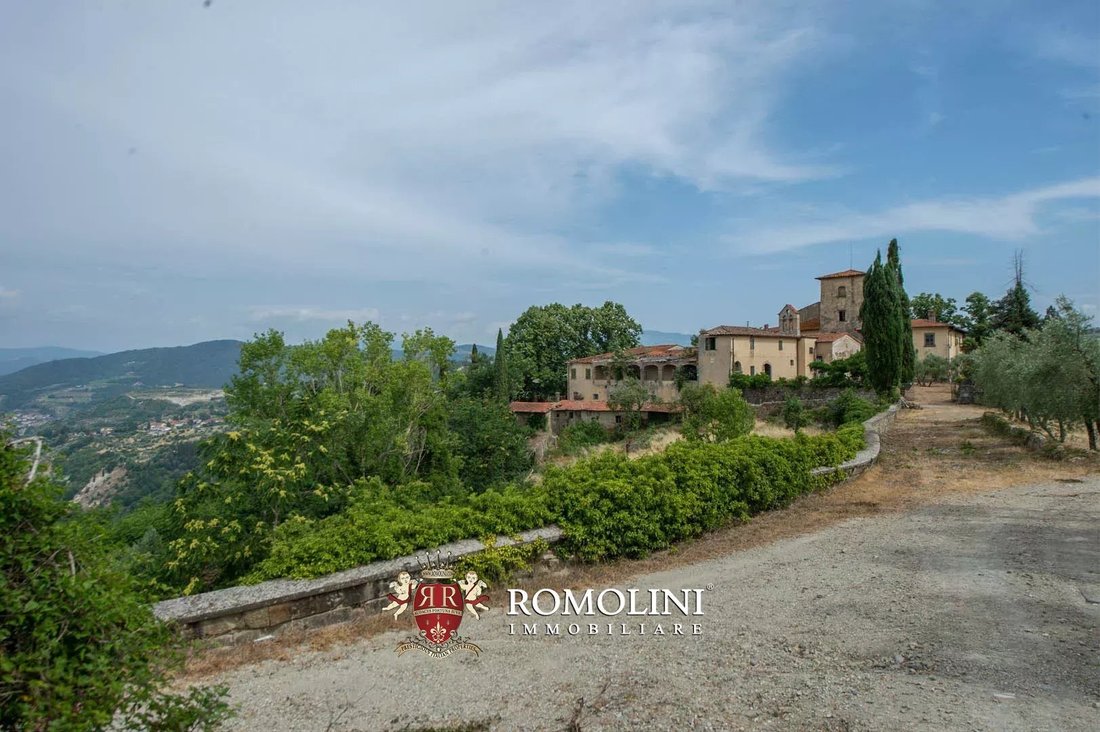
As testified by a document from 1427, by that year the castle had already been totally demolished and the remains used as a base for a new building (nowadays a farm) which was built between 1260 and 1420. However, the building was already in an advanced state of ruin and during the 17th century the new owners decided to restore the northern part of the complex which included the old tower (the only remain of the castle), obtaining a villa. When in the 19th century the property changed hands again, the rectory of the church was expanded and this allowed the conjunction of the villa with the farm. The last change (which is the one that made the complex look what it is today) was the relocation of the bell tower from the left to the right side of the church.
The property is currently abandoned for the most part and just a few of the buildings have been structurally reinforced and restored. The villa in particular is a real gem, covered as it is in frescoes and decorations; however it needs lots of work to be brought back to its original splendor. The church is also in bad shape, with the roof partially collapsed.
The other farms are mainly made up of rural and agricultural buildings (which are easier to recover and restore following the guidelines for historical buildings).
The cellar is currently working, as well as the olive mill, and both grant the regular production of olive oil and wines.
EXTERIOR
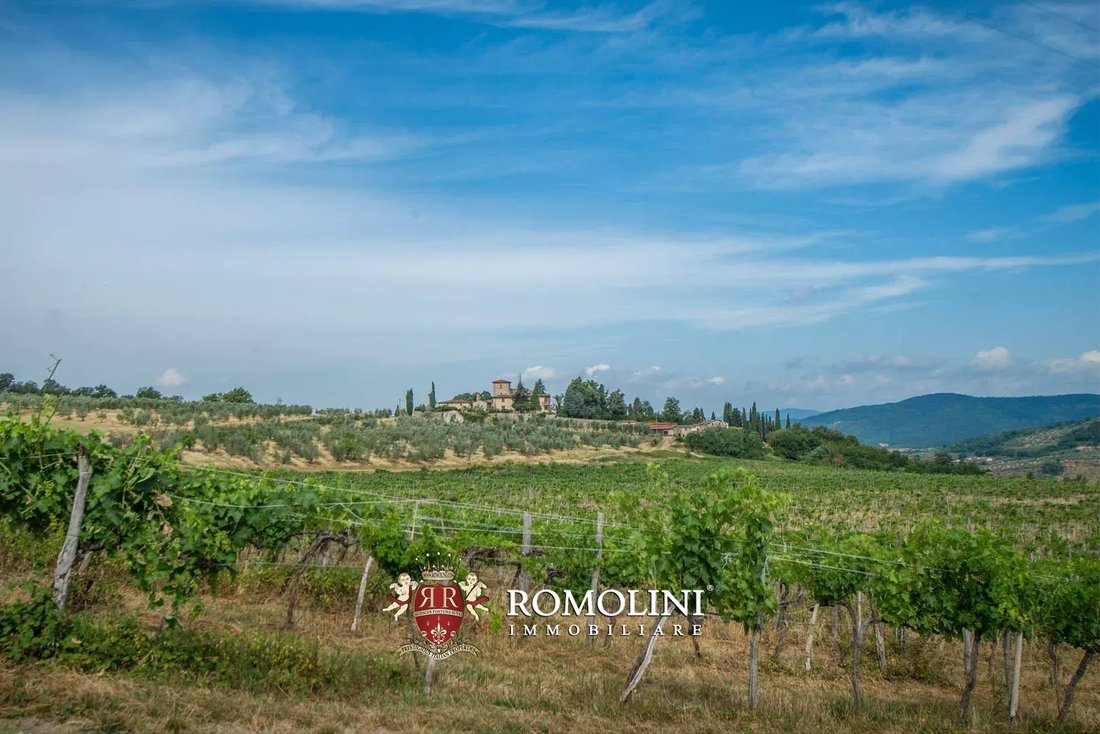
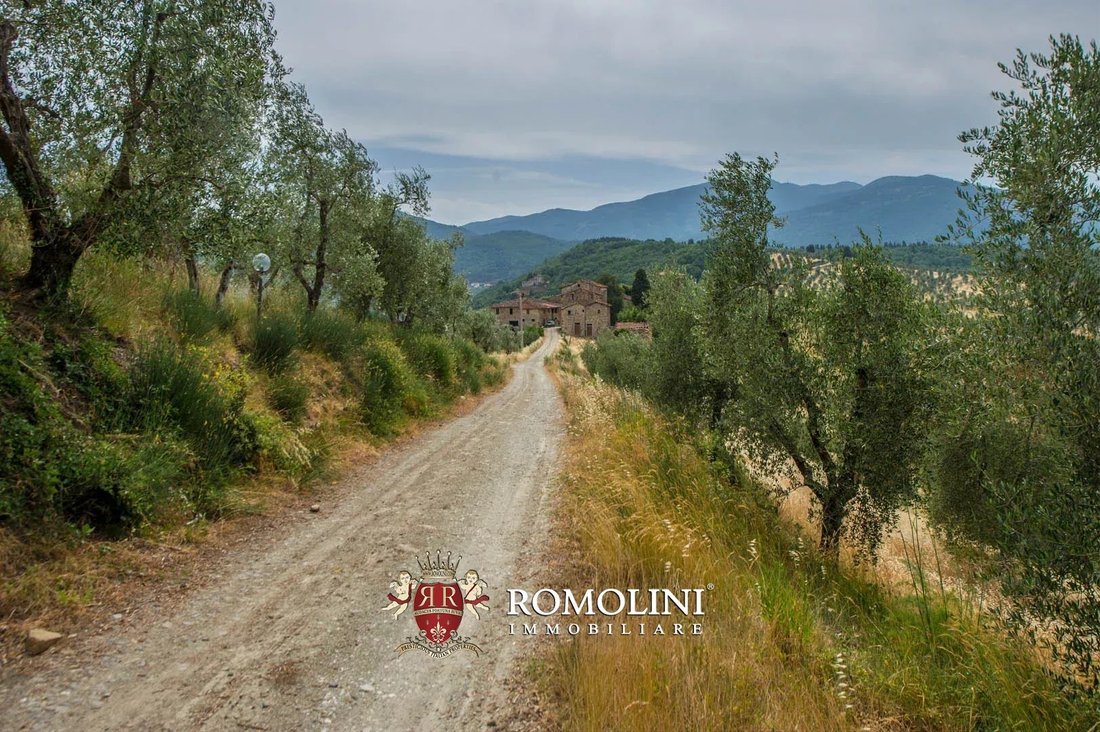
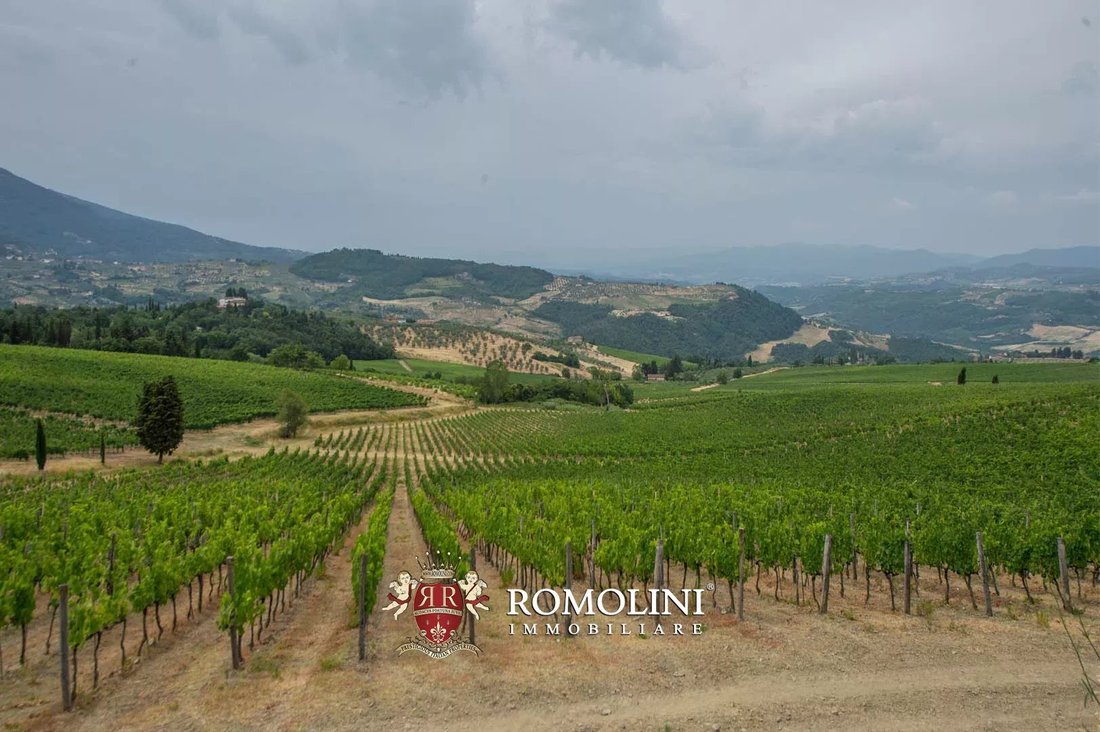
The property consists of a 236.2 hectares piece of land, split among vineyard (18.1 ha), olive grove (47.7 ha), arable land (82.2 ha), grazing land (7.8 ha), fruit orchard (2.6 ha) and mixed woodland (77.8 ha).
The vineyard is potentially expandable for further 27 hectares, taking some land from the arable plots (12 hectares of which had been used as a vineyard in the past). Same goes for the olive grove, which should be expanded with 8 more hectares thanks to the Rural Development Program which could cover up to 80% of the total cost.
The production of olives is totally organic (with certification), without the use of pesticides and chemical fertilizers, while vineyard hasn’t got the certification yet, even if harvesting is carried out without using chemical substances. Manual harvesting and sorting of grapes contribute to the excellent quality of the wine.
DETAILS ON WINE PRODUCTION
- Vineyard surface: 18.1 hectares (+ 27.0 ha available for plantation)
- Varieties: Sangiovese, Cabernet Sauvignon, Canaiolo, Syrah, Malvasia and Trebbiano
- Year of planting: 1957 – 2011
- Altitude: 280 – 330 m
- Exposure: south, south-east, south-west
- Density: 3,500 – 5,000 vines / ha
- Average yield: 4.5 – 7.0 tons / ha
- Training: pruned-spur cordon-trained vines
- Harvesting: manual
- Soil composition: calcareous, marlstone, clayish
- Yearly production: 350.0 hl (46,700 bottles)
- Maximum potential productions: 1,425.0 hl (190,000 bottles)
- Maximum wine capacity: 1,870.0 hl
PRODUCED WINES
- Chianti Colli Fiorentini DOCG: 100% Sangiovese
- Chianti Colli Fiorentini DOCG Riserva: 90% Sangiovese, 10% Cabernet Sauvignon
- Rosso Toscano IGT: 40% Sangiovese, 30% Canaiolo, 20% Malvasia, 10% Trebbiano
- Rosso Toscano IGT: 50% Cabernet Sauvignon, 25% Merlot, 25% Syrah
- Bianco Toscano IGT: 50% Cabernet Sauvignon, 50% Chardonnay
DETAILS ON OIL PRODUCTION
- Surface: 47.7 hectares (+ 8.0 ha available for plantation)
- Varieties: Frantoio, Moraiolo, Leccino, Pendolino and Peranzana
- Altitude: 300 – 350 m
- Soil composition: calcareous, marlstone, clayish
- Yearly production: 90.0 hl (12,000 bottles)
USE AND POTENTIAL USES
The property is currently used exclusively as a wine and oil producing business, with a yearly production ranging around 46,700 bottles of wine (350 hl) and 12,000 bottles of oil (90 hl). Buildings are partially restored and usable without any work needed.
The estate is perfect for someone looking for something to develop in parallel with the oil and wine business. With a full restoration one could, as a matter of fact, think about starting a high quality hosting business, mainly thanks to the numerous available bedrooms and the panoramic position.
A conversion project has already been approved and envisages the realization of a hotel with restaurant, conference hall, oil museum, wellness centre, shop for local products, sporting facilities and the conversion of some of the farms into apartments.
As far as sporting facilities are concerned, there is the possibility of building pools and tennis courts with a limitation of one per group of buildings, with the exception of the main villa which is ample enough to allow the construction of both a pool and a tennis court in the vicinity.
CLOSEST CITIES AND TOWN†S
Town with services (6km; 10’), Figline e Incisa Valdarno (14km; 20’), Florence (25km; 40’), San Gimignano (76km; 1h 20’), Siena (84km; 1h 25’), Montepulciano (95km; 1h 15’), Pienza (102km; 1h 25’), Montalcino (122km; 1h 45’)
CLOSEST AIRPORTS
Firenze Peretola (49km; 45’), Pisa Galilei (109km; 1h 25’), Bologna Marconi (130km; 1h 35’), Perugia Sant’Egidio (145km; 1h 40’), Roma Ciampino (273km; 2h 45’), Roma Fiumicino (288km; 2h 50’)
In an easily accessed location, not far from a center with all the services (6km; 10’), the property grants a quick and excellent access to the whole Tuscany: the beautiful Florence (25km; 40’), the turreted San Gimignano (76km; 1h 20’), Siena (84km; 1h 25’), the renowned Montepulciano (95km; 1h 15’) and Montalcino (122km; 1h 45’) and the papal Pienza (102km; 1h 25’).
The airports to reach the property in reasonable time are Firenze Peretola (49km; 45’), Pisa Galilei (109km; 1h 25’), Bologna Marconi (130km; 1h 35’), Perugia Sant’Egidio (145km; 1h 40’), Roma Ciampino (273km; 2h 45’) e Roma Fiumicino (288km; 2h 50’).
DESCRIPTION OF THE BUILDINGS
The property is made up of numerous buildings (17 for a total surface of 15,500 sqm) split among the various farms. Icing on the cake is the historical manor villa, constituting the older core of the property dating back to the 11th and 14th century. This hamlet, beyond the villa, includes a late Middle Ages church, an olive mill, several cellar rooms, office for the business, a workshop and one of the farms.
The other five farms include several buildings intended for agricultural and residential use, partially to be restored partially already restored and almost livable.
To summarize, the property boasts 11,000 sqm (118,360 sqft) of residential buildings, 3,000 sqm (32,280 sqft) of agricultural sheds and 1,500 sqm (16,140 sqft) of rural buildings.
HISTORY, STATE AND FINISHES
The estate lies on a land inhabited since Prehistory, but the first real civilization to build and use the region was the Etruscans starting from the 7th century BC. Romans would then pick up the legacy of the Etruscan people by building impressive villas and farms in the region. It was a prosperous age for the inhabitants, which were granted a good degree of autonomy. However this wasn’t bound to last: the arrival of Germanic people from northern Europe after the fall of Rome in the 5th century AD dramatically changed the situation.
The feudal organization imposed by the Longobards severely reduced the independence for the people in the area and forced them to bow to the new conquerors.
After the end of the Langobardic reign, Tuscany was conquered and administered by Franks (and then Germans with the Holy Roman Empire) and in the 10th century a process of encastellation began on a large scale in the area of Florence and where the villa is sitting today.
The castle appears for the first time in a document dated 1080 AD and then in several other papers from 1102, 1123 and 1171 AD. The owners of the castle decided to abandon it when Florence started emerging as a superpower in Central Italy between 1140 and 1153. What is sure is that the people of the fiefdom took part in the Second Crusade in 1145 under the flag of Guido Guerra II. In the second decade of the 13th century the family decided to finally give up the castle by donating it to the nearby Abbey of Vallombrosa. After that, the castle was probably destroyed (or at least heavily damaged) by the Ghibellines armies following their victory in the battle of Montaperti in 1260 AD (recalled by Dante in the famous verses “[…] the slaughter and great carnage / which have with crimson stained the Arbia”).
As testified by a document from 1427, by that year the castle had already been totally demolished and the remains used as a base for a new building (nowadays a farm) which was built between 1260 and 1420. However, the building was already in an advanced state of ruin and during the 17th century the new owners decided to restore the northern part of the complex which included the old tower (the only remain of the castle), obtaining a villa. When in the 19th century the property changed hands again, the rectory of the church was expanded and this allowed the conjunction of the villa with the farm. The last change (which is the one that made the complex look what it is today) was the relocation of the bell tower from the left to the right side of the church.
The property is currently abandoned for the most part and just a few of the buildings have been structurally reinforced and restored. The villa in particular is a real gem, covered as it is in frescoes and decorations; however it needs lots of work to be brought back to its original splendor. The church is also in bad shape, with the roof partially collapsed.
The other farms are mainly made up of rural and agricultural buildings (which are easier to recover and restore following the guidelines for historical buildings).
The cellar is currently working, as well as the olive mill, and both grant the regular production of olive oil and wines.
EXTERIOR
The property consists of a 236.2 hectares piece of land, split among vineyard (18.1 ha), olive grove (47.7 ha), arable land (82.2 ha), grazing land (7.8 ha), fruit orchard (2.6 ha) and mixed woodland (77.8 ha).
The vineyard is potentially expandable for further 27 hectares, taking some land from the arable plots (12 hectares of which had been used as a vineyard in the past). Same goes for the olive grove, which should be expanded with 8 more hectares thanks to the Rural Development Program which could cover up to 80% of the total cost.
The production of olives is totally organic (with certification), without the use of pesticides and chemical fertilizers, while vineyard hasn’t got the certification yet, even if harvesting is carried out without using chemical substances. Manual harvesting and sorting of grapes contribute to the excellent quality of the wine.
DETAILS ON WINE PRODUCTION
- Vineyard surface: 18.1 hectares (+ 27.0 ha available for plantation)
- Varieties: Sangiovese, Cabernet Sauvignon, Canaiolo, Syrah, Malvasia and Trebbiano
- Year of planting: 1957 – 2011
- Altitude: 280 – 330 m
- Exposure: south, south-east, south-west
- Density: 3,500 – 5,000 vines / ha
- Average yield: 4.5 – 7.0 tons / ha
- Training: pruned-spur cordon-trained vines
- Harvesting: manual
- Soil composition: calcareous, marlstone, clayish
- Yearly production: 350.0 hl (46,700 bottles)
- Maximum potential productions: 1,425.0 hl (190,000 bottles)
- Maximum wine capacity: 1,870.0 hl
PRODUCED WINES
- Chianti Colli Fiorentini DOCG: 100% Sangiovese
- Chianti Colli Fiorentini DOCG Riserva: 90% Sangiovese, 10% Cabernet Sauvignon
- Rosso Toscano IGT: 40% Sangiovese, 30% Canaiolo, 20% Malvasia, 10% Trebbiano
- Rosso Toscano IGT: 50% Cabernet Sauvignon, 25% Merlot, 25% Syrah
- Bianco Toscano IGT: 50% Cabernet Sauvignon, 50% Chardonnay
DETAILS ON OIL PRODUCTION
- Surface: 47.7 hectares (+ 8.0 ha available for plantation)
- Varieties: Frantoio, Moraiolo, Leccino, Pendolino and Peranzana
- Altitude: 300 – 350 m
- Soil composition: calcareous, marlstone, clayish
- Yearly production: 90.0 hl (12,000 bottles)
USE AND POTENTIAL USES
The property is currently used exclusively as a wine and oil producing business, with a yearly production ranging around 46,700 bottles of wine (350 hl) and 12,000 bottles of oil (90 hl). Buildings are partially restored and usable without any work needed.
The estate is perfect for someone looking for something to develop in parallel with the oil and wine business. With a full restoration one could, as a matter of fact, think about starting a high quality hosting business, mainly thanks to the numerous available bedrooms and the panoramic position.
A conversion project has already been approved and envisages the realization of a hotel with restaurant, conference hall, oil museum, wellness centre, shop for local products, sporting facilities and the conversion of some of the farms into apartments.
As far as sporting facilities are concerned, there is the possibility of building pools and tennis courts with a limitation of one per group of buildings, with the exception of the main villa which is ample enough to allow the construction of both a pool and a tennis court in the vicinity.
CLOSEST CITIES AND TOWN†S
Town with services (6km; 10’), Figline e Incisa Valdarno (14km; 20’), Florence (25km; 40’), San Gimignano (76km; 1h 20’), Siena (84km; 1h 25’), Montepulciano (95km; 1h 15’), Pienza (102km; 1h 25’), Montalcino (122km; 1h 45’)
CLOSEST AIRPORTS
Firenze Peretola (49km; 45’), Pisa Galilei (109km; 1h 25’), Bologna Marconi (130km; 1h 35’), Perugia Sant’Egidio (145km; 1h 40’), Roma Ciampino (273km; 2h 45’), Roma Fiumicino (288km; 2h 50’)
-
Art der Immobilie
Farm Ranch
-
Etagen
3
Funktionen
Erkunden Sie die Gegend
Pontassieve, Toskana, Italien
Auf Google Maps anzeigen
Preis pro sqft
Niedrig
Hoch
Eingebettet in die toskanischen Hügel bietet Pontassieve eine Mischung aus Ruhe und Erreichbarkeit. Genießen Sie die Nähe zu Florenz, dem Herzen der Renaissancekunst und -kultur, nur 25 Minuten entfernt. Erkunden Sie lokale Weinberge und genießen Sie authentische italienische Küche. Die Gegend bietet bequemen Zugang zu luxuriösem Shopping und Wellness in Florenz, während die malerische Landschaft zu Outdoor-Abenteuern einlädt. Ideal für alle, die einen gehobenen Lebensstil inmitten des reichen Erbes Italiens suchen.
In der Nähe anzeigen
Sehenswürdigkeiten
Schulen
Flughafen Florenz Peretola
Flughafen
36 Min.
Bahnhof Pontassieve
Öffentlicher Verkehrsknotenpunkt
5 Min.
Die Mall Luxusoutlets
Einkaufen & Lifestyle
19 Min.
Uffizien
Kultur & Erbe
25 Min.
Ponte Vecchio
Kultur & Erbe
27 Min.
Weinregion Chianti
Natur & Natur
32 Min.
Internationale Schule von Florenz
Internationale Schule
27 Min.
Universität Florenz
Universität / Höhere Bildung
28 Min.
Naturwissenschaftliches Gymnasium Piero Gobetti
Öffentliche Schule
10 Min.

Vor 4 Jahren beigetreten
Sie haben sich nach diesem Objekt erkundigt
Der Agent wird sich in Kürze mit Ihnen in Verbindung setzen
Gelistet von
222
Angebote
2022
Beigetreten
Besichtigung mit Danilo Romolini buchen
Wählen Sie ein Datum und ob Sie eine virtuelle oder persönliche Besichtigung mit dem Makler wünschen.
Bevorzugtes Datum
Art der Tour

Romolini Immobiliare
Piazza Torre di Berta 4, Tuscany, 52037, Sansepolcro, Italy
Agenturprofil anzeigen
Riccardo and Marta met during their high school years. Since then, their paths have never parted. United by shared
Riccardo and Marta met during their high school years. Since then, their paths have never parted. United by shared dreams and aspirations, they married in 1999 and are today parents of three children. In 2004, driven by their passion for their native land, art, and beauty, they chose the historic heart of Tuscany – the charming village of Anghiari – as the birthplace of a project that already carried the warmth of home: Romolini Immobiliare. A story founded on courage, dedication, and profound values that, paired with their vision, quickly earned them recognition within both the national and international real estate markets. In 2008, an important achievement further strengthened their reputation: Romolini Immobiliare was appointed exclusive affiliate of Christie’s International Real Estate, the world’s most prestigious name in luxury real estate – a testament to their authenticity and unwavering commitment. Romolini, however, is more than a business: it is a family. Those who have joined Riccardo and Marta in this endeavor were welcomed for their human qualities, integrity, and outstanding professionalism, becoming not just exceptional team members, but part of a greater family. Each brings a unique approach, a personal style, and a shared dedication to the values that have always defined Romolini. In 2020, Danilo, their eldest son, chose to join the company. Having grown up amid the dreams and challenges of the family business, he brought a visionary spirit and a profound love for beauty. Danilo pioneered a new way of presenting properties in Italy, creating emotional and engaging video narratives that captivate and inspire. With his contribution, Romolini Immobiliare embraced a new chapter. A refined approach to communication, an even greater attention to detail, and a client-centered philosophy have established the company as a leading figure in the luxury real estate sector. Romolini is not just a name. It is a legacy. It is a family dream brought to life. It is a journey that moves forward with passion and purpose.
Zuletzt aktualisiert
August 7
Erstmalig gelistet
Mai 21, 2025
Angebotsreferenz
1561
Ähnliche Immobilien in der Nähe
Neue Angebote in Pontassieve





Entdecken Sie mehr Häuser zum Verkauf
Pontassieve, Toskana, Italien Immobilienarten
Pontassieve, Toskana, Italien beliebte Suchanfragen
- Immobilien mit Seeblick in Pontassieve, Toskana, Italien
- Immobilien mit Flussblick in Pontassieve, Toskana, Italien
- Immobilien in hohen Höhen in Pontassieve, Toskana, Italien
- Moderne Immobilien in Pontassieve, Toskana, Italien
- Immobilien mit Hubschrauberlandeplatz in Pontassieve, Toskana, Italien
- am See Immobilien in Pontassieve, Toskana, Italien
Verwandte Leitfäden & Geschichten
Das Vertrauen der führenden Makler der Welt
Die Makler hinter den außergewöhnlichsten Immobilien der Welt inserieren bei JamesEdition.
- Angebote von Sotheby's, Christie's, BARNES und Engel & Völkers
- Jedes Angebot wird vor der Veröffentlichung geprüft
- Verbinden Sie sich direkt mit verifizierten Maklern
Indem Sie fortfahren, akzeptieren Sie unsere Nutzungsbedingungen und Datenschutzrichtlinie.