$6,595,848
Majestätisches Historisches Herrenhaus Auf Den Hügeln Von Pistoia
- 10 Schlafz.
- 10 Bäder
- 16,146 Sqft
- 12.36 Ac lot
- 67
Über die Immobilie
Beschreibung wurde automatisch übersetzt.
Die Beschreibung wird in der Originalsprache angezeigt.
Villa il Merlo ist ein historischer Bau, der um 1750 fertiggestellt wurde und elegant auf den Hügeln von Pistoia liegt, umgeben von Hektar Wald, Zypressen- und Olivenhainen. Der Name leitet sich von der Ortschaft Merlo ab, die dank der ständigen Präsenz des Turdus merula benannt wurde. Die klare Fassade, der steinerne Giebel und die Rahmung der Saitengänge in ihrer Schlichtheit, harmonisch und fas
Villa il Merlo is a historic residence whose construction was completed around 1750. It lies nestled among the hills of Pistoia, surrounded by 5 hectares of woodland, rows of cypress trees, and olive groves.
The light-colored façade, the pietra serena pediment, and the framed stringcourses convey a refined, harmonious, and almost austere taste. With its panoramic gardens, the villa overlo
The light-colored façade, the pietra serena pediment, and the framed stringcourses convey a refined, harmonious, and almost austere taste. With its panoramic gardens, the villa overlo
Villa il Merlo ist ein historischer Bau, der um 1750 fertiggestellt wurde und elegant auf den Hügeln von Pistoia liegt, umgeben von Hektar Wald, Zypressen- und Olivenhainen. Der Name leitet sich von der Ortschaft Merlo ab, die dank der ständigen Präsenz des Turdus merula benannt wurde. Die klare Fassade, der steinerne Giebel und die Rahmung der Saitengänge in ihrer Schlichtheit, harmonisch und fast streng. Die Villa mit ihren Panoramagärten dominiert ein wunderschönes Panorama, das an klaren Tagen die Kuppel des Doms von Florenz und die gesamte Ebene, die sich im Westen mit den Türmen von Serravalle schließt, sehen kann. Im Inneren ist die Villa mit raffinierten mythologischen Szenen und Landschaften vollständig mit Fresken verziert, die von architektonischen Dekorationen durchsetzt sind, die immer mit Fresken versehen sind und die Strukturen hervorheben. Die Villa hat drei Stockwerke, zwei edle Stockwerke und ein Zwischengeschoss sowie einen Keller, in dem die Küchen und Keller untergebracht sind. Die vier Etagen sind durch eine große Treppe und einen Aufzug verbunden. Dieses Gebäude ist von innen praktisch intakt, nachdem es einige Besitzerwechsel und kein Ziel durchgemacht hat. Erbaut von Giuseppeppoliti, ging die Villa durch Erbschaft an die Familie Settimanni und dann die Familie erst im letzten Jahrhundert an die Familie Bini und Mitte der 1960er Jahre an den jetzigen Besitzer, der in diesen Jahren eine vollständige Restaurierung durchführte Dekorationen und dann mit raffinierten Stilmöbeln ausstatten. Eine kleine Kapelle, intim und nicht prunkvoll, erinnert an die Gelübde von Giuseppe Ippoliti, dem Bauherrn der Villa, der zum Bischof von Cortona und später von Prato und Pistoia ernannt wurde. Die Villa hat eine Innenfläche von ca. 1500 qm. Für ein Set von 25 Zimmern plus Dienstleistungen und Korridore. Neben der Villa, 100 Meter entfernt, befindet sich ein großes restauriertes Bauernhaus, das seit jeher das Hauptgebäude unterstützt.
Villa il Merlo is a historic residence whose construction was completed around 1750. It lies nestled among the hills of Pistoia, surrounded by 5 hectares of woodland, rows of cypress trees, and olive groves.
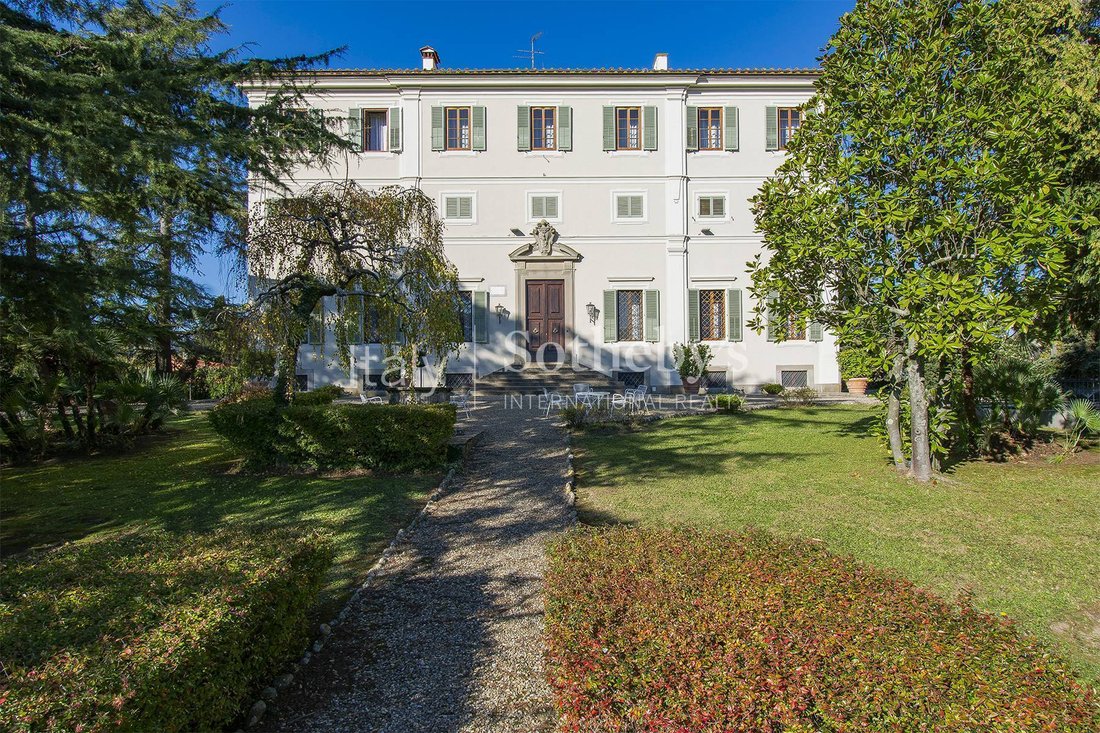
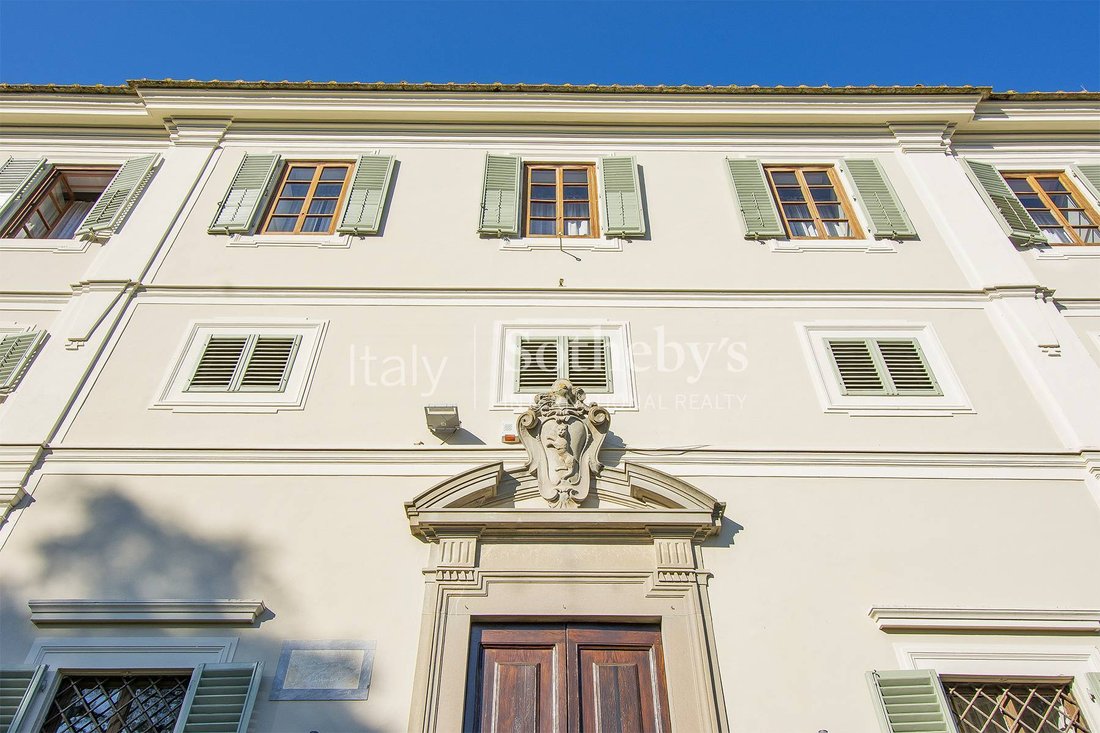
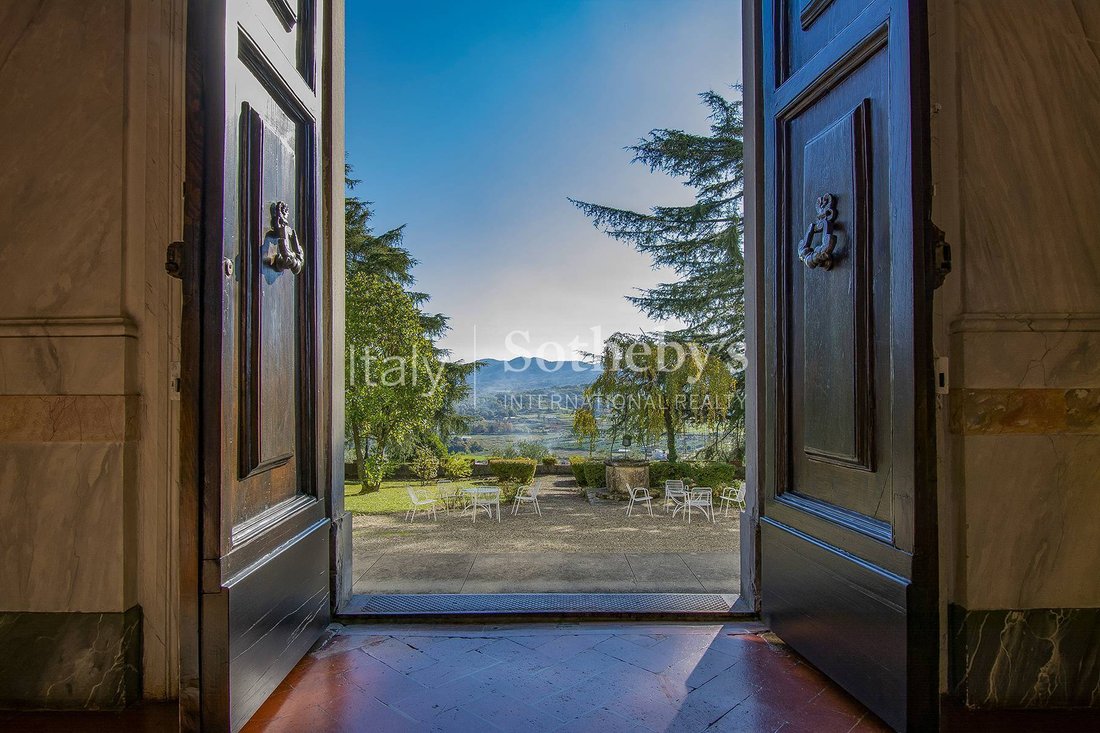
The light-colored façade, the pietra serena pediment, and the framed stringcourses convey a refined, harmonious, and almost austere taste. With its panoramic gardens, the villa overlooks a stunning landscape that offers views of the dome of Florence Cathedral and the entire plain stretching westward to the towers of Serravalle Pistoiese.
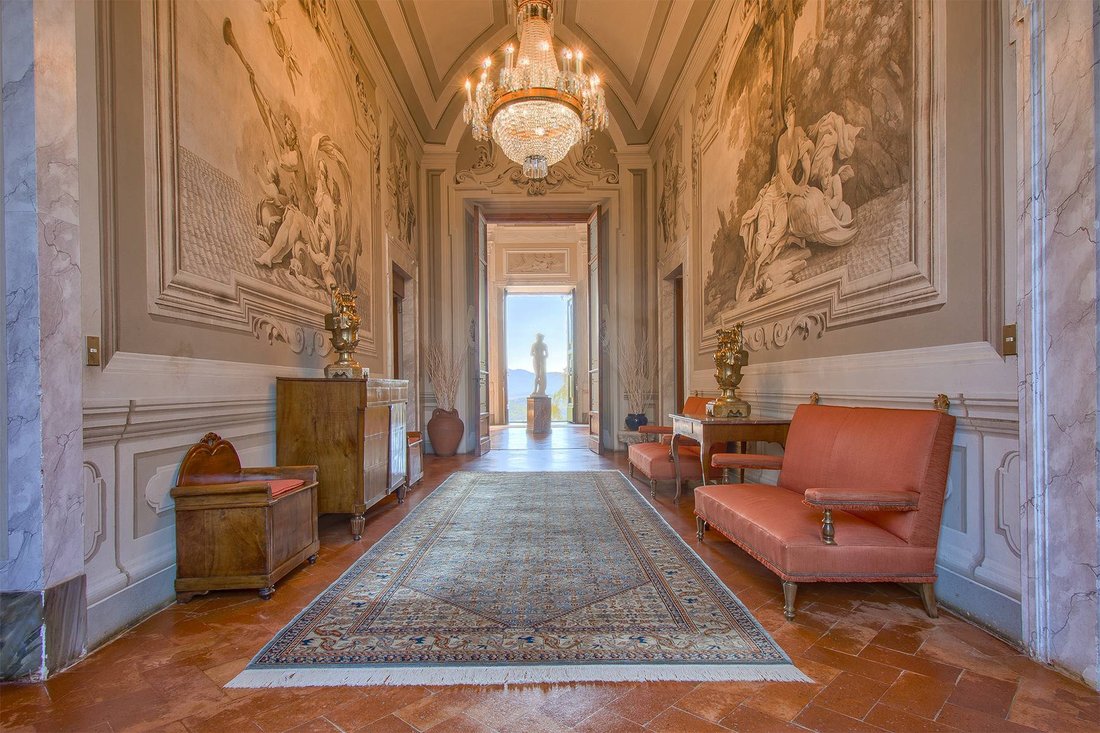
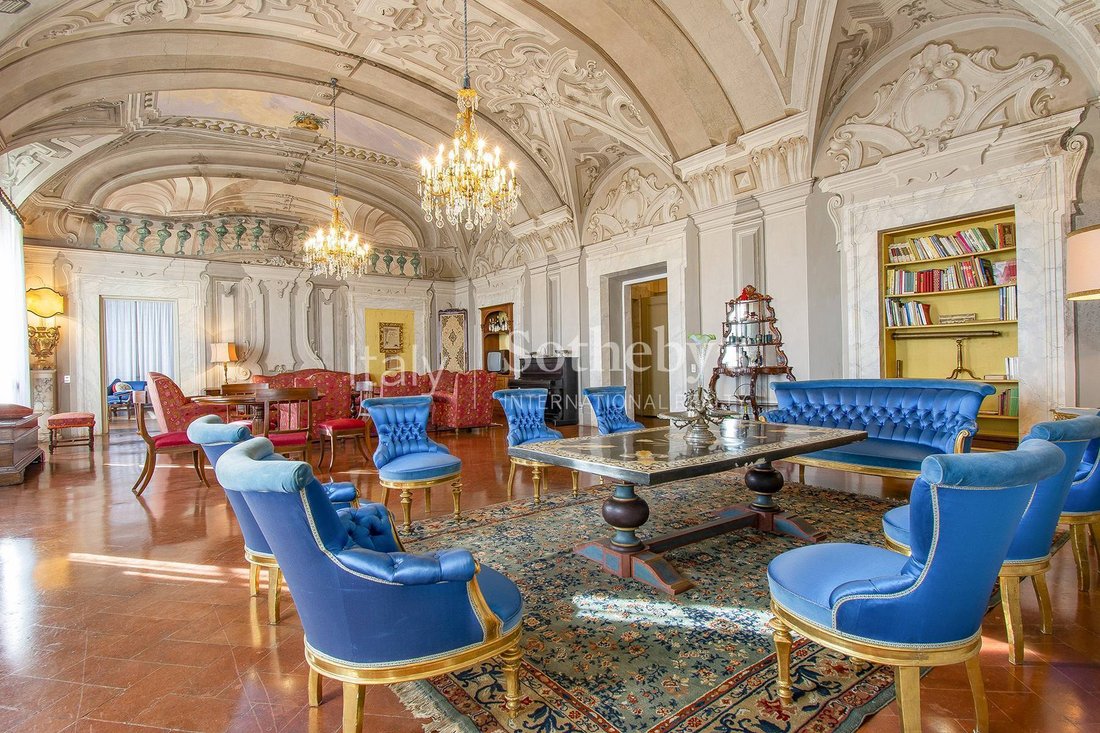
The villa has an internal surface area of approximately 1,500 square meters, comprising 25 rooms plus service areas and hallways. Inside, it is entirely frescoed with mythological scenes and landscapes, interspersed with architectural decorative elements, also in fresco, which enhance the structural features. The villa rises over three levels, two principal floors and one mezzanine plus a semi-basement level housing the kitchens and cellars. The four floors are connected by a grand staircase and an elevator. Adjacent to the villa, about 100 meters away, stands a large restored farmhouse that has always served as a support building to the main residence.
A small chapel commemorates the vows of Giuseppe Ippoliti, promoter of the villa’s construction, who was appointed Bishop of Cortona and later of Prato and Pistoia. The villa subsequently passed by inheritance to the Settimanni family and was later sold, in the last century, to the Bini family. In the mid-1960s, the current owning family carried out a complete restoration, respecting its architectural and decorative values, and furnished it with refined period antiques.
The light-colored façade, the pietra serena pediment, and the framed stringcourses convey a refined, harmonious, and almost austere taste. With its panoramic gardens, the villa overlooks a stunning landscape that offers views of the dome of Florence Cathedral and the entire plain stretching westward to the towers of Serravalle Pistoiese.
The villa has an internal surface area of approximately 1,500 square meters, comprising 25 rooms plus service areas and hallways. Inside, it is entirely frescoed with mythological scenes and landscapes, interspersed with architectural decorative elements, also in fresco, which enhance the structural features. The villa rises over three levels, two principal floors and one mezzanine plus a semi-basement level housing the kitchens and cellars. The four floors are connected by a grand staircase and an elevator. Adjacent to the villa, about 100 meters away, stands a large restored farmhouse that has always served as a support building to the main residence.
A small chapel commemorates the vows of Giuseppe Ippoliti, promoter of the villa’s construction, who was appointed Bishop of Cortona and later of Prato and Pistoia. The villa subsequently passed by inheritance to the Settimanni family and was later sold, in the last century, to the Bini family. In the mid-1960s, the current owning family carried out a complete restoration, respecting its architectural and decorative values, and furnished it with refined period antiques.
-
Art der Immobilie
Haus
-
Baujahr
1700
-
Preis/Quadratfuß
$408
Funktionen
Erkunden Sie die Gegend
Viale Macallè, Pistoia, PT 55100, Centro, Toskana
Auf Google Maps anzeigen
Preis pro sqft
Niedrig
Hoch
Eingebettet in die charmante Stadt Pistoia, bietet dieser Standort nahtlosen Zugang zu den Schätzen der Toskana. Genießen Sie einen raffinierten Lebensstil mit der Nähe zu exquisitem Speisen, historischen Sehenswürdigkeiten und üppiger Natur. Das Anwesen ist gut mit den Flughäfen Florenz und Pisa verbunden, ideal für internationale Reisen, und lädt zu entspannten Ausflügen zu renommierten Weinbergen und Landschaftsblicken ein. Pistoia verkörpert den ruhigen und dennoch lebendigen Geist der Toskana.
In der Nähe anzeigen
Sehenswürdigkeiten
Schulen
Flughafen Florenz
Flughafen
47 Min.
Flughafen Pisa
Flughafen
54 Min.
Zoo Pistoia
Natur & Erholung
10 Min.
Kathedrale von Pistoia
Kultur & Erbe
6 Min.
Internationale Schule Florenz
Internationale Schule
49 Min.
Gymnasium Amedeo Di Savoia
Öffentliche Schule
8 Min.

Vor 7 Jahren beigetreten
Sie haben sich nach diesem Objekt erkundigt
Der Agent wird sich in Kürze mit Ihnen in Verbindung setzen
Gelistet von
47
Angebote
2019
Beigetreten
Besichtigung mit Francesco Assennato buchen
Wählen Sie ein Datum und ob Sie eine virtuelle oder persönliche Besichtigung mit dem Makler wünschen.
Bevorzugtes Datum
Art der Tour

Italy Sotheby's International Realty
Via Vittorio Emanuele II, 14, 55100, Lucca, Lucca, Italy
Agenturprofil anzeigen
Lucca, a fortified town rising amidst vineyards and olive trees in the hills of Tuscany, is one of the main art cit
Lucca, a fortified town rising amidst vineyards and olive trees in the hills of Tuscany, is one of the main art cities in Italy. The most important European textile center since the Middle Ages, it keeps track of a rich history in the elegant and majestic villas with magnificent parks outside the walls, that once were the residences of the wealthy families active in the silk trade. What amazes most the visitors, however, are the Renaissance walls of the XV century surrounding the historic core of the city. The works promoted in the XIX century by Elisa Bonaparte Baciocchi, in honor of her brother Napoleon, led to the current structure of the central square Piazza Napoleone. The city also boasts many medieval churches of great architectural impact which make it gain the nickname of “the City of 100 Churches”. Lucca is one of the prides of Tuscany for its beauty and enchanting atmosphere and, thanks to this, many foreign visitors, after visiting the city and admiring its culture, choose it as a place to establish their second residence.
Zuletzt aktualisiert
Februar 26
Erstmalig gelistet
Dezember 15, 2021
Angebotslink
Angebotsreferenz
37G5B8
Ähnliche Immobilien in der Nähe
Neue Angebote in Centro



Entdecken Sie mehr Häuser zum Verkauf
Centro, Pistoia, Toskana Immobilienarten
Centro, Pistoia, Toskana beliebte Suchanfragen
- Panorama Immobilien in Centro, Pistoia, Toskana
- Immobilien mit Terrasse in Centro, Pistoia, Toskana
- Immobilien mit Spielzimmer in Centro, Pistoia, Toskana
- Immobilien mit Office in Centro, Pistoia, Toskana
- Immobilien mit Aufzug in Centro, Pistoia, Toskana
- Immobilien mit Bergblick in Centro, Pistoia, Toskana
- Immobilien mit Garten in Centro, Pistoia, Toskana
- Privatsphäre Immobilien in Centro, Pistoia, Toskana
- Immobilien auf Hügeln in Centro, Pistoia, Toskana
- Anlageimmobilie Immobilien in Centro, Pistoia, Toskana
- Moderne Immobilien in Centro, Pistoia, Toskana
- Immobilien mit Bibliothek in Centro, Pistoia, Toskana
- Immobilien mit Klimaanlage in Centro, Pistoia, Toskana
- Immobilien mit Weinkeller in Centro, Pistoia, Toskana
- Immobilien mit Kamin in Centro, Pistoia, Toskana
- Immobilien mit Pool in Centro, Pistoia, Toskana
- Immobilien mit Tennisplatz in Centro, Pistoia, Toskana
- Immobilien mit Weinberg in Centro, Pistoia, Toskana
- Luxusvilla Immobilien in Centro, Pistoia, Toskana
- Immobilien mit Offene Küche in Centro, Pistoia, Toskana
- Renoviert Immobilien in Centro, Pistoia, Toskana
Verwandte Leitfäden & Geschichten
Das Vertrauen der führenden Makler der Welt
Die Makler hinter den außergewöhnlichsten Immobilien der Welt inserieren bei JamesEdition.
- Angebote von Sotheby's, Christie's, BARNES und Engel & Völkers
- Jedes Angebot wird vor der Veröffentlichung geprüft
- Verbinden Sie sich direkt mit verifizierten Maklern
Indem Sie fortfahren, akzeptieren Sie unsere Nutzungsbedingungen und Datenschutzrichtlinie.