


$6,609,178
Repräsentative Villa In Carmignano
- 15 Schlafz.
- 15 Bäder
- 17,223 Sqft
- 37,674 Sqft lot
- Aktualisiert: März 27
- 3
Über die Immobilie
Beschreibung wurde automatisch übersetzt.
Die Beschreibung wird in der Originalsprache angezeigt.
Das fragliche Anwesen befindet sich auf dem Hügel „Castello“, auf dem einst das befestigte mittelalterliche Dorf Carmignano stand.
Teil des Komplexes, der um die historische Villa herum entstanden ist, ist das langgestreckte Herrenhaus, das immer noch Formen aus dem 16. Jahrhundert bewahrt hat. Es hat eine wunderschöne Fassade aus dem späten 16. Jahrhundert mit Pietra-Serena-Steinrahmen i
Teil des Komplexes, der um die historische Villa herum entstanden ist, ist das langgestreckte Herrenhaus, das immer noch Formen aus dem 16. Jahrhundert bewahrt hat. Es hat eine wunderschöne Fassade aus dem späten 16. Jahrhundert mit Pietra-Serena-Steinrahmen i
The property in question is located on the hill called ”Castello,” where the fortified medieval village of Carmignano once stood.
Part of the complex developed around the historic Villa is the elongated manor building that still retains sixteenth-century forms with a beautiful late sixteenth-century facade, featuring pietra serena stone frames on the main floor and typical ”kneeling” wind
Part of the complex developed around the historic Villa is the elongated manor building that still retains sixteenth-century forms with a beautiful late sixteenth-century facade, featuring pietra serena stone frames on the main floor and typical ”kneeling” wind
Das fragliche Anwesen befindet sich auf dem Hügel „Castello“, auf dem einst das befestigte mittelalterliche Dorf Carmignano stand.
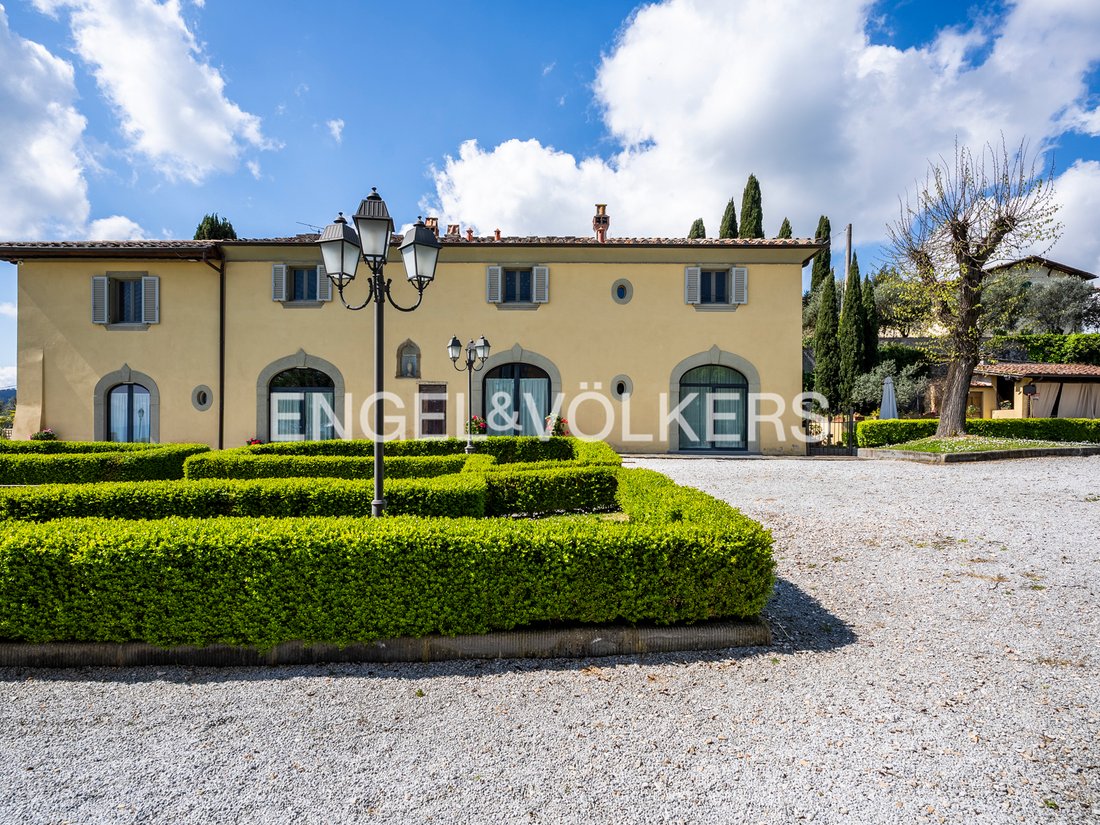
Teil des Komplexes, der um die historische Villa herum entstanden ist, ist das langgestreckte Herrenhaus, das immer noch Formen aus dem 16. Jahrhundert bewahrt hat. Es hat eine wunderschöne Fassade aus dem späten 16. Jahrhundert mit Pietra-Serena-Steinrahmen im Erdgeschoss und typischen „knienden“ Fenstern im Erdgeschoss.
In den frühen 1800er Jahren, mit der Gründung des Hofes, wurden dem Gebäude aus dem 16. Jahrhundert die Seitenflügel hinzugefügt, die als Keller für die Reifung und Lagerung von Wein genutzt wurden.
Bei den fraglichen Gebäuden, die für Wohnzwecke vorgesehen sind, handelt es sich um den Seitenteil der Villa, zu dem auch ein Nebengebäude aus dem 15. Jahrhundert gehört, das ursprünglich als Stall und später als Ölmühle genutzt wurde. Sie sind auf zwei oberirdischen Stockwerken angeordnet, die in vier Immobilienteile aufgeteilt sind, von denen die drei Hauptbereiche unterkellert sind.
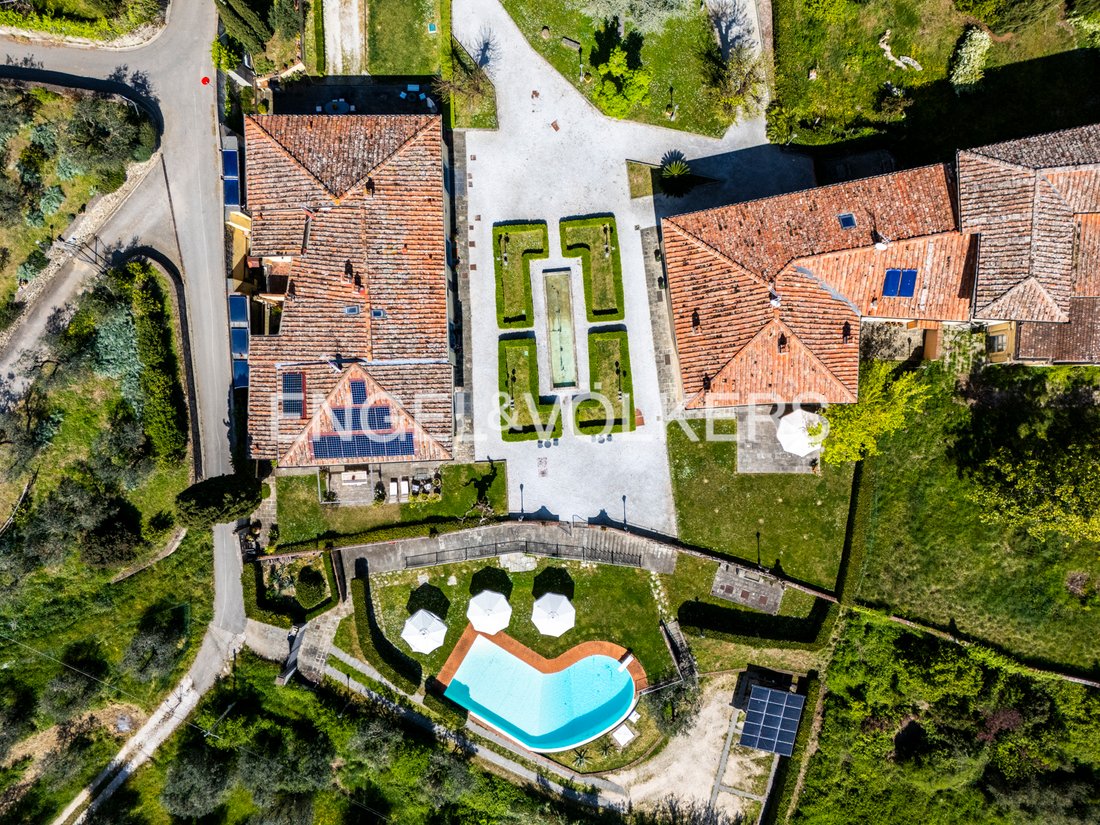
Der Komplex bietet einen außergewöhnlichen Blick auf die Stadtteile Florenz, Prato und Pistoia und befindet sich in einem eleganten 3.500 Quadratmeter großen Park auf drei Ebenen: Der Gemeinschaftsbereich am Eingang ist mit einem italienischen Garten mit einem zentralen Springbrunnen ausgestattet, aber jede Einheit hat ihren eigenen Garten; auf der zweiten Ebene befindet sich der Panoramapool, und auf der dritten Ebene ist der für das Parken reservierte Bereich versteckt und von den Häusern aus nicht sichtbar.
Die Restaurierung der Gebäude, die von den jetzigen Eigentümern durchgeführt wurde, dauerte über zwei Jahre, war radikal und rigoros und wird in jeder Phase dokumentiert. Bei der konservativen Restaurierung wurden typisch toskanische Materialien von höchster Qualität wie Terrakotta und Pietra Serena-Stein bevorzugt, mit Holzparkett in den Schlafzimmern, modernen Einrichtungsgegenständen...
Die vier Immobilienteile befinden sich in einem ausgezeichneten Zustand und sind sofort bewohnbar, wobei der aktuelle Grundriss beibehalten wird. Mit wenigen Eingriffen können sie jedoch zu einem einzigen Teil zusammengefasst werden.
Zwei von ihnen sind unabhängige Villen mit eigenem Garten und einer Innenfläche von etwa 450 Quadratmetern.
Die dritte ist jedoch eine Villa von ebenfalls 450 Quadratmetern, die jedoch intern in zwei Wohnungen aufgeteilt ist, die jeweils aus zwei Schlafzimmern bestehen, die durch eine interne Treppe miteinander verbunden sind.
Der vierte Teil, der kleinste, ist in zwei Wohnungen mit insgesamt etwa 250 Quadratmetern und einem dazugehörigen Innenhof aufgeteilt.
Insgesamt finden wir innerhalb des Immobilienkomplexes, aufgeteilt auf die verschiedenen Bereiche, 15 Schlafzimmer und 15 Badezimmer.
Diese wichtige Villa ist potenziell perfekt für diejenigen, die ein einzigartiges Anwesen im Herzen der toskanischen Hügel benötigen. Sie verfügt über große, gut aufgeteilte Räume, die sowohl für Gastgewerbe als auch für Wohnzwecke perfekt geeignet sind.
Die wahren Stärken dieser exklusiven Residenz sind zweifellos die sorgfältige und geschickte Renovierung, der Pool, die herrlichen Gärten und die atemberaubende Aussicht.
Eine prestigeträchtige Villa, die bereit ist, das Beste zu erleben, was dieses herrliche Gebiet zu bieten hat.
Der Hügel von Carmignano — eine Panoramahöhe, die zwischen der Ebene liegt, die Florenz mit Prato und Pistoia verbindet, und dem unteren Arno-Tal, mit Blick auf die Apenninen und die Apuanischen Alpen — hat in der Geschichte der Toskana immer eine bedeutende Rolle gespielt und war im Laufe der Jahrhunderte ein Knotenpunkt von Geschichte, Kunst und innovativer Landwirtschaft.
Ein weitläufiges Gebiet, eingebettet in das Grün der Montalbano-Hügel, ist sowohl aus Sicht des Weinbaus als auch von erheblicher historischer Bedeutung hoch geschätzt. Heute gilt es auch aus Sicht der Wohngebiete als sehr wertvoll für seine „Natürlichkeit“ und die Nähe zu den Städten Prato und Florenz, von denen es nur wenige Minuten entfernt ist.
Es war genau die logistische Lage dieses Gebietes, das die ersten etruskischen und dann römischen Siedlungen anzog — Spuren davon finden sich noch heute in der antiken Festung —, aber es war im Mittelalter, als Vorposten für die Kontrolle des Durchzugs von Armeen von und nach Norditalien, dass es zu heftigen Auseinandersetzungen zwischen der pistoischen und der florentinischen Grafschaft kam, die schließlich im 15. Jahrhundert endgültig unter die Herrschaft der letzteren fiel..
Die Familie Medici — und ihr Netzwerk von noblen Villenfarmen, die den Hof versorgten, aber auch angenehme Wohn-, Studien- und Landschaftspflegeplätze waren — gaben der Gegend mit dem Bau der faszinierenden Villa von Artimino (auch bekannt als „Villa der 100 Kamine“ und heute UNESCO-Weltkulturerbe) und der Schaffung der monumentalen „Bandita del Barco Reale“, einem über 4000 Hektar großen Jagdgebiet, umgeben von einem umlaufende Steinmauer von über 50 km. Der Zugang ist durch Türen und Tore geschützt, um das Wild zu bewachen und das Gebiet vom Meer zu trennen angrenzende bewirtschaftete Felder.
1716 erließ ein aufgeklärter Cosimo III. de’ Medici restriktive Regeln für die Weinherstellung innerhalb der Bandita — mit dem Ziel, die Qualität des Weins zu verbessern: Dies ist das weltweit erste und älteste Beispiel für eine DOC-Verordnung, sogar ein Jahrhundert vor der französischen „AOC — Appellation d’Origine Contrôl“ée.“
Heute ist das Gebiet von Carmignano ein begehrtes Gebiet für die Herstellung zertifizierter DOC- und DOCG-Weine. An den Hängen der Hügel befinden sich Weinberge mit Panoramablick.
Im Jahr 1792 erklärte der Großherzog Peter Leopold von Lothringen die „Sbandita“, indem er das Reservat stilllegte und das Land der Gegend anderen Nutzungen zuwies.
Die Festung von Carmignano, ursprünglich Teil der größeren Festung mit Blick auf das weitläufige Gebiet, ist seit 1990 im Besitz der Gemeinde, die die Räumlichkeiten Ausstellungsräumen und Veranstaltungsorten für kulturelle Veranstaltungen zur Verfügung gestellt hat.
Entfernungen
Autobahn A1 21 km - 28’
Flughafen Florenz 20 km — 28’
Krankenhaus 15 km — 23 Minuten
Zentrum von Prato 13 km - 25 Minuten
Zentrum von Florenz 27 km - 45’
Flughafen Pisa 66 km — 56 Minuten
Zentrum von Pisa 75 km - 60 Minuten
*Die vorliegenden Informationen und Grundrisse sind lediglich Richtwerte und stellen keine vertraglichen Elemente dar.
Teil des Komplexes, der um die historische Villa herum entstanden ist, ist das langgestreckte Herrenhaus, das immer noch Formen aus dem 16. Jahrhundert bewahrt hat. Es hat eine wunderschöne Fassade aus dem späten 16. Jahrhundert mit Pietra-Serena-Steinrahmen im Erdgeschoss und typischen „knienden“ Fenstern im Erdgeschoss.
In den frühen 1800er Jahren, mit der Gründung des Hofes, wurden dem Gebäude aus dem 16. Jahrhundert die Seitenflügel hinzugefügt, die als Keller für die Reifung und Lagerung von Wein genutzt wurden.
Bei den fraglichen Gebäuden, die für Wohnzwecke vorgesehen sind, handelt es sich um den Seitenteil der Villa, zu dem auch ein Nebengebäude aus dem 15. Jahrhundert gehört, das ursprünglich als Stall und später als Ölmühle genutzt wurde. Sie sind auf zwei oberirdischen Stockwerken angeordnet, die in vier Immobilienteile aufgeteilt sind, von denen die drei Hauptbereiche unterkellert sind.
Der Komplex bietet einen außergewöhnlichen Blick auf die Stadtteile Florenz, Prato und Pistoia und befindet sich in einem eleganten 3.500 Quadratmeter großen Park auf drei Ebenen: Der Gemeinschaftsbereich am Eingang ist mit einem italienischen Garten mit einem zentralen Springbrunnen ausgestattet, aber jede Einheit hat ihren eigenen Garten; auf der zweiten Ebene befindet sich der Panoramapool, und auf der dritten Ebene ist der für das Parken reservierte Bereich versteckt und von den Häusern aus nicht sichtbar.
Die Restaurierung der Gebäude, die von den jetzigen Eigentümern durchgeführt wurde, dauerte über zwei Jahre, war radikal und rigoros und wird in jeder Phase dokumentiert. Bei der konservativen Restaurierung wurden typisch toskanische Materialien von höchster Qualität wie Terrakotta und Pietra Serena-Stein bevorzugt, mit Holzparkett in den Schlafzimmern, modernen Einrichtungsgegenständen...
Die vier Immobilienteile befinden sich in einem ausgezeichneten Zustand und sind sofort bewohnbar, wobei der aktuelle Grundriss beibehalten wird. Mit wenigen Eingriffen können sie jedoch zu einem einzigen Teil zusammengefasst werden.
Zwei von ihnen sind unabhängige Villen mit eigenem Garten und einer Innenfläche von etwa 450 Quadratmetern.
Die dritte ist jedoch eine Villa von ebenfalls 450 Quadratmetern, die jedoch intern in zwei Wohnungen aufgeteilt ist, die jeweils aus zwei Schlafzimmern bestehen, die durch eine interne Treppe miteinander verbunden sind.
Der vierte Teil, der kleinste, ist in zwei Wohnungen mit insgesamt etwa 250 Quadratmetern und einem dazugehörigen Innenhof aufgeteilt.
Insgesamt finden wir innerhalb des Immobilienkomplexes, aufgeteilt auf die verschiedenen Bereiche, 15 Schlafzimmer und 15 Badezimmer.
Diese wichtige Villa ist potenziell perfekt für diejenigen, die ein einzigartiges Anwesen im Herzen der toskanischen Hügel benötigen. Sie verfügt über große, gut aufgeteilte Räume, die sowohl für Gastgewerbe als auch für Wohnzwecke perfekt geeignet sind.
Die wahren Stärken dieser exklusiven Residenz sind zweifellos die sorgfältige und geschickte Renovierung, der Pool, die herrlichen Gärten und die atemberaubende Aussicht.
Eine prestigeträchtige Villa, die bereit ist, das Beste zu erleben, was dieses herrliche Gebiet zu bieten hat.
Der Hügel von Carmignano — eine Panoramahöhe, die zwischen der Ebene liegt, die Florenz mit Prato und Pistoia verbindet, und dem unteren Arno-Tal, mit Blick auf die Apenninen und die Apuanischen Alpen — hat in der Geschichte der Toskana immer eine bedeutende Rolle gespielt und war im Laufe der Jahrhunderte ein Knotenpunkt von Geschichte, Kunst und innovativer Landwirtschaft.
Ein weitläufiges Gebiet, eingebettet in das Grün der Montalbano-Hügel, ist sowohl aus Sicht des Weinbaus als auch von erheblicher historischer Bedeutung hoch geschätzt. Heute gilt es auch aus Sicht der Wohngebiete als sehr wertvoll für seine „Natürlichkeit“ und die Nähe zu den Städten Prato und Florenz, von denen es nur wenige Minuten entfernt ist.
Es war genau die logistische Lage dieses Gebietes, das die ersten etruskischen und dann römischen Siedlungen anzog — Spuren davon finden sich noch heute in der antiken Festung —, aber es war im Mittelalter, als Vorposten für die Kontrolle des Durchzugs von Armeen von und nach Norditalien, dass es zu heftigen Auseinandersetzungen zwischen der pistoischen und der florentinischen Grafschaft kam, die schließlich im 15. Jahrhundert endgültig unter die Herrschaft der letzteren fiel..
Die Familie Medici — und ihr Netzwerk von noblen Villenfarmen, die den Hof versorgten, aber auch angenehme Wohn-, Studien- und Landschaftspflegeplätze waren — gaben der Gegend mit dem Bau der faszinierenden Villa von Artimino (auch bekannt als „Villa der 100 Kamine“ und heute UNESCO-Weltkulturerbe) und der Schaffung der monumentalen „Bandita del Barco Reale“, einem über 4000 Hektar großen Jagdgebiet, umgeben von einem umlaufende Steinmauer von über 50 km. Der Zugang ist durch Türen und Tore geschützt, um das Wild zu bewachen und das Gebiet vom Meer zu trennen angrenzende bewirtschaftete Felder.
1716 erließ ein aufgeklärter Cosimo III. de’ Medici restriktive Regeln für die Weinherstellung innerhalb der Bandita — mit dem Ziel, die Qualität des Weins zu verbessern: Dies ist das weltweit erste und älteste Beispiel für eine DOC-Verordnung, sogar ein Jahrhundert vor der französischen „AOC — Appellation d’Origine Contrôl“ée.“
Heute ist das Gebiet von Carmignano ein begehrtes Gebiet für die Herstellung zertifizierter DOC- und DOCG-Weine. An den Hängen der Hügel befinden sich Weinberge mit Panoramablick.
Im Jahr 1792 erklärte der Großherzog Peter Leopold von Lothringen die „Sbandita“, indem er das Reservat stilllegte und das Land der Gegend anderen Nutzungen zuwies.
Die Festung von Carmignano, ursprünglich Teil der größeren Festung mit Blick auf das weitläufige Gebiet, ist seit 1990 im Besitz der Gemeinde, die die Räumlichkeiten Ausstellungsräumen und Veranstaltungsorten für kulturelle Veranstaltungen zur Verfügung gestellt hat.
Entfernungen
Autobahn A1 21 km - 28’
Flughafen Florenz 20 km — 28’
Krankenhaus 15 km — 23 Minuten
Zentrum von Prato 13 km - 25 Minuten
Zentrum von Florenz 27 km - 45’
Flughafen Pisa 66 km — 56 Minuten
Zentrum von Pisa 75 km - 60 Minuten
*Die vorliegenden Informationen und Grundrisse sind lediglich Richtwerte und stellen keine vertraglichen Elemente dar.
The property in question is located on the hill called ”Castello,” where the fortified medieval village of Carmignano once stood.
Part of the complex developed around the historic Villa is the elongated manor building that still retains sixteenth-century forms with a beautiful late sixteenth-century facade, featuring pietra serena stone frames on the main floor and typical ”kneeling” windows on the ground floor.
In the early 1800s, with the establishment of the farm, the lateral wings were added to the sixteenth-century structure, which were used as cellars for aging and storing wine.
The properties in question, intended for residential use, are the lateral portion of the villa that also includes a fifteenth-century annex, initially used as stables and later as an oil mill. They are arranged on two above-ground floors divided into four real estate portions, of which the three main ones have a basement.
The complex enjoys an extraordinary view of the areas of Florence, Prato, and Pistoia, and is set in an elegant 3,500 square meter park over three levels: the common area at the entrance is set up with an Italian garden with a central fountain, but each unit has its own garden; at the second level, the garden hosts the panoramic swimming pool, and at the third level, the area reserved for car parking is hidden and not visible from the houses.
The restoration of the buildings, carried out by the current owners, lasted over two years, was radical and rigorous, and is documented at every stage. The conservative restoration favored typically Tuscan materials of the highest quality such as terracotta and pietra serena stone, with wooden parquet in the bedrooms, modern fixtures....
The four real estate portions are in excellent condition and immediately habitable while maintaining the current layout, but with few interventions, they can be combined into a single portion.
Two of them are independent villas with their own garden and an internal area of about 450 square meters.
The third, however, is a villa also of 450 square meters but internally divided into two apartments each consisting of two bedrooms, connected by an internal staircase.
The fourth portion, the smallest, is divided into two apartments with a total of about 250 square meters and a pertinent courtyard.
Overall, within the real estate complex, we find, divided among the various portions, 15 bedrooms and 15 bathrooms.
This important villa is potentially perfect for those who need a unique property in the heart of the Tuscan hills, with large, well-divided spaces perfectly usable for both hospitality and residential use.
The real strengths of this exclusive residence are undoubtedly the careful and skillful renovation, the pool, the splendid gardens, and the breathtaking view.
A prestigious villa ready to experience the best that this magnificent territory can offer.
The hill of Carmignano – a panoramic dominant height, located between the plain that connects Florence with Prato and Pistoia and the lower Arno valley, with views extending to the Apennines and the Apuan Alps - has always played a significant role in the history of Tuscany and has been a crossroads of History, Art, and innovative Agriculture over the centuries.
A vast area, immersed in the greenery of the Montalbano hills, is highly esteemed both from a viticulture perspective and of considerable historical importance, which today is also considered very valuable – from a residential point of view – for its “naturalness” and proximity to the cities of Prato and Florence, from which it is just a few tens of minutes away.
It was precisely the logistical position of this territory that attracted the first Etruscan and then Roman settlements – traces of which are still found in the ancient Fortress - but it was in the Middle Ages, as an outpost for controlling the passage of armies, to and from northern Italy, that it became an area of fierce disputes between the Pistoian and Florentine counties, eventually passing definitively under the dominion of the latter in the 15th century.
The Medici family – and its network of noble Villa-Farms that supplied the court, but were also pleasant places of residence and study and landscape care - gave a great impulse to the area with the construction of the fascinating Villa of Artimino (also known as the “Villa of the 100 Chimneys” and today a UNESCO heritage site) and the creation of the monumental “Bandita del Barco Reale,” a hunting estate of over 4000 hectares enclosed by a perimeter stone wall of over 50 km., with access protected by doors and gates to guard the game and separate the area from the adjacent cultivated fields.
In 1716, an enlightened Cosimo III de’ Medici established restrictive rules – aimed at improving its quality - for wine production within the bandita: this is the world’s first and oldest example of a DOC regulation, even a century before the French “AOC - Appellation d’Origine Contrôlée.”
Today, the territory of Carmignano is a prized area for the production of certified . DOC and DOCG wines, with panoramic vineyards covering the slopes of its hills.
It was in 1792 that the Grand Duke Peter Leopold of Lorraine declared the “sbandita,” decommissioning the reserve and allocating the land of the area to other uses.
The Fortress of Carmignano, originally part of the larger fortification overlooking the vast territory, has been owned by the Municipality since 1990, which has allocated the premises to exhibition spaces and venues for cultural events.
Distances
Highway A1 21 km - 28’
Florence Airport 20 km – 28‘
Hospital 15 km – 23‘
Prato center 13 km - 25’
Florence center 27 km - 45’
Pisa Airport 66 km – 56‘
Pisa center 75 km - 60’
*The present information and floor plans are merely indicative and do not constitute contractual elements.
Part of the complex developed around the historic Villa is the elongated manor building that still retains sixteenth-century forms with a beautiful late sixteenth-century facade, featuring pietra serena stone frames on the main floor and typical ”kneeling” windows on the ground floor.
In the early 1800s, with the establishment of the farm, the lateral wings were added to the sixteenth-century structure, which were used as cellars for aging and storing wine.
The properties in question, intended for residential use, are the lateral portion of the villa that also includes a fifteenth-century annex, initially used as stables and later as an oil mill. They are arranged on two above-ground floors divided into four real estate portions, of which the three main ones have a basement.
The complex enjoys an extraordinary view of the areas of Florence, Prato, and Pistoia, and is set in an elegant 3,500 square meter park over three levels: the common area at the entrance is set up with an Italian garden with a central fountain, but each unit has its own garden; at the second level, the garden hosts the panoramic swimming pool, and at the third level, the area reserved for car parking is hidden and not visible from the houses.
The restoration of the buildings, carried out by the current owners, lasted over two years, was radical and rigorous, and is documented at every stage. The conservative restoration favored typically Tuscan materials of the highest quality such as terracotta and pietra serena stone, with wooden parquet in the bedrooms, modern fixtures....
The four real estate portions are in excellent condition and immediately habitable while maintaining the current layout, but with few interventions, they can be combined into a single portion.
Two of them are independent villas with their own garden and an internal area of about 450 square meters.
The third, however, is a villa also of 450 square meters but internally divided into two apartments each consisting of two bedrooms, connected by an internal staircase.
The fourth portion, the smallest, is divided into two apartments with a total of about 250 square meters and a pertinent courtyard.
Overall, within the real estate complex, we find, divided among the various portions, 15 bedrooms and 15 bathrooms.
This important villa is potentially perfect for those who need a unique property in the heart of the Tuscan hills, with large, well-divided spaces perfectly usable for both hospitality and residential use.
The real strengths of this exclusive residence are undoubtedly the careful and skillful renovation, the pool, the splendid gardens, and the breathtaking view.
A prestigious villa ready to experience the best that this magnificent territory can offer.
The hill of Carmignano – a panoramic dominant height, located between the plain that connects Florence with Prato and Pistoia and the lower Arno valley, with views extending to the Apennines and the Apuan Alps - has always played a significant role in the history of Tuscany and has been a crossroads of History, Art, and innovative Agriculture over the centuries.
A vast area, immersed in the greenery of the Montalbano hills, is highly esteemed both from a viticulture perspective and of considerable historical importance, which today is also considered very valuable – from a residential point of view – for its “naturalness” and proximity to the cities of Prato and Florence, from which it is just a few tens of minutes away.
It was precisely the logistical position of this territory that attracted the first Etruscan and then Roman settlements – traces of which are still found in the ancient Fortress - but it was in the Middle Ages, as an outpost for controlling the passage of armies, to and from northern Italy, that it became an area of fierce disputes between the Pistoian and Florentine counties, eventually passing definitively under the dominion of the latter in the 15th century.
The Medici family – and its network of noble Villa-Farms that supplied the court, but were also pleasant places of residence and study and landscape care - gave a great impulse to the area with the construction of the fascinating Villa of Artimino (also known as the “Villa of the 100 Chimneys” and today a UNESCO heritage site) and the creation of the monumental “Bandita del Barco Reale,” a hunting estate of over 4000 hectares enclosed by a perimeter stone wall of over 50 km., with access protected by doors and gates to guard the game and separate the area from the adjacent cultivated fields.
In 1716, an enlightened Cosimo III de’ Medici established restrictive rules – aimed at improving its quality - for wine production within the bandita: this is the world’s first and oldest example of a DOC regulation, even a century before the French “AOC - Appellation d’Origine Contrôlée.”
Today, the territory of Carmignano is a prized area for the production of certified . DOC and DOCG wines, with panoramic vineyards covering the slopes of its hills.
It was in 1792 that the Grand Duke Peter Leopold of Lorraine declared the “sbandita,” decommissioning the reserve and allocating the land of the area to other uses.
The Fortress of Carmignano, originally part of the larger fortification overlooking the vast territory, has been owned by the Municipality since 1990, which has allocated the premises to exhibition spaces and venues for cultural events.
Distances
Highway A1 21 km - 28’
Florence Airport 20 km – 28‘
Hospital 15 km – 23‘
Prato center 13 km - 25’
Florence center 27 km - 45’
Pisa Airport 66 km – 56‘
Pisa center 75 km - 60’
*The present information and floor plans are merely indicative and do not constitute contractual elements.
-
Art der Immobilie
Villa
-
Etagen
2
-
Baujahr
1500
-
Preis/Quadratfuß
$383
-
Emissionen
D
-
Verbrauch
D
Funktionen
Erkunden Sie die Gegend
Via del Castello, 59015 Carmignano PO, Italy, Centro - La Rocca, Toskana
Auf Google Maps anzeigen
Preis pro sqft
Niedrig
Hoch
Dieses exquisite Anwesen im charmanten toskanischen Städtchen Carmignano verspricht ein idyllisches Leben. Umgeben von malerischen Hügeln, verspricht es Ruhe und landschaftliche Schönheit. Florenz ist nur 30 Minuten entfernt, wo Sie in renommierte Kunst, Kultur und exquisite gastronomische Erlebnisse eintauchen können. Die nahegelegene Chianti-Region verstärkt die Anziehungskraft mit ihren feinen Weinen und kulinarischen Traditionen.
In der Nähe anzeigen
Sehenswürdigkeiten
Schulen
Flughafen Florenz
Flughafen
28 Min.
Prato Centrale Bahnhof
Bahnhof
20 Min.
Historisches Zentrum von Florenz
Kultur & Erbe
40 Min.
Chianti Weinregion
Natur & Outdoor
30 Min.
Internationale Schule von Florenz
Internationale Schule
45 Min.
Liceo Classico Cicognini
Öffentliche Schule
18 Min.
Sie haben sich nach diesem Objekt erkundigt
Der Agent wird sich in Kürze mit Ihnen in Verbindung setzen
Gelistet von
51
Angebote
2025
Beigetreten
Besichtigung mit Engel & Völkers buchen
Wählen Sie ein Datum und ob Sie eine virtuelle oder persönliche Besichtigung mit dem Makler wünschen.
Bevorzugtes Datum
Art der Tour

Engel & Völkers Firenze
Lungarno Guicciardini 25R, 50125, Firenze, Firenze, Italy
Agenturprofil anzeigen
Zuletzt aktualisiert
März 27
Erstmalig gelistet
Mai 21, 2025
Angebotsreferenz
W-02Z325
Ähnliche Immobilien in der Nähe
Neue Angebote in Centro - La Rocca


Entdecken Sie mehr Häuser zum Verkauf
Centro - La Rocca, Carmignano, Toskana Immobilienarten
- Villen zum Verkauf in Centro - La Rocca, Carmignano, Toskana
- Landhaus zum Verkauf in Centro - La Rocca, Carmignano, Toskana
- Wohnungen zum Verkauf in Centro - La Rocca, Carmignano, Toskana
- Farm Ranches zum Verkauf in Centro - La Rocca, Carmignano, Toskana
- Häuser zum Verkauf in Centro - La Rocca, Carmignano, Toskana
Centro - La Rocca, Carmignano, Toskana beliebte Suchanfragen
- Panorama Immobilien in Centro - La Rocca, Carmignano, Toskana
- Immobilien mit Terrasse in Centro - La Rocca, Carmignano, Toskana
- Immobilien mit Bar in Centro - La Rocca, Carmignano, Toskana
- Immobilien mit Spielzimmer in Centro - La Rocca, Carmignano, Toskana
- Immobilien mit Office in Centro - La Rocca, Carmignano, Toskana
- Immobilien mit Aufzug in Centro - La Rocca, Carmignano, Toskana
- Immobilien mit Bergblick in Centro - La Rocca, Carmignano, Toskana
- Immobilien mit Garten in Centro - La Rocca, Carmignano, Toskana
- Gesicherte Wohnanlage Immobilien in Centro - La Rocca, Carmignano, Toskana
- Privatsphäre Immobilien in Centro - La Rocca, Carmignano, Toskana
- Immobilien auf Hügeln in Centro - La Rocca, Carmignano, Toskana
- Anlageimmobilie Immobilien in Centro - La Rocca, Carmignano, Toskana
- Immobilien mit Fitnessstudio in Centro - La Rocca, Carmignano, Toskana
- Immobilien mit Bibliothek in Centro - La Rocca, Carmignano, Toskana
- Immobilien mit Klimaanlage in Centro - La Rocca, Carmignano, Toskana
- Immobilien mit Weinkeller in Centro - La Rocca, Carmignano, Toskana
- Immobilien mit Whirlpool in Centro - La Rocca, Carmignano, Toskana
- Immobilien mit Kamin in Centro - La Rocca, Carmignano, Toskana
- Immobilien mit Pool in Centro - La Rocca, Carmignano, Toskana
- Immobilien mit Garage in Centro - La Rocca, Carmignano, Toskana
- Immobilien mit Balkon in Centro - La Rocca, Carmignano, Toskana
- Luxusvilla Immobilien in Centro - La Rocca, Carmignano, Toskana
- Immobilien mit Offene Küche in Centro - La Rocca, Carmignano, Toskana
- Renoviert Immobilien in Centro - La Rocca, Carmignano, Toskana
- Immobilien mit Wasserblick in Centro - La Rocca, Carmignano, Toskana
Verwandte Leitfäden & Geschichten
Das Vertrauen der führenden Makler der Welt
Die Makler hinter den außergewöhnlichsten Immobilien der Welt inserieren bei JamesEdition.
- Angebote von Sotheby's, Christie's, BARNES und Engel & Völkers
- Jedes Angebot wird vor der Veröffentlichung geprüft
- Verbinden Sie sich direkt mit verifizierten Maklern
Indem Sie fortfahren, akzeptieren Sie unsere Nutzungsbedingungen und Datenschutzrichtlinie.