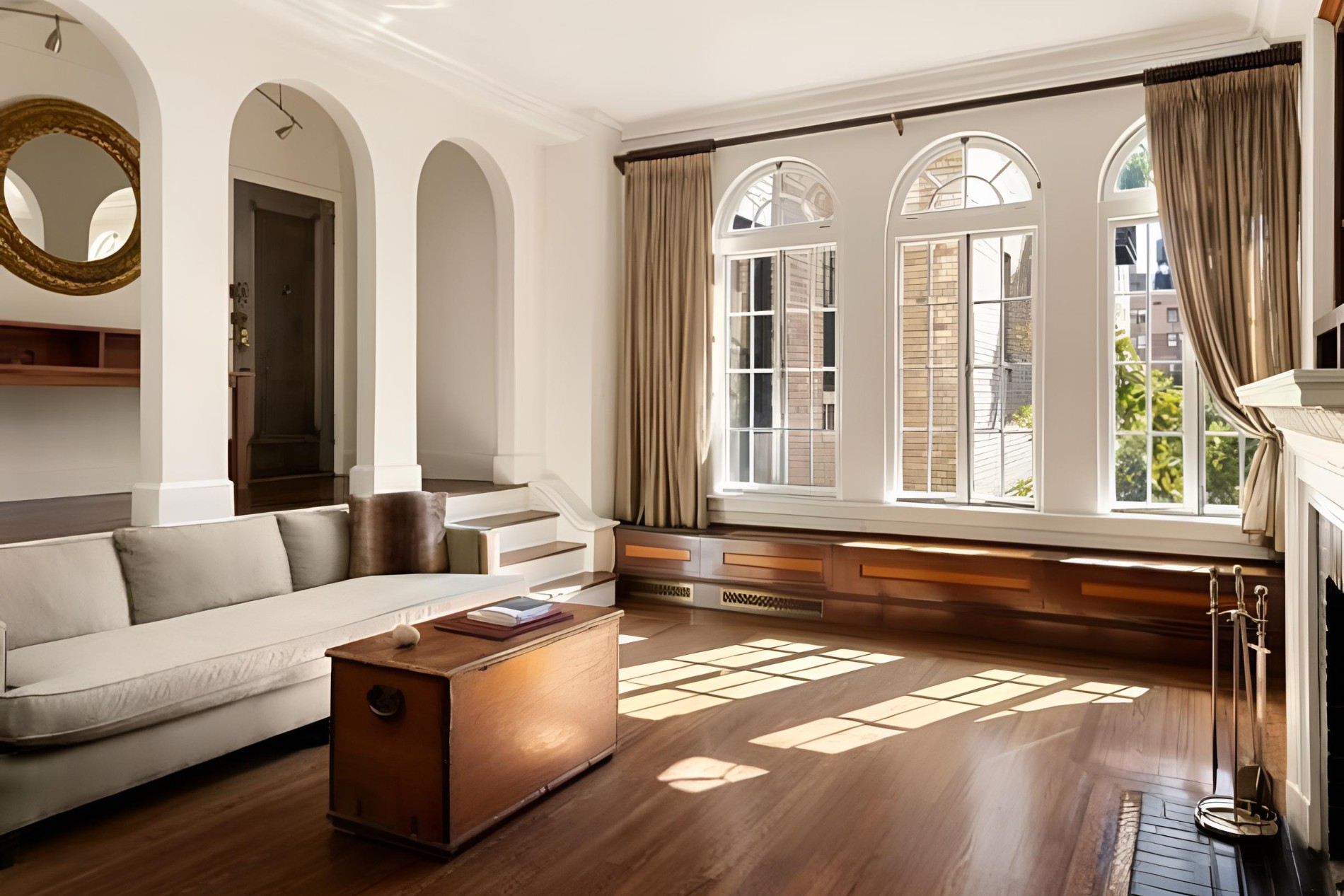
For more than three decades, Chris Noth held an address that mirrored, in its own quieter way, the Manhattan lifestyle his most famous character came to represent. While Mr. Big occupied penthouses and town cars on screen, Noth’s real-life New York base was a prewar co-op in one of Greenwich Village’s most admired full-service buildings. Purchased in 1994, four years before he debuted as Mr. Big in HBO’s ‘Sex and the City,’ the apartment is now on the market for $1,495,000.
The listing is handled by Daniel Davis of Corcoran SoHo.

Before Mr. Big: A Greenwich Village Address Since 1994
Noth’s purchase of the Greenwich Village apartment coincided with the beginning of a cultural moment that would reshape how the world thought about New York City real estate, romance, and status. When ‘Sex and the City’ debuted on HBO in 1998, Noth’s Mr. Big became the show’s most polarizing figure: elusive, moneyed, emotionally unavailable, and inextricably linked to the idea of Manhattan as a place where love and luxury exist in constant, complicated tension.
The role followed Noth across two feature films and the more recent ‘And Just Like That’ series, spanning nearly three decades of on-screen association with New York’s most aspirational zip codes. Throughout that entire period, his actual New York home remained this one-bedroom co-op in a 1925 building between Union Square and Washington Square, a far cry from Mr. Big’s fictional addresses but squarely within one of Downtown Manhattan’s most desirable residential corridors.
Prewar Grandeur at Village Scale
The apartment delivers the kind of architectural character that newer Manhattan construction rarely attempts. The listing describes it as offering “breathtaking prewar grandeur,” and the details support the claim.
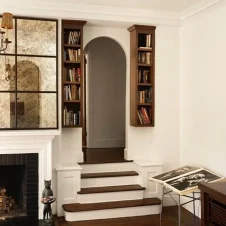
An oversized entry gallery greets arrivals with enough room to function as a home office or library, overlooking an elegant sunken living room below. The step-down creates a sense of spatial drama uncommon in a one-bedroom layout, amplified by soaring ceilings, handsome hardwood floors, and a row of leaded glass arched windows that frame open-sky views.
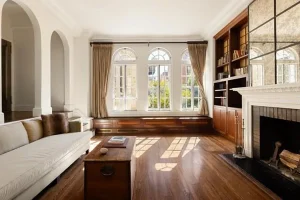
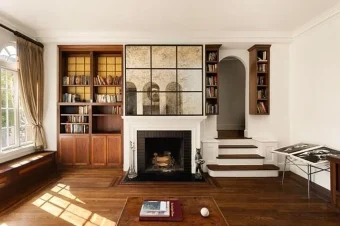
A wood-burning fireplace anchors the living room, flanked by regal archways and beautiful built-ins that speak to the building’s 1925 craftsmanship. The composition feels both intimate and ceremonial, a space designed for an era when even modestly scaled apartments were expected to carry architectural weight.
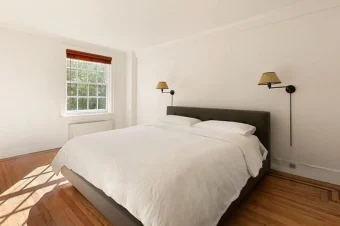
The kitchen embraces classic New York City prewar style with dark wood cabinetry, ample storage, and modern appliances. A dining alcove, powder room, and laundry room connect the social spaces to a spacious bedroom with full bathroom, completing a layout that prioritizes proportion and character over square footage.
45 East 9th Street: The Building
The building itself contributes meaningfully to the listing’s appeal. Constructed in 1925 and converted to cooperative ownership in 1958, 45 East 9th Street operates as a full-service prewar building with a full-time doorman, live-in superintendent, laundry facilities, storage (currently waitlisted), and a rooftop deck with panoramic views across the Village skyline.
The co-op permits pets, pieds-à-terre, and 65% financing with board approval, offering a degree of flexibility that not all prewar Village buildings allow. For a buyer seeking a pied-à-terre in one of Manhattan’s most walkable neighborhoods, or a primary residence with genuine Downtown character, the building’s policies and services align well with a range of ownership profiles.
Between Union Square and Washington Square: Location as Amenity
The apartment’s position between two of Downtown Manhattan’s defining public squares places it within one of the city’s most concentrated corridors of dining, shopping, culture, and transit access. The Union Square greenmarket, NYU’s campus, Washington Square Park, Irving Plaza, Webster Hall, Whole Foods, and Trader Joe’s are all within immediate walking distance.
Transit options are equally dense: N/Q/R/W, 4/5/6, L, and PATH trains, along with bus service and CitiBike stations, ensure connectivity to virtually every corner of the city without requiring a car, a quality that Mr. Big, with his chauffeured town car, might not have appreciated but that any real New Yorker would.
Pricing a Piece of Television History
At $1,495,000, the apartment sits within the upper range for one-bedroom co-ops in the Village, a premium justified by the building’s full-service offering, the unit’s prewar details, and the fireplace, a feature that remains genuinely rare in Manhattan apartments at any price point.
The television provenance adds an intangible layer. Noth did not film ‘Sex and the City’ in this apartment, and Mr. Big’s fictional residences bore no resemblance to this Village co-op. But there is something fitting about the fact that the actor who embodied Manhattan’s most famous fictional bachelor lived, in real life, in a prewar Village building with a wood-burning fireplace and leaded glass windows. The apartment is not Mr. Big’s home. It is, however, the home of the man who made Mr. Big believable.
Explore luxury homes in New York