

Price On Request
The Castle Of Torre Alfina: Medieval Masterpiece
- 52,636 Sqft
- 10,764 Sqft lot
- 89
About the Property
Some properties are simply large. Others carry within their walls the layered memory of centuries — of families, fiefdoms, and the slow accumulation of power and beauty. This castle belongs unmistakably to the second category. Rising within the ancient fiefdom of the Monaldeschi della Cervara, its defensive towers announce a presence that has commanded this corner of Tuscia since the Early Middle
Some properties are simply large. Others carry within their walls the layered memory of centuries — of families, fiefdoms, and the slow accumulation of power and beauty. This castle belongs unmistakably to the second category. Rising within the ancient fiefdom of the Monaldeschi della Cervara, its defensive towers announce a presence that has commanded this corner of Tuscia since the Early Middle Ages, when the fortress grew outward from an original Lombard watchtower into the seat of Orvieto’s most powerful families.
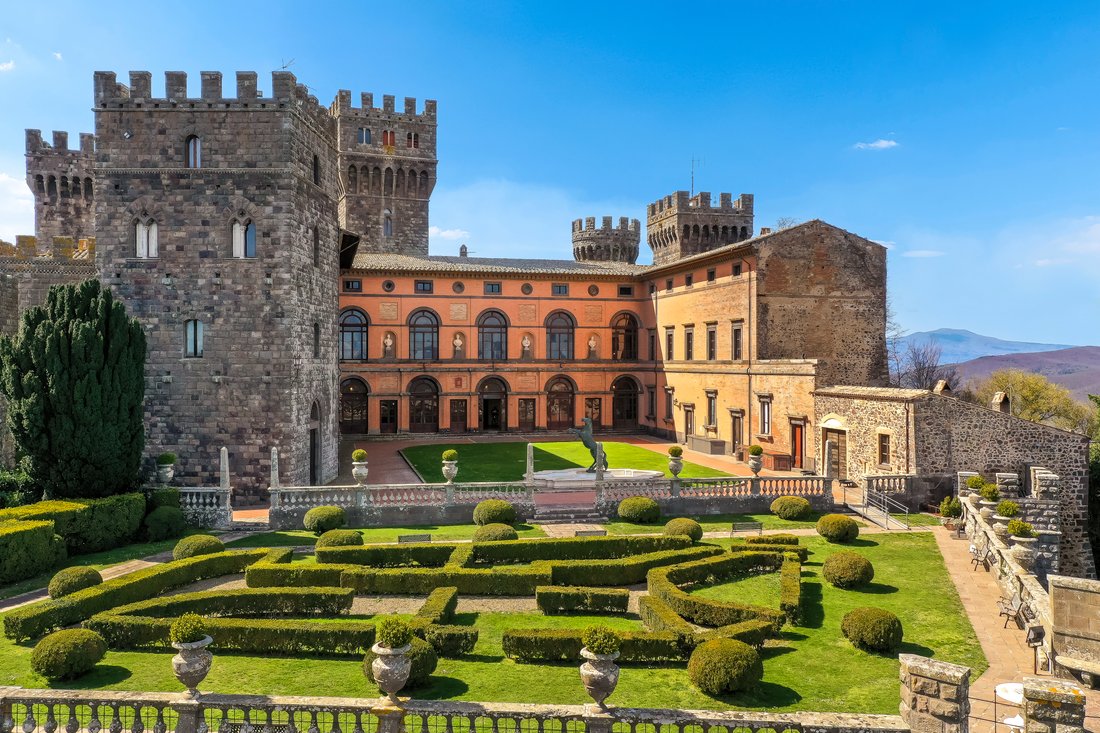
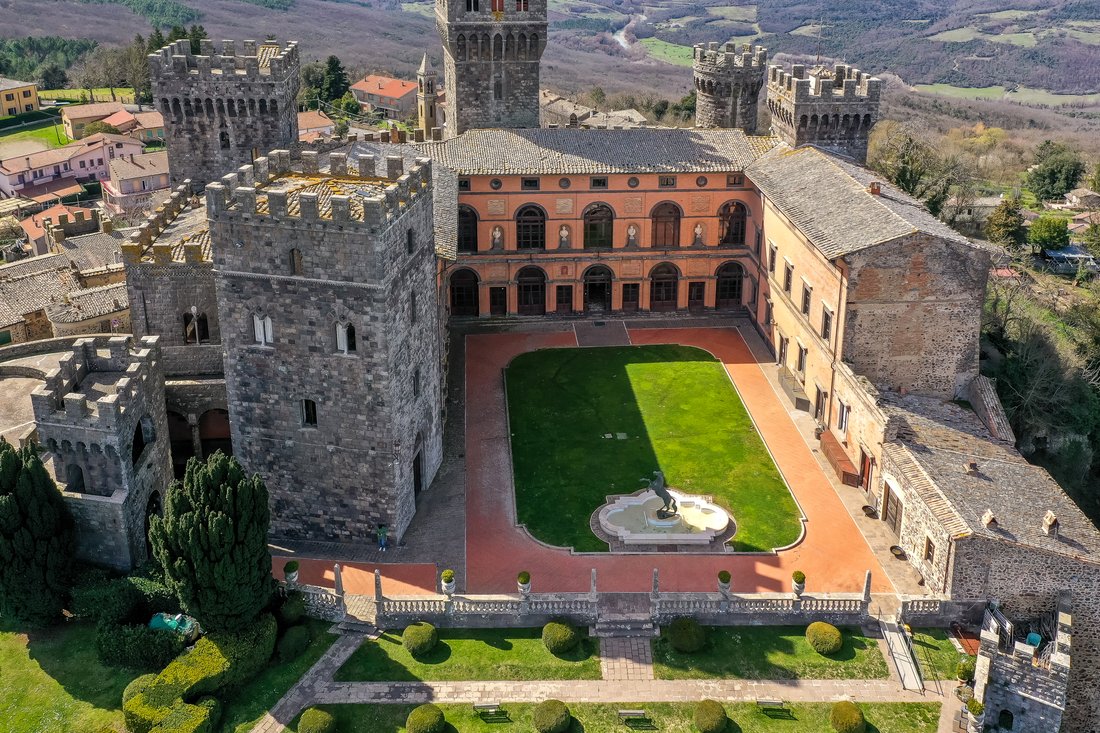
The castle unfolds across approximately 4,900 sqm of interiors, distributed among 35 principal rooms, and is framed by roughly 1,000 sqm of Italian-style gardens — their pathways laid out in geometries so harmonious they seem to choreograph the very act of walking. Under the Sforza Monaldeschi during the Renaissance, the castle underwent its most radical transformation, yet its essential elegance survived intact: in the sweep of its long corridors, in halls still carrying their original frescoes, in furnishings that speak of generations of refined stewardship. In 1880, Count Edoardo Cahen d’Anvers acquired the property and entrusted its conservative restoration to architect Giuseppe Partini alongside garden designers Henri and Achille Duchêne — a decision that preserved, rather than reinvented, the castle’s deep connection to the land it governs.
On the ground floor, an expansive fresco gallery unfolds in historical and allegorical themes — coats of arms, noble emblems, and Renaissance ornamentation celebrating the great houses that once called this castle home. Beyond it, room after room reveals coffered ceilings in inlaid wood, sculpted statuary, and marble floors shifting in color underfoot, each space composed with a painter’s sense of proportion and perspective.
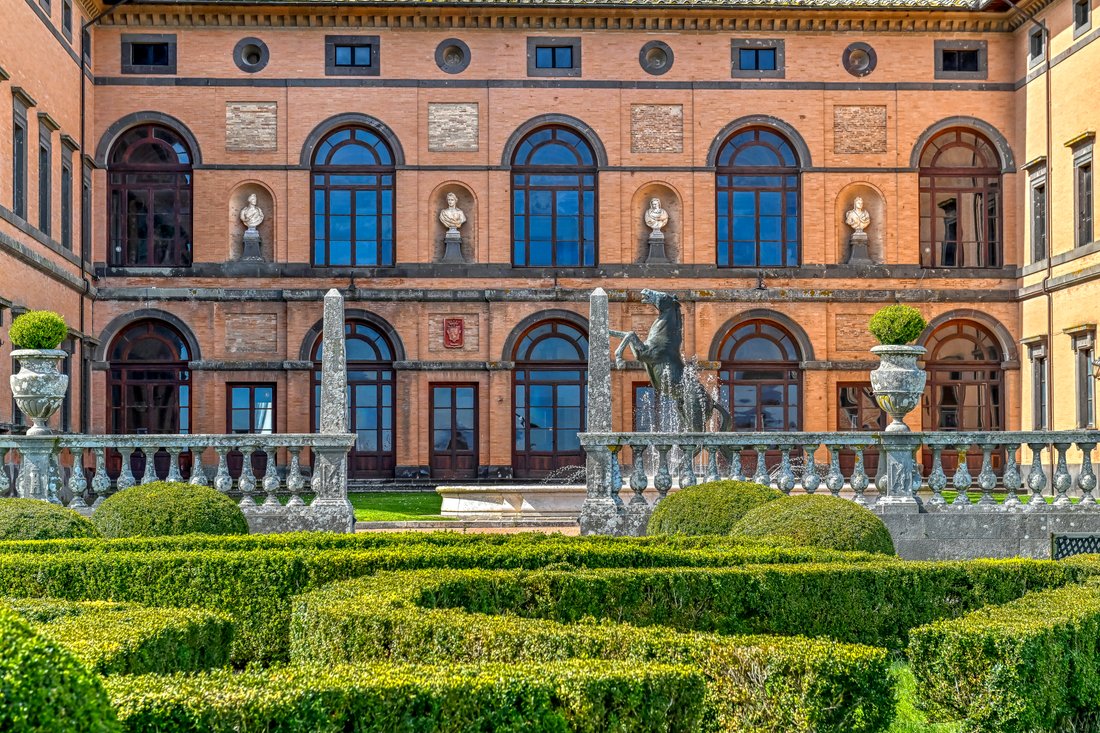
Climbing to the piano nobile, the atmosphere shifts entirely: light floods through tall, round-arched windows that frame uninterrupted views over the village below and the green countryside of Lazio beyond. This floor holds the castle’s most ceremonial spaces — frescoed corridors, ten bedrooms, a formal dining room, a sequence of grand reception halls, and a wood-floored library suited equally to quiet study or intimate conversation. Above, the second floor gives way to a continuous run of characterful attic rooms, largely given over to further sleeping quarters, with additional space for storage and utility. From the towers themselves, the view opens fully onto the surrounding territory — the kind of layered, sun-washed panorama that defines Tuscia at its most distinctive.
The garden remains the estate’s most jealously guarded treasure: a fountain animating the central axis, labyrinthine hedges, urns and planters in rich color, tall wrought gates, and a sequence of enfilade rooms that carry the formality of the garden indoors. Game rooms, fireside reading rooms, and an open courtyard complete a property that reads less like a residence and more like a work of art meant to be inhabited, room by room, season by season.
The castle stands at the heart of Torre Alfina, a small medieval hamlet perched on the border between Lazio and Umbria, within the wider territory of Tuscia — a region shaped by Etruscan history, volcanic lakes, and beech forests that turn gold each autumn. The village itself remains remarkably intact, its stone streets leading directly to the castle gates, while the surrounding countryside offers some of central Italy’s most unspoiled scenery. Orvieto, with its cathedral and Umbrian hill-town character, lies a short drive away, and the wider network of Rome’s international airports keeps the estate within comfortable reach of global travel — a rare combination of deep seclusion and genuine accessibility that has long made Tuscia a discreet favorite among those seeking Italy away from its more crowded stages.
The castle unfolds across approximately 4,900 sqm of interiors, distributed among 35 principal rooms, and is framed by roughly 1,000 sqm of Italian-style gardens — their pathways laid out in geometries so harmonious they seem to choreograph the very act of walking. Under the Sforza Monaldeschi during the Renaissance, the castle underwent its most radical transformation, yet its essential elegance survived intact: in the sweep of its long corridors, in halls still carrying their original frescoes, in furnishings that speak of generations of refined stewardship. In 1880, Count Edoardo Cahen d’Anvers acquired the property and entrusted its conservative restoration to architect Giuseppe Partini alongside garden designers Henri and Achille Duchêne — a decision that preserved, rather than reinvented, the castle’s deep connection to the land it governs.
On the ground floor, an expansive fresco gallery unfolds in historical and allegorical themes — coats of arms, noble emblems, and Renaissance ornamentation celebrating the great houses that once called this castle home. Beyond it, room after room reveals coffered ceilings in inlaid wood, sculpted statuary, and marble floors shifting in color underfoot, each space composed with a painter’s sense of proportion and perspective.
Climbing to the piano nobile, the atmosphere shifts entirely: light floods through tall, round-arched windows that frame uninterrupted views over the village below and the green countryside of Lazio beyond. This floor holds the castle’s most ceremonial spaces — frescoed corridors, ten bedrooms, a formal dining room, a sequence of grand reception halls, and a wood-floored library suited equally to quiet study or intimate conversation. Above, the second floor gives way to a continuous run of characterful attic rooms, largely given over to further sleeping quarters, with additional space for storage and utility. From the towers themselves, the view opens fully onto the surrounding territory — the kind of layered, sun-washed panorama that defines Tuscia at its most distinctive.
The garden remains the estate’s most jealously guarded treasure: a fountain animating the central axis, labyrinthine hedges, urns and planters in rich color, tall wrought gates, and a sequence of enfilade rooms that carry the formality of the garden indoors. Game rooms, fireside reading rooms, and an open courtyard complete a property that reads less like a residence and more like a work of art meant to be inhabited, room by room, season by season.
The castle stands at the heart of Torre Alfina, a small medieval hamlet perched on the border between Lazio and Umbria, within the wider territory of Tuscia — a region shaped by Etruscan history, volcanic lakes, and beech forests that turn gold each autumn. The village itself remains remarkably intact, its stone streets leading directly to the castle gates, while the surrounding countryside offers some of central Italy’s most unspoiled scenery. Orvieto, with its cathedral and Umbrian hill-town character, lies a short drive away, and the wider network of Rome’s international airports keeps the estate within comfortable reach of global travel — a rare combination of deep seclusion and genuine accessibility that has long made Tuscia a discreet favorite among those seeking Italy away from its more crowded stages.
-
Property type
Castle
-
Floors
5
Features
Features
Lot
Indoor
Outdoor
Explore the Area
Via Monaldeschi della Cervara, 1, 01021 Torre Alfina VT, Acquapendente, Lazio, Italy
View on Google Maps
Price per sqft
Low
High
Located in serene Torre Alfina, this property offers peaceful countryside living with easy access to local historic sites and natural parks. The nearby Orvieto Train Station connects you to regional destinations, while Rome Fiumicino Airport is reachable within 1.5 hours by car. Fine dining and cultural experiences in Orvieto are just a short drive away.
Get nearby
Attractions
Schools
Rome Fiumicino Airport
Airport
90 min
Orvieto Train Station
Train Station
15 min
Castello di Torre Alfina
Culture & Heritage
3 min
Parco Naturale Regionale della Valle del Treja
Outdoor & Nature
15 min
Ristorante La Cantina della Torre
Dining & Wine
5 min
International School of Orvieto
International School
20 min
Istituto Comprensivo Orvieto
Public School
15 min
Joined 1 year ago
You have inquired about this property
The agent will contact you soon by
Listed by
10
Listings
2025
Joined
Book home tour with the agent
Choose a date and whether you'd like a virtual or in-person tour with the agent.
Preferred date
Tour type

Engel & Völkers Viterbo is part of a renowned international network specializing in luxury real estate and dis
Engel & Völkers Viterbo is part of a renowned international network specializing in luxury real estate and distinguished by its commitment to competence, exclusivity, and passion. With a refined understanding of the Viterbo and Tuscia markets, our team offers tailored guidance for buyers and sellers seeking exceptional homes, historic properties, and high‑quality investments. Combining global reach with deep local expertise, we provide discreet service, strategic marketing, and professional support throughout every stage of the transaction, ensuring a seamless experience for clients looking for a property that reflects their lifestyle and aspirations
First listed
July 30
Listing reference
W-0486QE
Similar Properties Nearby
New Listings in Acquapendente


Explore More Homes for Sale
Acquapendente property types
Acquapendente popular searches
- Properties with Game Room in Acquapendente
- Properties with Elevator in Acquapendente
- City View properties in Acquapendente
- High Altitude properties in Acquapendente
- Hilltop properties in Acquapendente
- Investment Property properties in Acquapendente
- Properties with Sauna in Acquapendente
- Properties with Library in Acquapendente
- Properties with Air Conditioning in Acquapendente
- Properties with Jacuzzi in Acquapendente
- Properties with Tennis Court in Acquapendente
- Renovated properties in Acquapendente
Related Guides & Stories
Trusted by the World's Leading Brokers
The agents behind the world's most exceptional properties list with JamesEdition.
- Listings from Sotheby's, Christie's, BARNES, and Engel & Völkers
- Every listing reviewed before it goes live
- Connect directly with verified listing agents
By continuing you agree to our Terms and Privacy Policy.