$11,207,231
Domaine Viticole De 102 Ha Avec Villa Historique À Vendre Dans Le Chianti Classico, En Toscane
- 33 Chambres
- 32 SdB
- 46,823 Sqft
- 124.53 Ac lot
- Mis à jour: Août 7
- 12
À propos de la propriété
La description a été traduite automatiquement.
La description est affichée dans la langue d'origine.
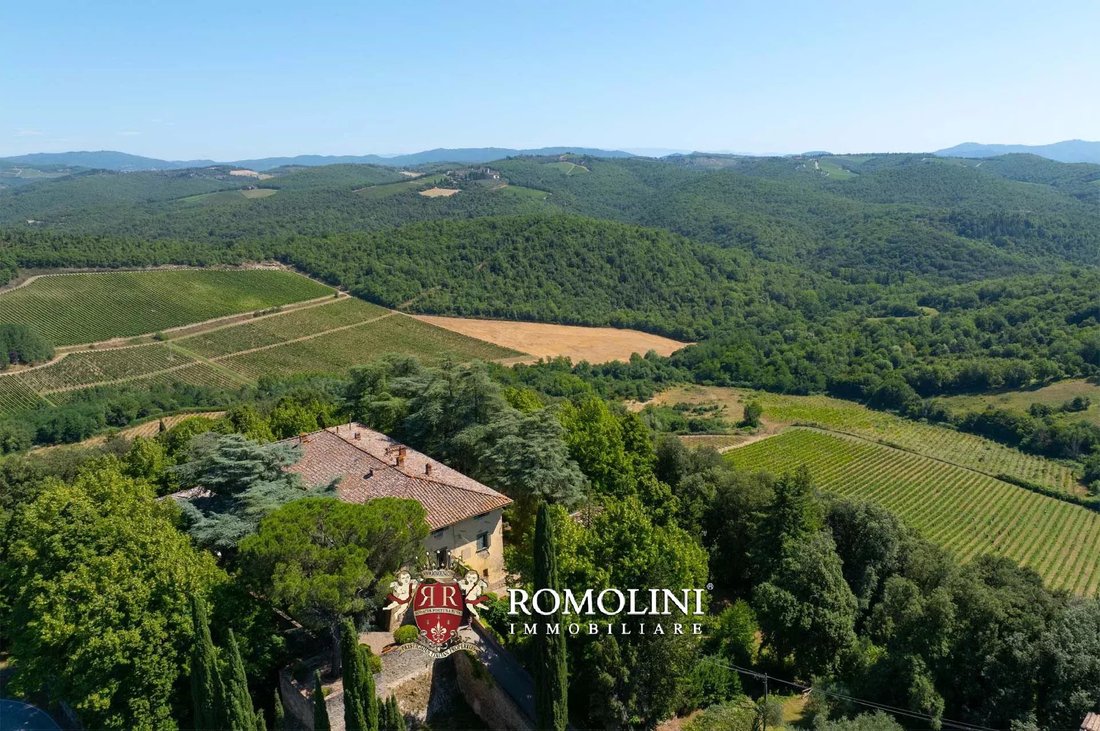
Sur les collines du Chianti, non loin de Castelnuovo Berardenga et de Radda, domaine viticole de 102,1 hectares avec manoir et hameau à restaurer à vendre. La propriété, qui possède une histoire incroyable allant du Moyen Âge à nos jours, offre un fort potentiel de développement touristique réceptif allant de pair avec la production de vin : en effet, la ferme exploite 28,5 hectares de vignob
On the hills of Chianti, not far from Castelnuovo Berardenga and Radda, 102.1-ha wine estate with manor villa and hamlet to be restored for sale. The property, which boasts an incredible history ranging from the Middle Ages to the present day, offers great potential for receptive tourist development to go hand in hand with wine production: in fact, the farm exploits 28.5 ha of vineyards to produce
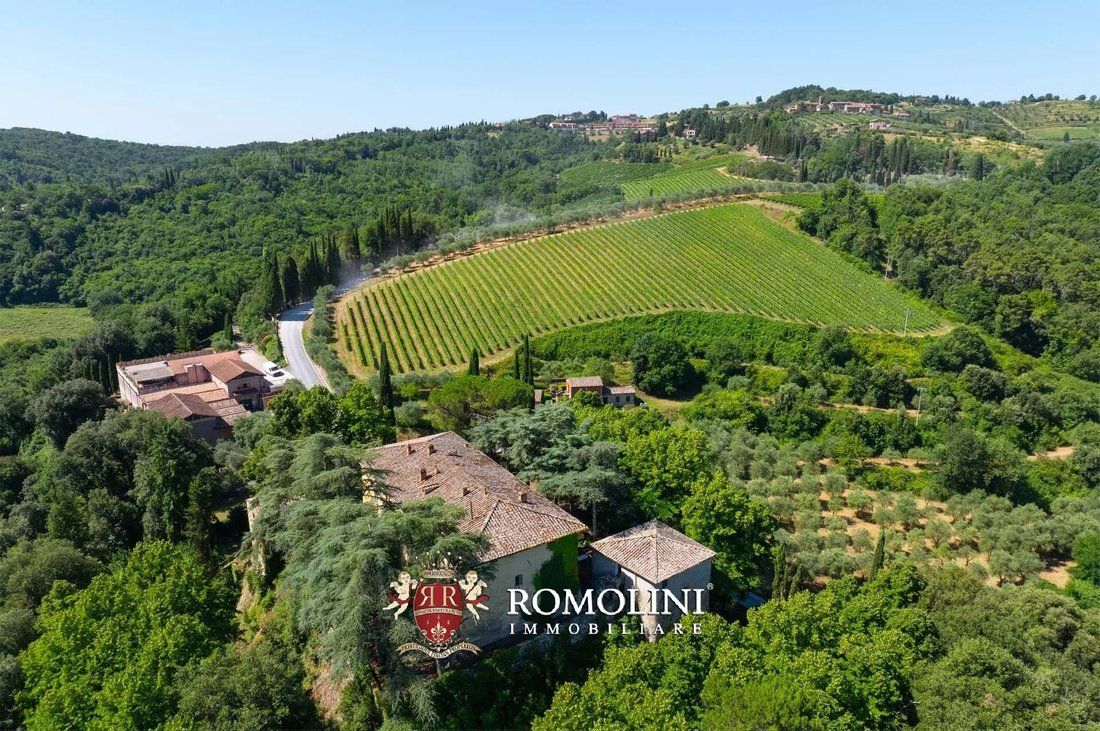
Sur les collines du Chianti, non loin de Castelnuovo Berardenga et de Radda, domaine viticole de 102,1 hectares avec manoir et hameau à restaurer à vendre. La propriété, qui possède une histoire incroyable allant du Moyen Âge à nos jours, offre un fort potentiel de développement touristique réceptif allant de pair avec la production de vin : en effet, la ferme exploite 28,5 hectares de vignobles pour produire environ 130 000 bouteilles de vin par an.
La rénovation des différents bâtiments (plus de 4 500 m² au total) ouvrirait la voie à la création d’un boutique-hôtel de luxe dans une région très réputée de la Toscane, à moins d’une heure de Florence et de Sienne : l’emplacement idéal et les beaux espaces (intérieurs et extérieurs) permettraient également d’exploiter la propriété non seulement pour des locations saisonnières mais aussi comme lieu pour des événements, des cérémonies, des conférences et des conventions d’entreprise.
Les services de base sont disponibles dans le village médiéval voisin (1 km ; 2 minutes), tandis que pour tout le reste, il vous suffit de rejoindre Sienne, à moins d’une demi-heure de route. Les villes d’art les plus connues de Toscane (Monteriggioni, San Gimignano, Pienza, Montepulciano...)
DESCRIPTION DES BÂTIMENTS, ÉTAT ET FINITIONS
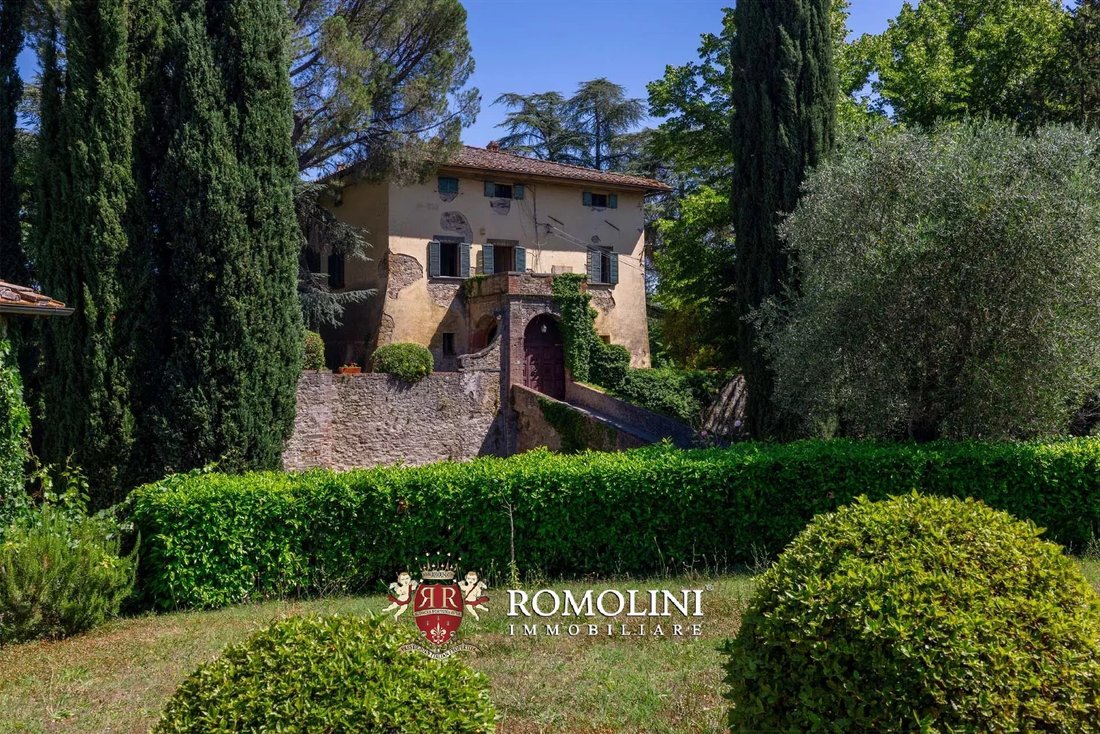
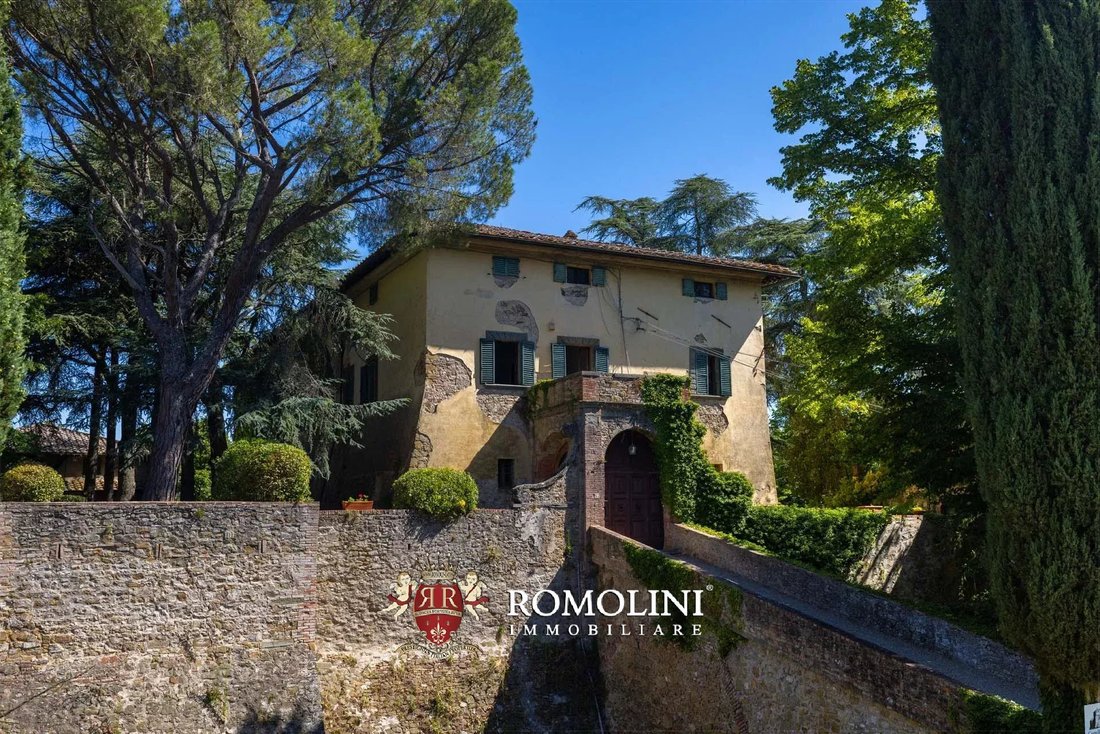
Le manoir (1 300 m² — 13 988 pieds carrés, jusqu’à 15 chambres et 15 salles de bains) est un grand bâtiment majestueux datant des XVIIe et XVIIIe siècles, enregistré auprès de la surintendance et actuellement inutilisé. Les grandes salles du rez-de-chaussée étaient autrefois utilisées comme espace de dégustation (pouvant accueillir jusqu’à 80 personnes) avec des toilettes pour les invités, une cuisine professionnelle et des débarras. Les étages supérieurs sont abandonnés et nécessitent d’importants travaux de rénovation et de restauration avant de pouvoir être utilisés.
La cave à vin (2 000 m² — 21 520 pieds carrés, 2 salles de bains) est un grand bâtiment moderne structuré sur trois étages et équipé de monte-charges entre les niveaux pour faciliter le transport des produits.
- Rez-de-chaussée : bureaux administratifs, magasin avec coin dégustation, cuisine pour la préparation, entrepôt, salles de bains et grande terrasse panoramique (potentiellement utilisée comme espace de dégustation en été) ;
- Sous-sol (—1) (avec accès direct pour les véhicules agricoles) : salles de vinification, ligne d’embouteillage, entrepôt pour le stockage du produit fini ;
- Sous-sol (—2) : cave de vieillissement, rangement du matériel, cuisine, vestiaires pour les employés et toilettes.
L’équipement de la cave comprend vingt-quatre vignerons en acier (10 hl chacun), des fûts de chêne (d’une capacité allant de 5 à 60 hl), des pressoirs Bucher, des égrappoirs, des cuves de collecte des raisins, un système de climatisation et diverses machines.
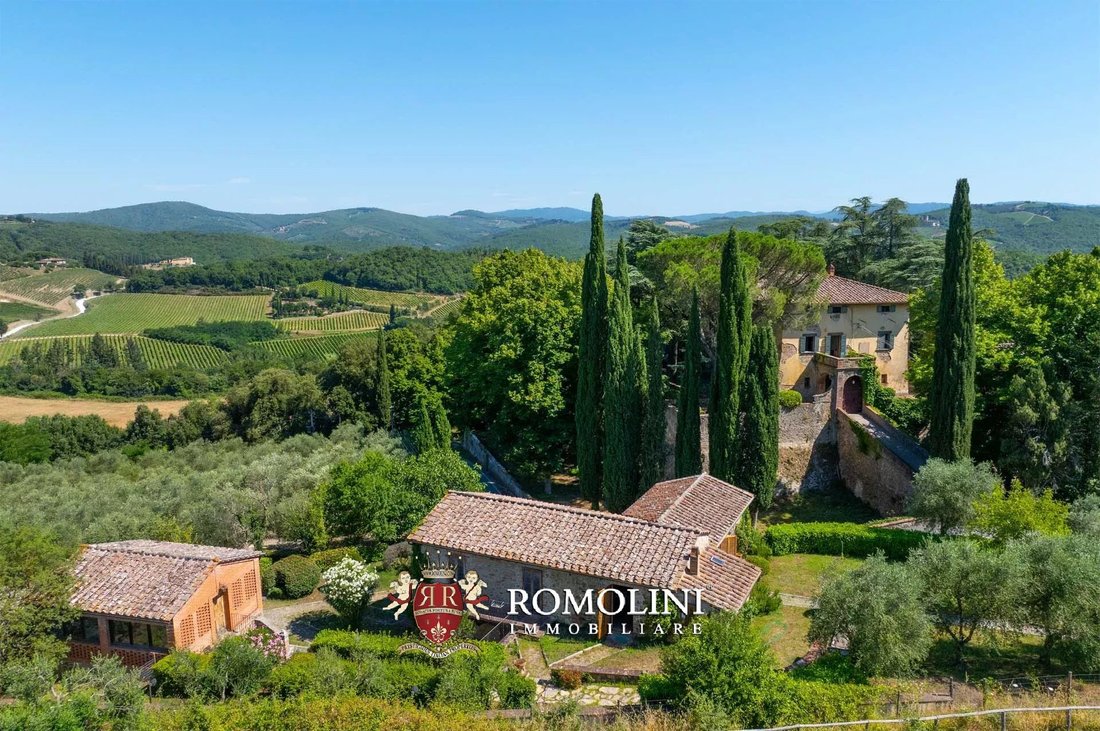
En face du château, à une courte distance du pont d’accès, se trouve une ferme rustique (220 m² — 2 367 pieds carrés, 8 chambres et 8 salles de bains) actuellement désaffectée mais facilement convertie en charmant B&B. Le bâtiment est réparti sur deux étages et se compose de huit chambres spacieuses, toutes avec salle de bain privée et accès direct depuis l’extérieur.
À côté de la ferme se trouve l’ancienne grange (105 m² — 1 130 pieds carrés), structurée sur deux étages et autrefois utilisée comme espace commun pour les invités avec une salle de petit-déjeuner, une cuisine professionnelle pour la préparation des repas, une réception pour les invités, deux salles de bains et une spacieuse salle commune indépendante à l’étage supérieur.
Au milieu des vignes, au nord du manoir, se trouve un petit hameau rural à rénover composé de deux fermes rustiques (340 m² — 3 658 pieds carrés et 360 m² — 3 874 pieds carrés, respectivement, jusqu’à 10 chambres et 7 salles de bains), toutes deux réparties sur deux étages, et une ancienne écurie (125 m² — 1 345 pieds carrés), très pratique comme rangement d’outils. Sous la végétation, il y avait autrefois deux bâtiments de stockage agricoles (25 m² — 269 pieds carrés au total) qui pouvaient être reconstruits et/ou utilisés comme cubage pour agrandir les bâtiments existants.
La propriété est complétée par un hangar à véhicules (55 m² — 592 pieds carrés) situé à la lisière des vignobles.
HISTOIRE DE LA PROPRIÉTÉ
La villa se trouve sur les vestiges d’un château probablement construit au XIIIe siècle par Sienne pour défendre la région. En 1554, la forteresse (considérablement agrandie) appartenait à la famille Bellanti et, sous leur direction, elle a réussi à contenir les attaques florentines dans la région, grâce aux imposants murs de 10 mètres de haut mais aussi au courage de la petite garnison (25 hommes) stationnée dans le château. Le bastion a finalement été contraint de capituler, car l’artillerie florentine avait causé trop de dégâts à la structure, mais les Florentins ont payé le prix fort pour leur victoire avec la mort de l’ingénieur militaire Giovanni Battista Belluzzi. La chute de la forteresse n’a pas signifié la fin du domaine : la vie agricole s’est poursuivie et, en 1692, un paiement d’impôts sur la production de vin du « domaine » est enregistré.
Sur les vestiges du château, le manoir visible aujourd’hui a été construit (probablement entre le XVIIIe et le XIXe siècle). L’aspect actuel du bâtiment date du début du XXe siècle : un tremblement de terre a en effet endommagé la villa en 1911, et une grande partie des étages supérieurs a été supprimée pour réduire le risque d’effondrement (à ce jour, il ne reste que dix des quarante chambres).
De structure médiévale d’origine, les murs quadrangulaires sont toujours debout, bien que leur hauteur soit réduite, les quatre tours d’angle s’élevant au-dessus du niveau de la rue. Seules deux des tours sont encore debout dans leur intégralité (angles nord-ouest et nord-est).
En 1934, l’impressionnant complexe a été acheté par un homme politique bien connu du Parti libéral et transformé en cave : le Chianti Classico produit est même devenu le « vin de la maison » du Palazzo Madama.
EXTÉRIEUR
La cave s’étend sur environ 102,1 hectares (252,3 acres) au total, située sur les collines du Chianti. Les piliers du domaine sont sans aucun doute le vignoble (28,5 ha répartis en seize parcelles) et l’oliveraie (6,2 ha avec des plantes des variétés Frantoio, Leccino et Moraiolo). L’entreprise prévoit de planter 3,8 ha supplémentaires de vignobles (avec des variétés à définir) en plus des permis déjà obtenus (expirant en 2025) pour la plantation de 7,0 ha supplémentaires.
Le reste de la ferme est ensuite consacré aux terres arables (15,3 ha), aux bois (5,0 ha) et aux terres relatives aux bâtiments (1,6 ha) avec jardins et aires de manœuvre. Un grand lac privé (environ 10 000 m² de surface) insiste également sur les terres arables, qui peuvent être utilisées pour irriguer les champs et les vignobles en cas de besoin.
La ferme est en conversion biologique depuis 2021, la certification finale étant prévue pour 2024.
DÉTAILS SUR LA PRODUCTION DE VIN
- Vignobles : 28,5 hectares (70,4 acres)
- Variétés : Sangiovese (72 %), Merlot (13 %), Cabernet Sauvignon (6 %), Colorino (4 %), Chardonnay (2 %), Sauvignon Blanc (3 %)
- Altitude et exposition : 320 à 480 m au-dessus du niveau de la mer (nord, est, sud-est, sud)
- Années de plantation : 1999 — 2019
- Entraînement : cordon d’éperons taillés (4 000 à 5 000 pieds/ha)
- Composition du sol : sableux, argileux, grès
- Production annuelle : 1 000 hl (environ 130 000 bouteilles)
- Marchés touchés : Italie (65 %), Canada, Japon, Allemagne, Danemark, Asie du Sud-Est, États-Unis
VINS PRODUITS
La cave produit de nombreux vins DOCG (4 étiquettes) et IGT (6 étiquettes), tous d’excellente qualité, comme en témoignent les excellentes notes reçues de James Suckling (94/100), Falstaff (92/100), Wine Critic (93/100) et Wine Align (91/100) et les récompenses décernées lors d’événements tels que le Concours Mondial de Bruxelles, Wine Hunter et Decanter. Les vins figurent également dans les guides viticoles les plus renommés tels que Slow Wine, Veronelli, Weinwisser et Bibenda.
- Chianti Classico DOCG : Sangiovese 90 %, Merlot, Colorino
- Réserve DOCG du Chianti Classico : Sangiovese 100 %
- Réserve DOCG du Chianti Classico : Sangiovese 90 %, Merlot, Colorino
- Chianti Classico DOCG Gran Selezione : Sangiovese 90 %, Merlot, Colorino
- Toscana Rosso IGT : 70 % Sangiovese, 30 % Merlot
- Toscana Rosso IGT : cabernet-sauvignon 70 %, sangiovese 30 %
- Toscana Rosso IGT : Merlot 90 %, Sangiovese 10 %
- Toscana Bianco IGT : Sauvignon blanc 70 %, Chardonnay 30 %
- Toscana Rosé IGT : Sangiovese 100 %
- Spumante Brut Rosé IGT : Sangiovese 100 %
VILLES ET VILLAGES LES PLUS PROCHES
Pays avec services (1 km ; 2 minutes), Radda in Chianti (10 km ; 15 minutes), Castellina in Chianti (11 km ; 20 minutes), Sienne (16 km ; 30 minutes), Gaiole in Chianti (16 km ; 25 minutes), Monteriggioni (24 km ; 30 minutes), Greve in Chianti (27 km ; 40 minutes), Castelnuovo Berardenga (28 km ; 40 minutes) km ; 35’), San Gimignano (46 km ; 50’), Volterra (59 km ; 1h), Arezzo (70 km ; 1h 20’), Pienza (71 km ; 1h 20 ’), Montepulciano (76 km ; 1h 15’), Florence (80 km ; 1h 15 ’), Cortone (85 km ; 1h 15’)
AÉROPORTS LES PLUS PROCHES
Grosseto C. Baccarini (89 km ; 1 h 20), Firenze A. Vespucci (90 km ; 1 h 15), Pise G. Galilei (124 km ; 1 h 45), Pérouse San Francesco (129 km ; 1 h 45), Bologne G. Marconi (172 km ; 2 h), Roma Ciampino (257 km ; 2 h 55), Rome Fiumicino (272 km ; 2 km ; 3 heures)
La rénovation des différents bâtiments (plus de 4 500 m² au total) ouvrirait la voie à la création d’un boutique-hôtel de luxe dans une région très réputée de la Toscane, à moins d’une heure de Florence et de Sienne : l’emplacement idéal et les beaux espaces (intérieurs et extérieurs) permettraient également d’exploiter la propriété non seulement pour des locations saisonnières mais aussi comme lieu pour des événements, des cérémonies, des conférences et des conventions d’entreprise.
Les services de base sont disponibles dans le village médiéval voisin (1 km ; 2 minutes), tandis que pour tout le reste, il vous suffit de rejoindre Sienne, à moins d’une demi-heure de route. Les villes d’art les plus connues de Toscane (Monteriggioni, San Gimignano, Pienza, Montepulciano...)
DESCRIPTION DES BÂTIMENTS, ÉTAT ET FINITIONS
Le manoir (1 300 m² — 13 988 pieds carrés, jusqu’à 15 chambres et 15 salles de bains) est un grand bâtiment majestueux datant des XVIIe et XVIIIe siècles, enregistré auprès de la surintendance et actuellement inutilisé. Les grandes salles du rez-de-chaussée étaient autrefois utilisées comme espace de dégustation (pouvant accueillir jusqu’à 80 personnes) avec des toilettes pour les invités, une cuisine professionnelle et des débarras. Les étages supérieurs sont abandonnés et nécessitent d’importants travaux de rénovation et de restauration avant de pouvoir être utilisés.
La cave à vin (2 000 m² — 21 520 pieds carrés, 2 salles de bains) est un grand bâtiment moderne structuré sur trois étages et équipé de monte-charges entre les niveaux pour faciliter le transport des produits.
- Rez-de-chaussée : bureaux administratifs, magasin avec coin dégustation, cuisine pour la préparation, entrepôt, salles de bains et grande terrasse panoramique (potentiellement utilisée comme espace de dégustation en été) ;
- Sous-sol (—1) (avec accès direct pour les véhicules agricoles) : salles de vinification, ligne d’embouteillage, entrepôt pour le stockage du produit fini ;
- Sous-sol (—2) : cave de vieillissement, rangement du matériel, cuisine, vestiaires pour les employés et toilettes.
L’équipement de la cave comprend vingt-quatre vignerons en acier (10 hl chacun), des fûts de chêne (d’une capacité allant de 5 à 60 hl), des pressoirs Bucher, des égrappoirs, des cuves de collecte des raisins, un système de climatisation et diverses machines.
En face du château, à une courte distance du pont d’accès, se trouve une ferme rustique (220 m² — 2 367 pieds carrés, 8 chambres et 8 salles de bains) actuellement désaffectée mais facilement convertie en charmant B&B. Le bâtiment est réparti sur deux étages et se compose de huit chambres spacieuses, toutes avec salle de bain privée et accès direct depuis l’extérieur.
À côté de la ferme se trouve l’ancienne grange (105 m² — 1 130 pieds carrés), structurée sur deux étages et autrefois utilisée comme espace commun pour les invités avec une salle de petit-déjeuner, une cuisine professionnelle pour la préparation des repas, une réception pour les invités, deux salles de bains et une spacieuse salle commune indépendante à l’étage supérieur.
Au milieu des vignes, au nord du manoir, se trouve un petit hameau rural à rénover composé de deux fermes rustiques (340 m² — 3 658 pieds carrés et 360 m² — 3 874 pieds carrés, respectivement, jusqu’à 10 chambres et 7 salles de bains), toutes deux réparties sur deux étages, et une ancienne écurie (125 m² — 1 345 pieds carrés), très pratique comme rangement d’outils. Sous la végétation, il y avait autrefois deux bâtiments de stockage agricoles (25 m² — 269 pieds carrés au total) qui pouvaient être reconstruits et/ou utilisés comme cubage pour agrandir les bâtiments existants.
La propriété est complétée par un hangar à véhicules (55 m² — 592 pieds carrés) situé à la lisière des vignobles.
HISTOIRE DE LA PROPRIÉTÉ
La villa se trouve sur les vestiges d’un château probablement construit au XIIIe siècle par Sienne pour défendre la région. En 1554, la forteresse (considérablement agrandie) appartenait à la famille Bellanti et, sous leur direction, elle a réussi à contenir les attaques florentines dans la région, grâce aux imposants murs de 10 mètres de haut mais aussi au courage de la petite garnison (25 hommes) stationnée dans le château. Le bastion a finalement été contraint de capituler, car l’artillerie florentine avait causé trop de dégâts à la structure, mais les Florentins ont payé le prix fort pour leur victoire avec la mort de l’ingénieur militaire Giovanni Battista Belluzzi. La chute de la forteresse n’a pas signifié la fin du domaine : la vie agricole s’est poursuivie et, en 1692, un paiement d’impôts sur la production de vin du « domaine » est enregistré.
Sur les vestiges du château, le manoir visible aujourd’hui a été construit (probablement entre le XVIIIe et le XIXe siècle). L’aspect actuel du bâtiment date du début du XXe siècle : un tremblement de terre a en effet endommagé la villa en 1911, et une grande partie des étages supérieurs a été supprimée pour réduire le risque d’effondrement (à ce jour, il ne reste que dix des quarante chambres).
De structure médiévale d’origine, les murs quadrangulaires sont toujours debout, bien que leur hauteur soit réduite, les quatre tours d’angle s’élevant au-dessus du niveau de la rue. Seules deux des tours sont encore debout dans leur intégralité (angles nord-ouest et nord-est).
En 1934, l’impressionnant complexe a été acheté par un homme politique bien connu du Parti libéral et transformé en cave : le Chianti Classico produit est même devenu le « vin de la maison » du Palazzo Madama.
EXTÉRIEUR
La cave s’étend sur environ 102,1 hectares (252,3 acres) au total, située sur les collines du Chianti. Les piliers du domaine sont sans aucun doute le vignoble (28,5 ha répartis en seize parcelles) et l’oliveraie (6,2 ha avec des plantes des variétés Frantoio, Leccino et Moraiolo). L’entreprise prévoit de planter 3,8 ha supplémentaires de vignobles (avec des variétés à définir) en plus des permis déjà obtenus (expirant en 2025) pour la plantation de 7,0 ha supplémentaires.
Le reste de la ferme est ensuite consacré aux terres arables (15,3 ha), aux bois (5,0 ha) et aux terres relatives aux bâtiments (1,6 ha) avec jardins et aires de manœuvre. Un grand lac privé (environ 10 000 m² de surface) insiste également sur les terres arables, qui peuvent être utilisées pour irriguer les champs et les vignobles en cas de besoin.
La ferme est en conversion biologique depuis 2021, la certification finale étant prévue pour 2024.
DÉTAILS SUR LA PRODUCTION DE VIN
- Vignobles : 28,5 hectares (70,4 acres)
- Variétés : Sangiovese (72 %), Merlot (13 %), Cabernet Sauvignon (6 %), Colorino (4 %), Chardonnay (2 %), Sauvignon Blanc (3 %)
- Altitude et exposition : 320 à 480 m au-dessus du niveau de la mer (nord, est, sud-est, sud)
- Années de plantation : 1999 — 2019
- Entraînement : cordon d’éperons taillés (4 000 à 5 000 pieds/ha)
- Composition du sol : sableux, argileux, grès
- Production annuelle : 1 000 hl (environ 130 000 bouteilles)
- Marchés touchés : Italie (65 %), Canada, Japon, Allemagne, Danemark, Asie du Sud-Est, États-Unis
VINS PRODUITS
La cave produit de nombreux vins DOCG (4 étiquettes) et IGT (6 étiquettes), tous d’excellente qualité, comme en témoignent les excellentes notes reçues de James Suckling (94/100), Falstaff (92/100), Wine Critic (93/100) et Wine Align (91/100) et les récompenses décernées lors d’événements tels que le Concours Mondial de Bruxelles, Wine Hunter et Decanter. Les vins figurent également dans les guides viticoles les plus renommés tels que Slow Wine, Veronelli, Weinwisser et Bibenda.
- Chianti Classico DOCG : Sangiovese 90 %, Merlot, Colorino
- Réserve DOCG du Chianti Classico : Sangiovese 100 %
- Réserve DOCG du Chianti Classico : Sangiovese 90 %, Merlot, Colorino
- Chianti Classico DOCG Gran Selezione : Sangiovese 90 %, Merlot, Colorino
- Toscana Rosso IGT : 70 % Sangiovese, 30 % Merlot
- Toscana Rosso IGT : cabernet-sauvignon 70 %, sangiovese 30 %
- Toscana Rosso IGT : Merlot 90 %, Sangiovese 10 %
- Toscana Bianco IGT : Sauvignon blanc 70 %, Chardonnay 30 %
- Toscana Rosé IGT : Sangiovese 100 %
- Spumante Brut Rosé IGT : Sangiovese 100 %
VILLES ET VILLAGES LES PLUS PROCHES
Pays avec services (1 km ; 2 minutes), Radda in Chianti (10 km ; 15 minutes), Castellina in Chianti (11 km ; 20 minutes), Sienne (16 km ; 30 minutes), Gaiole in Chianti (16 km ; 25 minutes), Monteriggioni (24 km ; 30 minutes), Greve in Chianti (27 km ; 40 minutes), Castelnuovo Berardenga (28 km ; 40 minutes) km ; 35’), San Gimignano (46 km ; 50’), Volterra (59 km ; 1h), Arezzo (70 km ; 1h 20’), Pienza (71 km ; 1h 20 ’), Montepulciano (76 km ; 1h 15’), Florence (80 km ; 1h 15 ’), Cortone (85 km ; 1h 15’)
AÉROPORTS LES PLUS PROCHES
Grosseto C. Baccarini (89 km ; 1 h 20), Firenze A. Vespucci (90 km ; 1 h 15), Pise G. Galilei (124 km ; 1 h 45), Pérouse San Francesco (129 km ; 1 h 45), Bologne G. Marconi (172 km ; 2 h), Roma Ciampino (257 km ; 2 h 55), Rome Fiumicino (272 km ; 2 km ; 3 heures)
On the hills of Chianti, not far from Castelnuovo Berardenga and Radda, 102.1-ha wine estate with manor villa and hamlet to be restored for sale. The property, which boasts an incredible history ranging from the Middle Ages to the present day, offers great potential for receptive tourist development to go hand in hand with wine production: in fact, the farm exploits 28.5 ha of vineyards to produce about 130,000 bottles of wine per year.
The renovation of the various buildings (over 4,500 sqm in total) would pave the way for the creation of a luxury boutique hotel in a very renowned area of Tuscany, less than an hour from Florence and Siena: the convenient location and beautiful spaces (both indoor and outdoor) would also allow the property to be exploited not only for seasonal rentals but also as a location for events, ceremonies, conferences and corporate conventions.
Basic services are available in the nearby medieval village (1km; 2’) while for everything else you just need to reach Siena, less than half an hour’s drive away. Tuscany’s best-known art cities (Monteriggioni, San Gimignano, Pienza, Montepulciano...)
DESCRIPTION OF THE BUILDINGS, STATE AND FINISHES
The manor house (1,300 sqm – 13,988 sqft, up to 15 bedrooms and 15 bathrooms) is a large stately building dating from the 17th and 18th centuries, registered at the superintendence and currently unused. The large rooms on the ground floor were formerly used as a tasting area (with capacity for up to 80 guests) with guest bathrooms, professional kitchen and storage rooms. The upper floors are abandoned and need major renovation and restoration before they can be used.
The wine cellar (2,000 sqm – 21,520 sqft, 2 bathrooms) is a modern, large building structured on three floors and equipped with freight elevators between levels for easier transport of products.
- Ground floor: administrative offices, store with tasting corner, kitchen for preparation, warehouse, bathrooms and large panoramic terrace (potentially to be used as tasting area in summer);
- Underground level (–1) (with direct access for farm vehicles): winemaking rooms, bottling line, warehouse for storage of finished product;
- Underground level (–2): aging cellar, equipment storage, kitchen, changing rooms for employees and toilets.
Equipment in the winery includes twenty-four steel winemakers (10 hl each), oak barrels (with capacities ranging from 5 to 60 hl), Bucher presses, destemmers, grape collection tanks, air conditioning system, and miscellaneous machinery.
In front of the castle, a short distance from the access bridge, we find a rustic farmhouse (220 sqm – 2,367 sqft, 8 bedrooms and 8 bathrooms) currently disused but easily converted into a charming B&B. The building is laid over two floors and consists of eight spacious bedrooms, all with private bathrooms and direct access from the outside.
Next to the farmhouse is the old barn (105 sqm – 1,130 sqft), structured on two floors and formerly used as a common area for guests with a breakfast room, professional kitchen for food preparation, reception for guests, two bathrooms and a spacious independent common room on the upper floor.
In the midst of the vineyards, north of the manor house, is a small rural hamlet to be renovated consisting of two rustic farmhouses (340 sqm – 3,658 sqft and 360 sqm – 3,874 sqft, respectively, up to 10 bedrooms and 7 bathrooms), both on two floors, and an old animal stable (125 sqm – 1,345 sqft), very convenient as a tool storage. Under the vegetation, there used to be two agricultural storage buildings (25 sqm – 269 sqft in total) that could be rebuilt and/or used as cubage to expand the existing buildings.
The property is completed by a vehicle shed (55 sqm – 592 sqft) set at the edge of the vineyards.
HISTORY OF THE PROPERTY
The villa stands on the remains of a castle probably built in the 13th century by Siena to defend the area. By 1554 the (greatly expanded) fortress was owned by the Bellanti family, and under their leadership it succeeded in containing Florentine attacks in the area, thanks to the imposing 10-meter-high walls but also to the courage of the small garrison (25 men) stationed in the castle. The bastion was eventually forced to capitulate, as Florentine artillery had caused too much damage to the structure, but the Florentines paid a high price for their victory with the death of military engineer Giovanni Battista Belluzzi. The fall of the fortress did not mean the end for the estate: farming life continued, and in 1692 a tax payment on wine production at the “estate” is recorded.
On the remains of the castle, the manor house visible today was built (probably between the 18th and 19th centuries). The current appearance of the building dates to the early 20th century: an earthquake in fact damaged the villa in 1911, and much of the upper floors were removed to reduce the risk of collapse (to date, only ten of the forty rooms remain).
Of the original medieval structure, the quadrangular walls are still standing, albeit reduced in height, with the four corner towers rising above street level. Only two of the towers remain standing in their entirety (northwest and northeast corners).
In 1934 the impressive complex was purchased by a well-known Liberal Party politician and turned into a winery: the Chianti Classico produced even became the “wine of the house” at Palazzo Madama.
EXTERIOR
The winery spans approximately 102.1 hectares (252.3 acres) in total, lying on the rolling hills of Chianti. Pillars of the estate are undoubtedly the vineyard (28.5 ha divided into sixteen plots) and the olive grove (6.2 ha with plants of the Frantoio, Leccino and Moraiolo varieties). The company plans to plant an additional 3.8 ha of vineyards (with varieties to be defined) in addition to permits already obtained (expiring in 2025) for the planting of another 7.0 ha.
The remainder of the farm is then devoted to arable land (15.3 ha), woods (5.0 ha) and land pertaining to the buildings (1.6 ha) with gardens and maneuvering yards. A large private lake (about 10,000 sqm in surface) also insists on the arable land, which can be used to irrigate the fields and vineyards when needed.
The farm has been in organic conversion since 2021, with final certification scheduled for 2024.
DETAILS ON WINE PRODUCTION
- Vineyards: 28.5 hectares (70.4 acres)
- Varieties: Sangiovese (72%), Merlot (13%), Cabernet Sauvignon (6%), Colorino (4%), Chardonnay (2%), Sauvignon Blanc (3%)
- Altitude and exposure: 320 – 480 m asl (north, east, southeast, south)
- Years of planting: 1999 – 2019
- Training: pruned-spur cordon (4,000 – 5,000 vines / ha)
- Soil composition: sandy, clayish, sandstone
- Yearly production: 1,000 hl (about 130,000 bottles)
- Markets reached: Italy (65%), Canada, Japan, Germany, Denmark, Southeast Asia, U. S. A.
WINES PRODUCED
The winery produces numerous DOCG (4 labels) and IGT (6 labels) wines, all of excellent quality as evidenced by the excellent ratings received from James Suckling (94/100), Falstaff (92/100), Wine Critic (93/100) and Wine Align (91/100) and awards at events such as Concours Mondial de Bruxelles, Wine Hunter and Decanter. The wines are also featured in the most renowned wine guides such as Slow Wine, Veronelli, Weinwisser and Bibenda.
- Chianti Classico DOCG: Sangiovese 90%, Merlot, Colorino
- Chianti Classico DOCG Riserva: Sangiovese 100%
- Chianti Classico DOCG Riserva: Sangiovese 90%, Merlot, Colorino
- Chianti Classico DOCG Gran Selezione: Sangiovese 90%, Merlot, Colorino
- Toscana Rosso IGT: Sangiovese 70%, Merlot 30%
- Toscana Rosso IGT: Cabernet Sauvignon 70%, Sangiovese 30%
- Toscana Rosso IGT: Merlot 90%, Sangiovese 10%
- Toscana Bianco IGT: Sauvignon Blanc 70%, Chardonnay 30%
- Toscana Rosé IGT: Sangiovese 100%
- Spumante Brut Rosé IGT: Sangiovese 100%
CLOSEST CITIES AND TOWNS
Paese con servizi (1km; 2’), Radda in Chianti (10km; 15’), Castellina in Chianti (11km; 20’), Siena (16km; 30’), Gaiole in Chianti (16km; 25’), Monteriggioni (24km; 30’), Greve in Chianti (27km; 40’), Castelnuovo Berardenga (28km; 35’), San Gimignano (46km; 50’), Volterra (59km; 1h), Arezzo (70km; 1h 20’), Pienza (71km; 1h 20’), Montepulciano (76km; 1h 15’), Firenze (80km; 1h 15’), Cortona (85km; 1h 15’)
CLOSEST AIRPORTS
Grosseto C. Baccarini (89km; 1h 20’), Firenze A. Vespucci (90km; 1h 15’), Pisa G. Galilei (124km; 1h 45’), Perugia San Francesco (129km; 1h 45’), Bologna G. Marconi (172km; 2h), Roma Ciampino (257km; 2h 55’), Roma Fiumicino (272km; 3h)
The renovation of the various buildings (over 4,500 sqm in total) would pave the way for the creation of a luxury boutique hotel in a very renowned area of Tuscany, less than an hour from Florence and Siena: the convenient location and beautiful spaces (both indoor and outdoor) would also allow the property to be exploited not only for seasonal rentals but also as a location for events, ceremonies, conferences and corporate conventions.
Basic services are available in the nearby medieval village (1km; 2’) while for everything else you just need to reach Siena, less than half an hour’s drive away. Tuscany’s best-known art cities (Monteriggioni, San Gimignano, Pienza, Montepulciano...)
DESCRIPTION OF THE BUILDINGS, STATE AND FINISHES
The manor house (1,300 sqm – 13,988 sqft, up to 15 bedrooms and 15 bathrooms) is a large stately building dating from the 17th and 18th centuries, registered at the superintendence and currently unused. The large rooms on the ground floor were formerly used as a tasting area (with capacity for up to 80 guests) with guest bathrooms, professional kitchen and storage rooms. The upper floors are abandoned and need major renovation and restoration before they can be used.
The wine cellar (2,000 sqm – 21,520 sqft, 2 bathrooms) is a modern, large building structured on three floors and equipped with freight elevators between levels for easier transport of products.
- Ground floor: administrative offices, store with tasting corner, kitchen for preparation, warehouse, bathrooms and large panoramic terrace (potentially to be used as tasting area in summer);
- Underground level (–1) (with direct access for farm vehicles): winemaking rooms, bottling line, warehouse for storage of finished product;
- Underground level (–2): aging cellar, equipment storage, kitchen, changing rooms for employees and toilets.
Equipment in the winery includes twenty-four steel winemakers (10 hl each), oak barrels (with capacities ranging from 5 to 60 hl), Bucher presses, destemmers, grape collection tanks, air conditioning system, and miscellaneous machinery.
In front of the castle, a short distance from the access bridge, we find a rustic farmhouse (220 sqm – 2,367 sqft, 8 bedrooms and 8 bathrooms) currently disused but easily converted into a charming B&B. The building is laid over two floors and consists of eight spacious bedrooms, all with private bathrooms and direct access from the outside.
Next to the farmhouse is the old barn (105 sqm – 1,130 sqft), structured on two floors and formerly used as a common area for guests with a breakfast room, professional kitchen for food preparation, reception for guests, two bathrooms and a spacious independent common room on the upper floor.
In the midst of the vineyards, north of the manor house, is a small rural hamlet to be renovated consisting of two rustic farmhouses (340 sqm – 3,658 sqft and 360 sqm – 3,874 sqft, respectively, up to 10 bedrooms and 7 bathrooms), both on two floors, and an old animal stable (125 sqm – 1,345 sqft), very convenient as a tool storage. Under the vegetation, there used to be two agricultural storage buildings (25 sqm – 269 sqft in total) that could be rebuilt and/or used as cubage to expand the existing buildings.
The property is completed by a vehicle shed (55 sqm – 592 sqft) set at the edge of the vineyards.
HISTORY OF THE PROPERTY
The villa stands on the remains of a castle probably built in the 13th century by Siena to defend the area. By 1554 the (greatly expanded) fortress was owned by the Bellanti family, and under their leadership it succeeded in containing Florentine attacks in the area, thanks to the imposing 10-meter-high walls but also to the courage of the small garrison (25 men) stationed in the castle. The bastion was eventually forced to capitulate, as Florentine artillery had caused too much damage to the structure, but the Florentines paid a high price for their victory with the death of military engineer Giovanni Battista Belluzzi. The fall of the fortress did not mean the end for the estate: farming life continued, and in 1692 a tax payment on wine production at the “estate” is recorded.
On the remains of the castle, the manor house visible today was built (probably between the 18th and 19th centuries). The current appearance of the building dates to the early 20th century: an earthquake in fact damaged the villa in 1911, and much of the upper floors were removed to reduce the risk of collapse (to date, only ten of the forty rooms remain).
Of the original medieval structure, the quadrangular walls are still standing, albeit reduced in height, with the four corner towers rising above street level. Only two of the towers remain standing in their entirety (northwest and northeast corners).
In 1934 the impressive complex was purchased by a well-known Liberal Party politician and turned into a winery: the Chianti Classico produced even became the “wine of the house” at Palazzo Madama.
EXTERIOR
The winery spans approximately 102.1 hectares (252.3 acres) in total, lying on the rolling hills of Chianti. Pillars of the estate are undoubtedly the vineyard (28.5 ha divided into sixteen plots) and the olive grove (6.2 ha with plants of the Frantoio, Leccino and Moraiolo varieties). The company plans to plant an additional 3.8 ha of vineyards (with varieties to be defined) in addition to permits already obtained (expiring in 2025) for the planting of another 7.0 ha.
The remainder of the farm is then devoted to arable land (15.3 ha), woods (5.0 ha) and land pertaining to the buildings (1.6 ha) with gardens and maneuvering yards. A large private lake (about 10,000 sqm in surface) also insists on the arable land, which can be used to irrigate the fields and vineyards when needed.
The farm has been in organic conversion since 2021, with final certification scheduled for 2024.
DETAILS ON WINE PRODUCTION
- Vineyards: 28.5 hectares (70.4 acres)
- Varieties: Sangiovese (72%), Merlot (13%), Cabernet Sauvignon (6%), Colorino (4%), Chardonnay (2%), Sauvignon Blanc (3%)
- Altitude and exposure: 320 – 480 m asl (north, east, southeast, south)
- Years of planting: 1999 – 2019
- Training: pruned-spur cordon (4,000 – 5,000 vines / ha)
- Soil composition: sandy, clayish, sandstone
- Yearly production: 1,000 hl (about 130,000 bottles)
- Markets reached: Italy (65%), Canada, Japan, Germany, Denmark, Southeast Asia, U. S. A.
WINES PRODUCED
The winery produces numerous DOCG (4 labels) and IGT (6 labels) wines, all of excellent quality as evidenced by the excellent ratings received from James Suckling (94/100), Falstaff (92/100), Wine Critic (93/100) and Wine Align (91/100) and awards at events such as Concours Mondial de Bruxelles, Wine Hunter and Decanter. The wines are also featured in the most renowned wine guides such as Slow Wine, Veronelli, Weinwisser and Bibenda.
- Chianti Classico DOCG: Sangiovese 90%, Merlot, Colorino
- Chianti Classico DOCG Riserva: Sangiovese 100%
- Chianti Classico DOCG Riserva: Sangiovese 90%, Merlot, Colorino
- Chianti Classico DOCG Gran Selezione: Sangiovese 90%, Merlot, Colorino
- Toscana Rosso IGT: Sangiovese 70%, Merlot 30%
- Toscana Rosso IGT: Cabernet Sauvignon 70%, Sangiovese 30%
- Toscana Rosso IGT: Merlot 90%, Sangiovese 10%
- Toscana Bianco IGT: Sauvignon Blanc 70%, Chardonnay 30%
- Toscana Rosé IGT: Sangiovese 100%
- Spumante Brut Rosé IGT: Sangiovese 100%
CLOSEST CITIES AND TOWNS
Paese con servizi (1km; 2’), Radda in Chianti (10km; 15’), Castellina in Chianti (11km; 20’), Siena (16km; 30’), Gaiole in Chianti (16km; 25’), Monteriggioni (24km; 30’), Greve in Chianti (27km; 40’), Castelnuovo Berardenga (28km; 35’), San Gimignano (46km; 50’), Volterra (59km; 1h), Arezzo (70km; 1h 20’), Pienza (71km; 1h 20’), Montepulciano (76km; 1h 15’), Firenze (80km; 1h 15’), Cortona (85km; 1h 15’)
CLOSEST AIRPORTS
Grosseto C. Baccarini (89km; 1h 20’), Firenze A. Vespucci (90km; 1h 15’), Pisa G. Galilei (124km; 1h 45’), Perugia San Francesco (129km; 1h 45’), Bologna G. Marconi (172km; 2h), Roma Ciampino (257km; 2h 55’), Roma Fiumicino (272km; 3h)
-
Type de propriété
Corps de ferme
-
Étages
5
-
Prix/pied²
$239
Caractéristiques
- Jardin
- Terrasse
- Garage
- Cheminée
- Vignoble / Cave
- Équestre
- Cave à vins
- Centre de remise en forme / Fitness
- Vue sur la montagne
Caractéristiques
Lot
- Vue sur la montagne
- Vue sur la mer
- Haute altitude
- Équestre
- Rénové
Intérieur
- Haut plafond
- Cheminée
- Climatisation
- Bar
- Cave à vins
- Sous-sol
- Centre de remise en forme / Fitness
Outdoor
- Terrasse
- Balcon
- Stationnement
- Garage
- Jardin
- Vignoble / Cave
Explorez le secteur
Castelnuovo Berardenga, Toscane, Italie
Voir sur Google Maps
Prix par sqft
Faible
Élevé
Nichée dans les collines pittoresques de la Toscane, Castelnuovo Berardenga offre un mélange enchanteur de charme rustique et de vie haut de gamme. Profitez de vignobles de classe mondiale et de visites de dégustation de vin, bénéficiez de la proximité de l’architecture historique de Sienne et savourez une cuisine exquise. Engagez-vous dans des activités de plein air et des expériences culturelles tout en admirant la beauté sereine de la campagne italienne.
Voir à proximité
Attractions
Écoles
Aéroport de Sienne
Aéroport
30 min
Gare de Sienne
Gare
25 min
Cathédrale de Sienne
Culture et Patrimoine
35 min
Parc de Sculptures du Chianti
Plein air et nature
15 min
École Internationale de Sienne
École Internationale
30 min
Institut Compréhensif Rosselli
École Publique
20 min

Inscrit il y a 4 ans
Vous vous êtes renseigné sur ce bien
L'agent vous contactera bientôt par
Publié par
223
Annonces
2022
Inscrit
Réserver une visite avec Danilo Romolini
Choisissez une date et si vous souhaitez une visite virtuelle ou en personne avec l’agent.
Date préférée
Type de visite

Romolini Immobiliare
Piazza Torre di Berta 4, Tuscany, 52037, Sansepolcro, Italy
Voir le profil de l’agence
Riccardo and Marta met during their high school years. Since then, their paths have never parted. United by shared
Riccardo and Marta met during their high school years. Since then, their paths have never parted. United by shared dreams and aspirations, they married in 1999 and are today parents of three children. In 2004, driven by their passion for their native land, art, and beauty, they chose the historic heart of Tuscany – the charming village of Anghiari – as the birthplace of a project that already carried the warmth of home: Romolini Immobiliare. A story founded on courage, dedication, and profound values that, paired with their vision, quickly earned them recognition within both the national and international real estate markets. In 2008, an important achievement further strengthened their reputation: Romolini Immobiliare was appointed exclusive affiliate of Christie’s International Real Estate, the world’s most prestigious name in luxury real estate – a testament to their authenticity and unwavering commitment. Romolini, however, is more than a business: it is a family. Those who have joined Riccardo and Marta in this endeavor were welcomed for their human qualities, integrity, and outstanding professionalism, becoming not just exceptional team members, but part of a greater family. Each brings a unique approach, a personal style, and a shared dedication to the values that have always defined Romolini. In 2020, Danilo, their eldest son, chose to join the company. Having grown up amid the dreams and challenges of the family business, he brought a visionary spirit and a profound love for beauty. Danilo pioneered a new way of presenting properties in Italy, creating emotional and engaging video narratives that captivate and inspire. With his contribution, Romolini Immobiliare embraced a new chapter. A refined approach to communication, an even greater attention to detail, and a client-centered philosophy have established the company as a leading figure in the luxury real estate sector. Romolini is not just a name. It is a legacy. It is a family dream brought to life. It is a journey that moves forward with passion and purpose.
Dernière mise à jour
Août 7
Première mise en ligne
Mai 21, 2025
Référence de l’annonce
2489
Propriétés similaires à proximité
Nouvelles annonces à Castelnuovo Berardenga










Explorez plus de biens à vendre
Castelnuovo Berardenga, Toscane, Italie types de propriétés
Castelnuovo Berardenga, Toscane, Italie Recherches populaires
- Duplex propriétés à Castelnuovo Berardenga, Toscane, Italie
- Constructions neuves propriétés à Castelnuovo Berardenga, Toscane, Italie
- Propriétés avec Sauna à Castelnuovo Berardenga, Toscane, Italie
- Propriétés avec Hammam à Castelnuovo Berardenga, Toscane, Italie
- Propriétés avec Terrain de tennis à Castelnuovo Berardenga, Toscane, Italie
- Propriétés avec Héliport à Castelnuovo Berardenga, Toscane, Italie
- Propriétés avec Vignoble / Cave à Castelnuovo Berardenga, Toscane, Italie
Guides et histoires connexes
La confiance des plus grands courtiers du monde
Les agents des propriétés les plus exceptionnelles du monde publient sur JamesEdition.
- Des annonces de Sotheby's, Christie's, BARNES et Engel & Völkers
- Chaque annonce est vérifiée avant sa mise en ligne
- Contactez directement des agents vérifiés
En continuant, vous acceptez nos Conditions et notre Politique de confidentialité.