In 1969, a group of Italian architects drew up tentative plans for what they called Il Monumento Continuo (or ‘The Continuous Monument’ in English) — a vast city in the Arizona Desert rendered as a gleaming white line of concrete stretching all the way to the horizon and beyond.
The group, known as Superstudio, intended the design to be an ironic satire on the ego of the modernist architect at a time when ancient cities all around them (like crumbling, beautiful Genoa) were being bisected and bulldozed to make way for superhighways and highspeed viaducts. In the Saudi desert, over half a century hence, that satire — that “negative utopia”, as the Superstudio architects deemed it — is inching closer to reality.
Sindalah, an ultra-luxurious holiday island in the Red Sea
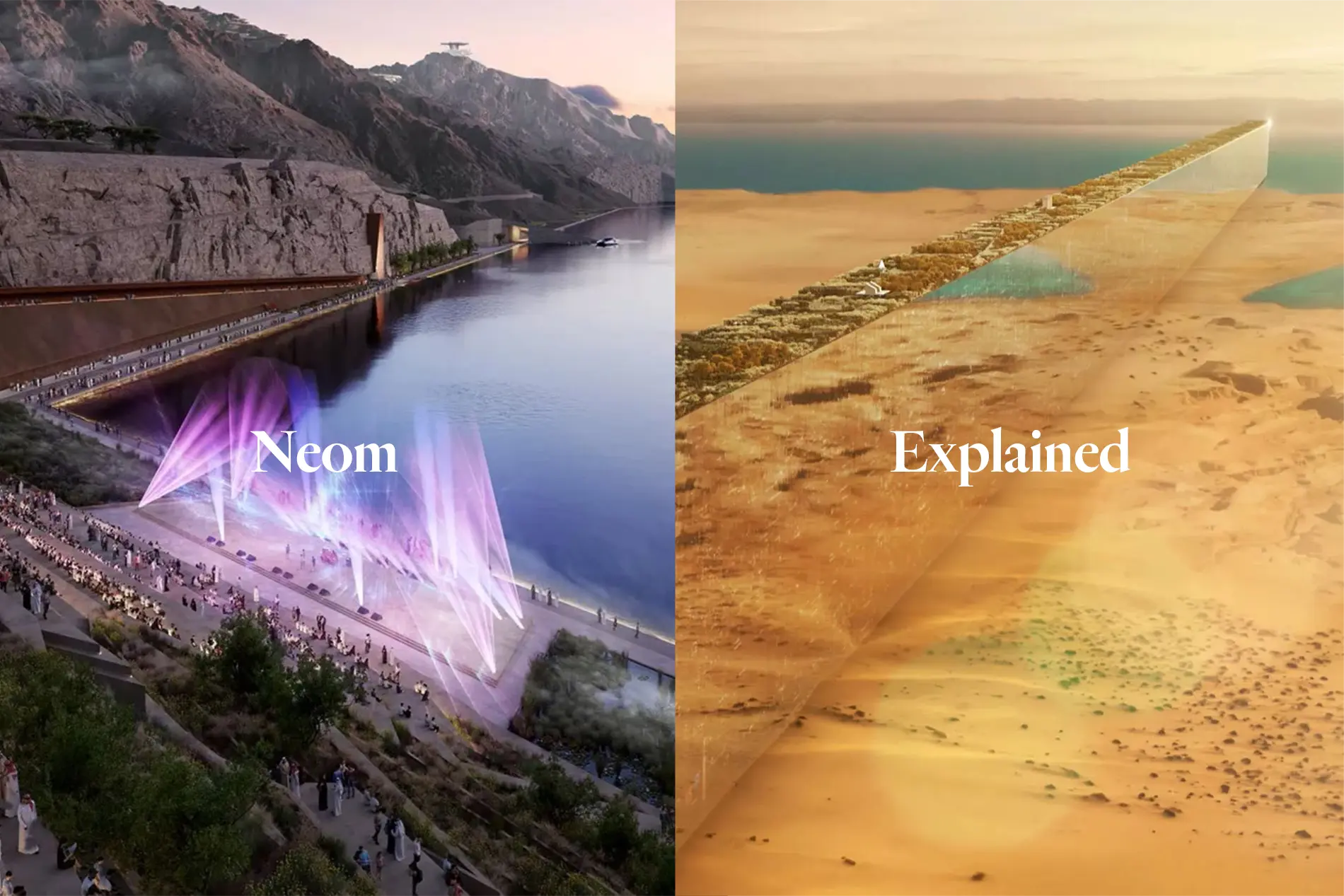
Neom is the collective name for a group of (at least) four futuristic regions (grouped broadly into a sort of a mega-city or new state) which hopes, ultimately, to shift the modern global centers of industrial, technological and tourist activity onto the Arabian peninsula. It’s situated on the North Western coast of Saudi Arabia, bordered by the waters of the Red Sea, desert flats and the rugged mountains of the Madiyan range, and is funded by the unparalleled wealth and resources of the sovereign state.
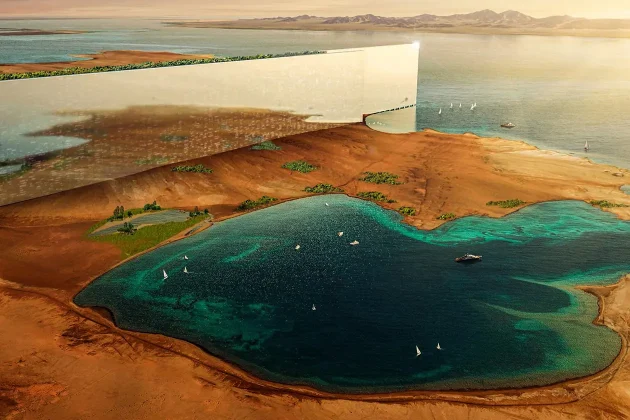
The mirrored city wall, the bane of many an unsuspecting bird
“Like the Aviators of a highway cop, impenetrable, expressionless, sinister”
Neom’s first announced development was The Line — a hyper-modern smart city that’s not a million miles from the ironic Superstudio proposal, and which clads itself, in the memorable words of the FT’s architecture critic, in reflective surfaces “like the Aviators of a highway cop, impenetrable, expressionless, sinister”. Two-hundred metres wide, 500 metres high and 170 kilometres long, The Line’s design foundations are all rooted in alleged sustainability, efficiency and all-round seamlessness: the mirrored surfaces on the outside are supposed to reflect, literally, the rugged beauty of the landscape around the city, while transport and movement on the inside is ultra-optimised. With “no roads, cars or emissions, it will run on 100% renewable energy and 95% of land will be preserved for nature,” says The Line’s website. “People’s health and wellbeing will be prioritised over transportation and infrastructure, unlike traditional cities.”
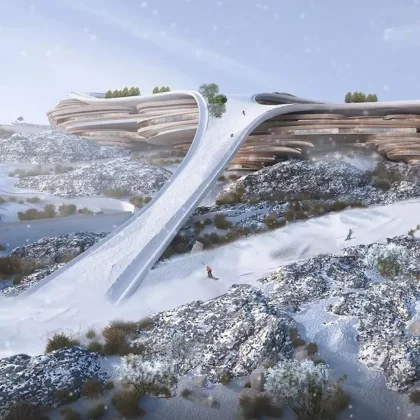
Neom’s ‘Fun’ district will have multiple skiing areas
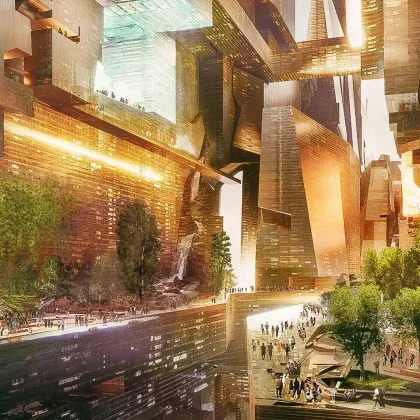
The renders show a sort of modular, space-age Babylon — hanging gardens, overflowing foliage, bubbling water features — where all your amenities (school, restaurants, office, gym) are just a “five-minute walk away”. (An end-to-end journey, moderated by AI, takes just 20 minutes.) It’s all structured in boxy steel and glass, and claims to boast perfectly clear air and the ideal climate all year round (though quite who decides what an ideal climate might be is not disclosed, and one imagines a sort of citywide version of the office air-conditioning debate). The animations look sparklingly clean and bizarrely bright, given that the proposition appears to essentially stack lots of skyscrapers very close to one another, as if Manhattan has been compressed and stretched.
Trojena, meanwhile, is Neom’s mountain complex. While The Line seemed to offer a futuristic solution for urban living for the masses, Trojena hopes to ape the playgrounds of the global elite. This is the Saudi challenger to Saint Moritz, Courchevel, Aspen, Verbier, Chamonix, Gstaad and Whistler, rolled into one. It has six distinct development districts which hope to offer year-round entertainment and experiences for residents and visitors, split over four seasons. There is ‘Gateway’: a “folded vertical village”, whatever that might be; ‘Valley’, a lake-based region for “events and water sports”; ‘Fun’, a high-altitude dedicated ski-village with multiple pistes; ‘Discovery’, an observatory- centred district for stargazing; ‘Relax’, a health/wellness/spa mega-complex; and ‘Explore’, a sort of Uncanny Valley hikers’ paradise with unique “wildlife and geology”. Chedi, the ultra-luxury hotel chain, has just announced a new mega-hotel there whose 3D renders look like a moon station with ski runs, while Ennismore (behind Gleneagles and Maison Estelle in the UK), was announced as the first hotel partner for the region back in October.
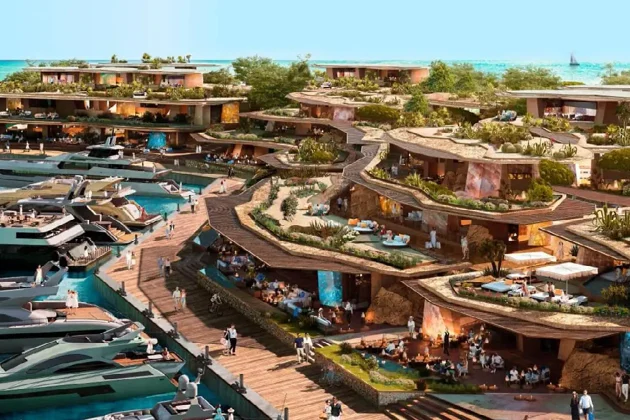
Sindalah’s yacht hub, boasting an 86-berth marina
Sindalah, on the other hand, mimics the summer-season obsessions of the 1%, with a sort of Caribbean-Mediterranean mash-up that is calibrated to entice the yachting classes. An island off the coast of Saudi Arabia in the Red Sea, this will be the first Neom project to be completed, apparently — an “840,000m² playground for the world’s luxury travellers” which will play host to “sophisticated cultural events, adrenaline-fuled [sic] sporting spectacles and glamorous social happenings”. Renders show women in linen kaftans on yacht-lined lagoons, while the press release outlines a complex of “413 rooms — including 88 villas — as well as 333 serviced apartments,” offering “world-class hospitality, fine dining and curated events in one perfect destination”. It seems to be the least ambitious of the four — essentially little more than a new island holiday resort; an inorganic Mauritius, say. For that reason, it may also be the most readily adopted by westerners.
The fourth city is Oxagon, the industrial heartland of Neom. It hopes to create “factories of the future for products of the future”, and be “a place where innovators and entrepreneurs can accelerate ideas from labs to market, and a city where people come together to live, work and play — in thriving communities.” This, one imagines, will be the largest moneymaker and will hope to centre the Gulf as the new global capital of trade. (It will also, one imagines, be populated by a far less wealthy class of citizen than Sindalah or Trojena.) It is a floating city in the shape of an octagon — not so much centred on a port as one huge, “fully automated next-generation port” itself, that will “offer unparalled [sic] connectivity to global markets, enabled by an integrated physical and digital supply chain”. Its renders look, at first glance, like suburban Miami — low slung houses, palm trees, warehouses — while others show off-brand Tesla factories and Lego-grade shipping containers. It will be powered by 100% clean energy and governed by an “unmatched regulatory business environment”.
Neom’s critics will take that with a heavy pinch of salt. The development has not been without its controversies, to say the least. The alleged murder of journalist Jamal Khashoggi in 2018 still hangs heavily over any projects helmed by de-facto Saudi ruler Crown Prince Mohammed bin Salman, while many local tribes have been forced to relocate to make room for the development, often under duress and threats. (It’s estimated that 20,000 people will be displaced.) There are widespread allegations of a highly abusive work culture, too — from manual labour up to the corporate level — a great deal of which has coalesced around Neom’s controversial firebrand CEO, Nadhmi Al- Nasr. “I drive everybody like a slave, and when they drop down dead, I celebrate,” Nasr is reported to have said of the allegedly relentless, demeaning working culture of Neom. “That’s how I do my projects.” Meanwhile, the Line’s plans to use its citizens’ personal data and information as a sort of pseudo-currency to allocate power, water, healthcare and security has been heavily criticised as an illegal breach of digital (and quite possibly human) rights.
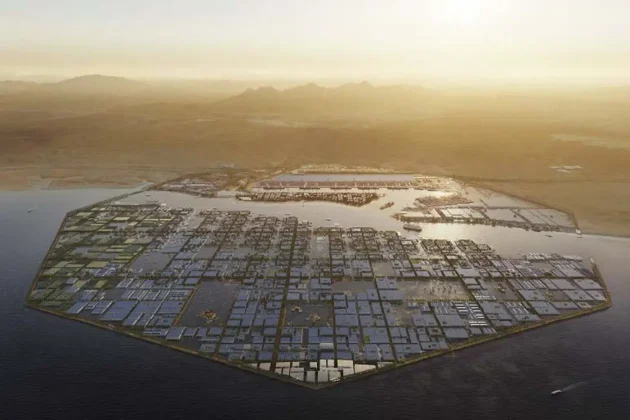
Oxagon, future home to industry
“Factories of the future for products of the future”
Its defenders (often shepherded by American PR firm Ruder Finn, on a $1.7million retainer) say that disruption is essential to progress, and that the singular vision of a sovereign-backed semi-autocracy is a very efficient way to fight the pressing global challenges of overpopulation, climate change and industrial growth. At the same time, any megaproject — think of the space race of the 1960s, or the Second World War — has the collateral effect of massively accelerating more ordinary technology and spurring innovation, no matter what its primary aim or effects might be. Neom might attempt to make a linear, futuristic city in the desert, say, and in doing so vastly improve battery-life for cars on the roads of Michigan, or reliable clean water for a village in Somalia. Depending on your position, it is either heartening or disconcerting to think that the success of these many projects, in the short-to-medium term at least, might hinge on the whims of the yacht-owning, après-ski quaffing elite.
Read more about luxury real estate markets in our first issue of The JamesEdition:
Get exclusive access now. Completely free.