Prix sur demande
Propriété Historique À Vendre À Florence Chianti
- 50 Chambres
- 30 SdB
- 175,226 Sqft
- 44.73 Ac lot
- Mis à jour: Août 7
- 10
À propos de la propriété
La description a été traduite automatiquement.
La description est affichée dans la langue d'origine.
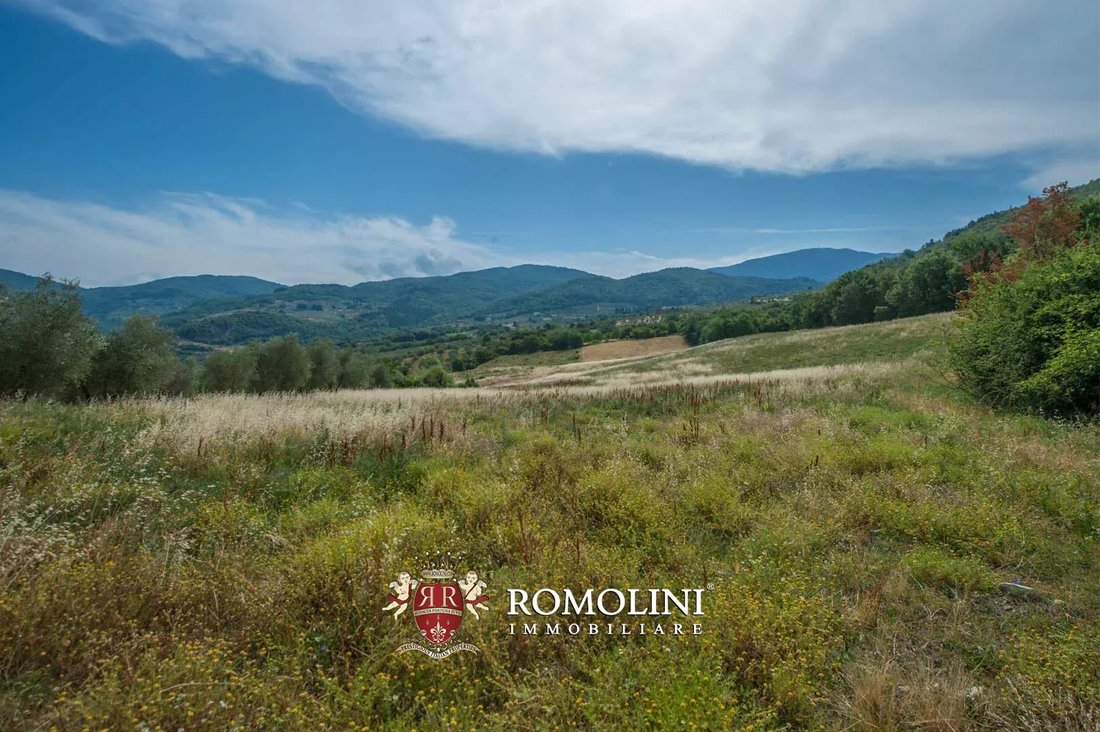
Dans la province de Florence, sur les collines du Chianti, prestigieux domaine historique avec manoir et cave.
Facilement accessible, non loin d’un centre avec tous les services (6 km ; 10 minutes), la propriété offre un accès rapide et excellent à toute la Toscane : la belle Florence (25 km ; 40 minutes), les tourelles de San Gimignano (76 km ; 1 h 20), Sienne (84 km
Facilement accessible, non loin d’un centre avec tous les services (6 km ; 10 minutes), la propriété offre un accès rapide et excellent à toute la Toscane : la belle Florence (25 km ; 40 minutes), les tourelles de San Gimignano (76 km ; 1 h 20), Sienne (84 km
In the province of Florence, on the Chianti Hills, prestigious historical estate with manor villa and winery.
In an easily accessed location, not far from a center with all the services (6km; 10’), the property grants a quick and excellent access to the whole Tuscany: the beautiful Florence (25km; 40’), the turreted San Gimignano (76km; 1h 20’), Siena (84km; 1h 25’), the renowned Montepul
In an easily accessed location, not far from a center with all the services (6km; 10’), the property grants a quick and excellent access to the whole Tuscany: the beautiful Florence (25km; 40’), the turreted San Gimignano (76km; 1h 20’), Siena (84km; 1h 25’), the renowned Montepul
Dans la province de Florence, sur les collines du Chianti, prestigieux domaine historique avec manoir et cave.
Facilement accessible, non loin d’un centre avec tous les services (6 km ; 10 minutes), la propriété offre un accès rapide et excellent à toute la Toscane : la belle Florence (25 km ; 40 minutes), les tourelles de San Gimignano (76 km ; 1 h 20), Sienne (84 km ; 1 h 25), le célèbre Montepulciano (95 km ; 1 h 15) et Montalcino (122 km ; 1h 45’) et la Pienza papale (102 km ; 1h 25’).
Les aéroports pour rejoindre l’établissement en un temps raisonnable sont Firenze Peretola (49 km ; 45 minutes), Pise Galilei (109 km ; 1h 25 minutes), Bologna Marconi (130 km ; 1h 35 minutes), Perugia Sant’Egidio (145 km ; 1h 40 ’), Roma Ciampino (273 km ; 2h 45’) et Roma Fiumicino (288 km ; 2h 50 ’).
DESCRIPTION DES BÂTIMENTS
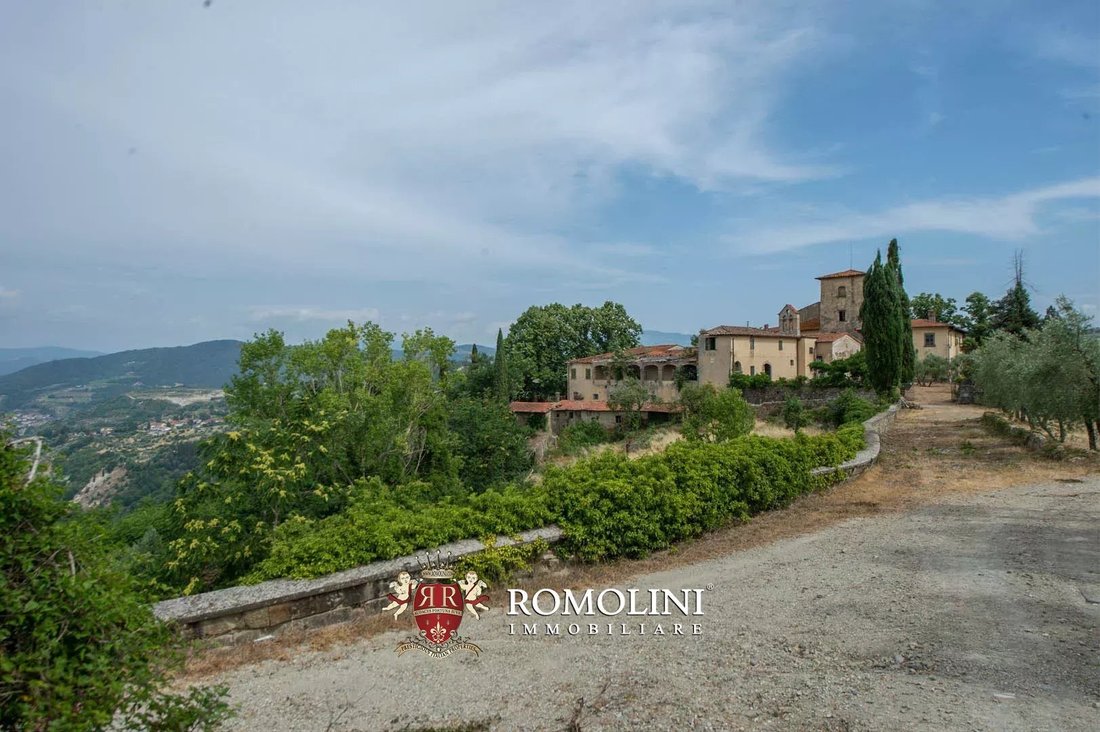
La propriété est composée de nombreux bâtiments (17 pour une surface totale de 15 500 m²) répartis entre les différentes fermes. Cerise sur le gâteau, le manoir historique constitue le noyau le plus ancien de la propriété, datant des XIe et XIVe siècles. Ce hameau, au-delà de la villa, comprend une église de la fin du Moyen Âge, un moulin à huile, plusieurs caves, un bureau pour l’entreprise, un atelier et l’une des fermes.
Les cinq autres fermes comprennent plusieurs bâtiments destinés à un usage agricole et résidentiel, en partie à restaurer, en partie déjà restaurés et presque habitables.
En résumé, la propriété comprend 11 000 m² (118 360 pieds carrés) de bâtiments résidentiels, 3 000 m² (32 280 pieds carrés) de hangars agricoles et 1 500 m² (16 140 pieds carrés) de bâtiments ruraux.
HISTOIRE, ÉTAT ET FINITIONS
Le domaine se trouve sur une terre habitée depuis la Préhistoire, mais la première véritable civilisation à avoir construit et utilisé la région a été les Étrusques à partir du VIIe siècle avant notre ère. Les Romains reprendraient ensuite l’héritage du peuple étrusque en construisant d’impressionnantes villas et fermes dans la région. C’était une époque prospère pour les habitants, qui bénéficiaient d’une bonne autonomie. Mais cela ne devait pas durer : l’arrivée de peuples germaniques du nord de l’Europe après la chute de Rome au Ve siècle de notre ère a radicalement changé la donne.
L’organisation féodale imposée par les Lombards a sévèrement réduit l’indépendance des habitants de la région et les a contraints à s’incliner devant les nouveaux conquérants.
Après la fin du règne langobardique, la Toscane a été conquise et administrée par les Francs (puis les Allemands avec le Saint Empire romain germanique) et, au Xe siècle, un processus d’encastellation a commencé à grande échelle dans la région de Florence, où se trouve aujourd’hui la villa.
Le château apparaît pour la première fois dans un document daté de 1080 après JC, puis dans plusieurs autres documents datant de 1102, 1123 et 1171 après JC. Les propriétaires du château ont décidé de l’abandonner lorsque Florence a commencé à devenir une superpuissance en Italie centrale entre 1140 et 1153. Ce qui est certain, c’est que les habitants du fief ont participé à la deuxième croisade en 1145 sous le drapeau de Guido Guerra II. Au cours de la deuxième décennie du XIIIe siècle, la famille a décidé d’abandonner définitivement le château en le donnant à l’abbaye voisine de Vallombrosa. Par la suite, le château a probablement été détruit (ou du moins fortement endommagé) par les armées gibelines à la suite de leur victoire à la bataille de Montaperti en 1260 après JC (rappelé par Dante dans les célèbres vers « [...] le massacre et le grand carnage/qui ont taché de pourpre les Arbia »).
Comme en témoigne un document datant de 1427, le château avait déjà été totalement démoli cette année-là et les vestiges servaient de base à un nouveau bâtiment (aujourd’hui une ferme) construit entre 1260 et 1420. Cependant, le bâtiment était déjà dans un état de ruine avancé et, au XVIIe siècle, les nouveaux propriétaires ont décidé de restaurer la partie nord du complexe, qui comprenait l’ancienne tour (le seul vestige du château), en obtenant une villa. Lorsque, au XIXe siècle, la propriété a de nouveau changé de mains, le presbytère de l’église a été agrandi, ce qui a permis de relier la villa à la ferme. Le dernier changement (qui a donné au complexe son aspect actuel) a été le déplacement du clocher de la gauche vers la droite de l’église.
La propriété est actuellement en grande partie abandonnée et seuls quelques-uns des bâtiments ont été renforcés structurellement et restaurés. La villa, en particulier, est un véritable joyau, recouverte de fresques et de décorations, mais elle nécessite de nombreux travaux pour retrouver sa splendeur d’origine. L’église est également en mauvais état, le toit étant partiellement effondré.
Les autres fermes sont principalement composées de bâtiments ruraux et agricoles (qui sont plus faciles à récupérer et à restaurer en suivant les directives relatives aux bâtiments historiques).
La cave fonctionne actuellement, ainsi que le moulin à huile, et tous deux permettent la production régulière d’huile d’olive et de vins.
EXTÉRIEUR
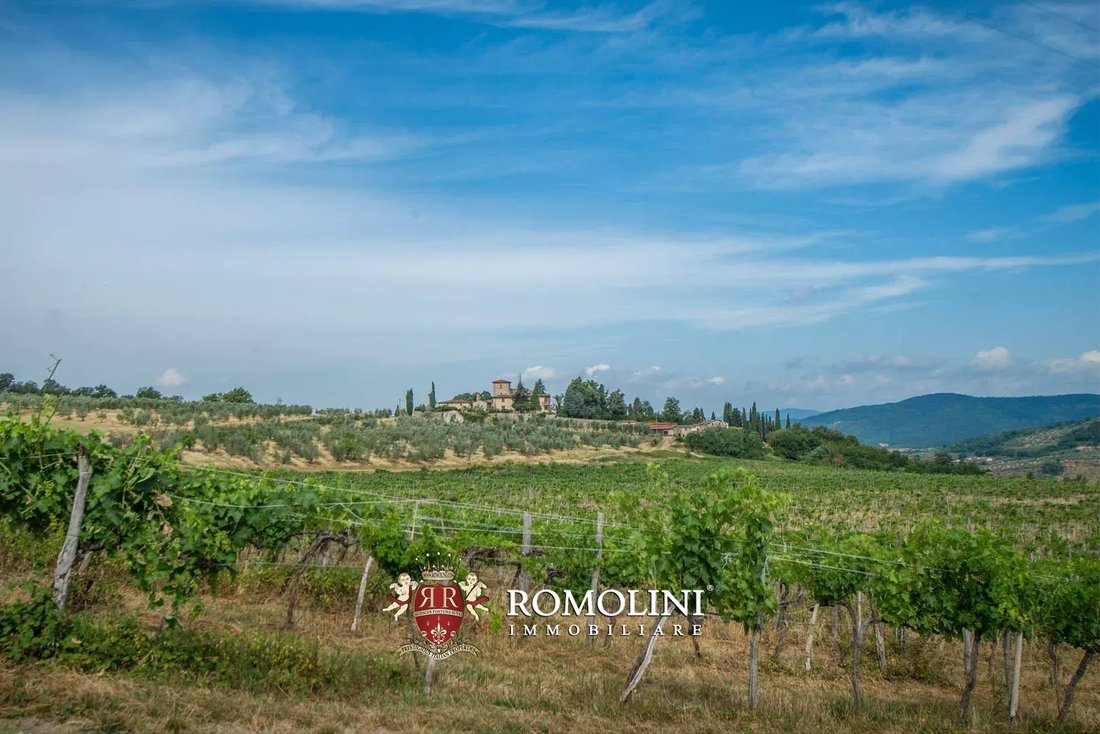
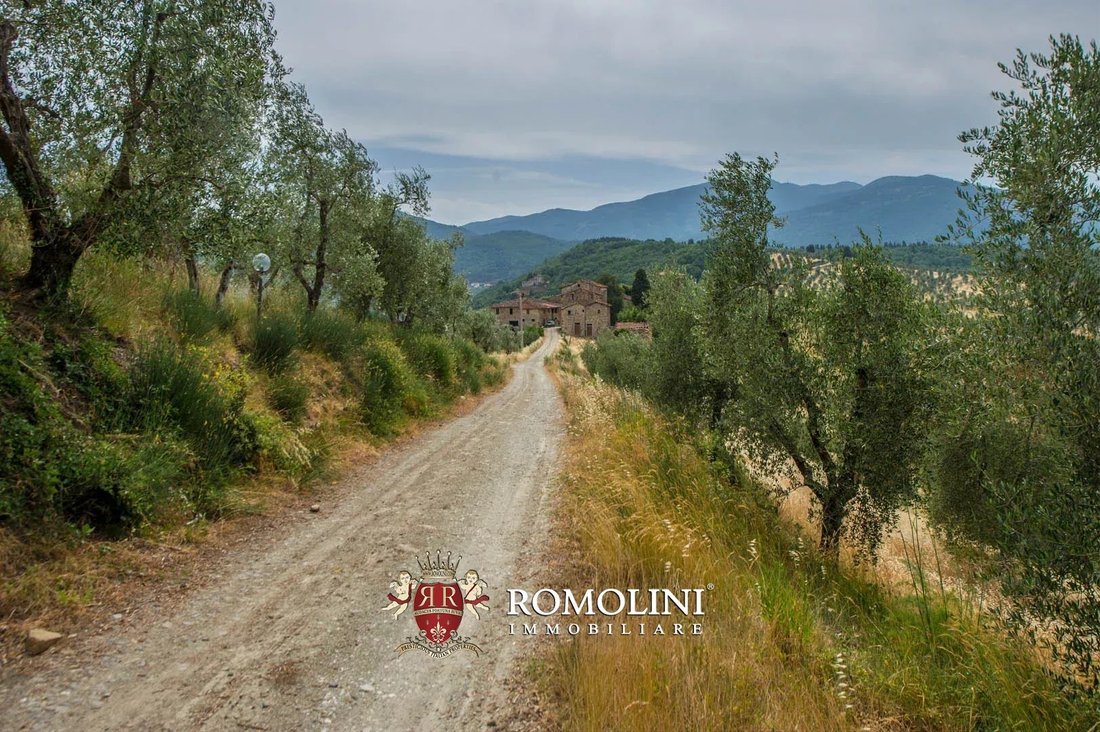
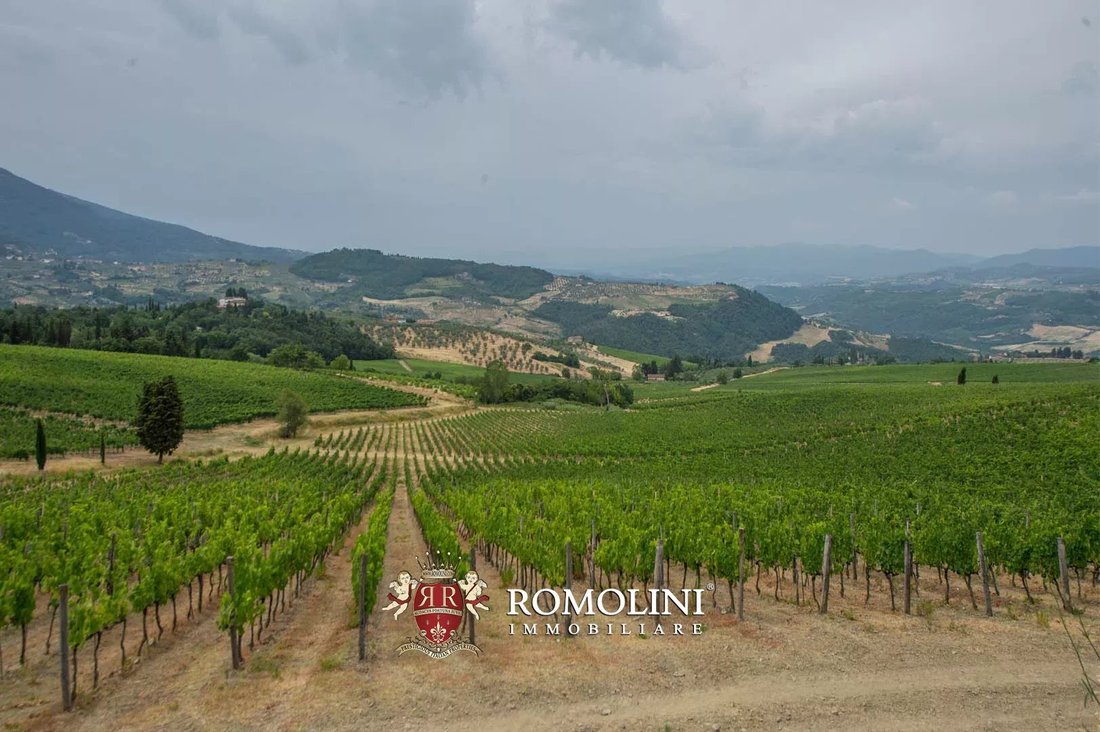
La propriété se compose d’un terrain de 236,2 hectares, réparti entre vignoble (18,1 ha), oliveraie (47,7 ha), terres arables (82,2 ha), pâturages (7,8 ha), verger (2,6 ha) et terres mixtes zone boisée (77,8 ha).
Le vignoble est potentiellement extensible sur 27 hectares supplémentaires, en reprenant une partie des terres des parcelles arables (dont 12 hectares étaient utilisés comme vignobles dans le passé). Il en va de même pour l’oliveraie, qui devrait être agrandie de 8 hectares supplémentaires grâce au programme de développement rural qui pourrait couvrir jusqu’à 80 % du coût total.
La production d’olives est totalement biologique (avec certification), sans utilisation de pesticides ni d’engrais chimiques, alors que le vignoble n’a pas encore obtenu la certification, même si la récolte est effectuée sans utiliser de substances chimiques. Les vendanges manuelles et le tri des raisins contribuent à l’excellente qualité du vin.
DÉTAILS SUR LA PRODUCTION DE VIN
- Surface du vignoble : 18,1 hectares (+ 27,0 ha disponibles pour la plantation)
- Variétés : Sangiovese, Cabernet Sauvignon, Canaiolo, Syrah, Malvasia et Trebbiano
- Année de plantation : 1957 — 2011
- Altitude : 280 à 330 m
- Exposition : sud, sud-est, sud-ouest
- Densité : 3 500 à 5 000 vignes/ha
- Rendement moyen : 4,5 à 7,0 tonnes/ha
- Entraînement : vignes taillées en éperon et dressées en cordon
- Récolte : manuelle
- Composition du sol : calcaire, marneux, argileux
- Production annuelle : 350,0 hl (46 700 bouteilles)
- Productions potentielles maximales : 1 425,0 hl (190 000 bouteilles)
- Capacité maximale de vin : 1 870,0 hl
VINS PRODUITS
- Chianti Colli Fiorentini DOCG : 100 % Sangiovese
- Chianti Colli Fiorentini DOCG Reserva : 90 % Sangiovese, 10 % Cabernet-Sauvignon
- Rosso Toscano IGT : 40 % Sangiovese, 30 % Canaiolo, 20 % Malvasia, 10 % Trebbiano
- Rosso Toscano IGT : 50 % cabernet-sauvignon, 25 % merlot, 25 % syrah
- Bianco Toscano IGT : 50 % Cabernet-Sauvignon, 50 % Chardonnay
DÉTAILS SUR LA PRODUCTION DE PÉTROLE
- Surface : 47,7 hectares (+ 8,0 ha disponibles pour la plantation)
- Variétés : Frantoio, Moraiolo, Leccino, Pendolino et Peranzana
- Altitude : 300 à 350 m
- Composition du sol : calcaire, marneux, argileux
- Production annuelle : 90,0 hl (12 000 bouteilles)
UTILISATION ET UTILISATIONS POTENTIELLES
La propriété est actuellement utilisée exclusivement comme une entreprise de production de vin et d’huile, avec une production annuelle d’environ 46 700 bouteilles de vin (350 hl) et 12 000 bouteilles d’huile (90 hl). Les bâtiments sont partiellement restaurés et utilisables sans travaux.
Le domaine est parfait pour ceux qui recherchent quelque chose à développer en parallèle avec le commerce de l’huile et du vin. Avec une restauration complète, on pourrait envisager de démarrer une activité d’hébergement de haute qualité, principalement grâce aux nombreuses chambres disponibles et à la position panoramique.
Un projet de reconversion a déjà été approuvé et prévoit la construction d’un hôtel avec restaurant, salle de conférence, musée du pétrole, centre de bien-être, boutique de produits locaux, installations sportives et la conversion de certaines fermes en appartements.
En ce qui concerne les installations sportives, il est possible de construire des piscines et des courts de tennis dans la limite d’un par groupe de bâtiments, à l’exception de la villa principale qui est suffisamment spacieuse pour permettre la construction d’une piscine et d’un court de tennis à proximité.
VILLES ET VILLAGES LES PLUS PROCHES
Ville desservie (6 km ; 10 minutes), Figline e Incisa Valdarno (14 km ; 20 minutes), Florence (25 km ; 40 minutes), San Gimignano (76 km ; 1h 20 minutes), Sienne (84 km ; 1h 25 minutes), Montepulciano (95 km ; 1h 15 minutes), Pienza (102 km ; 1h 25’), Montalcino (122 km ; 1h 45’)
AÉROPORTS LES PLUS PROCHES
Firenze Peretola (49 km ; 45 minutes), Pise Galilei (109 km ; 1 h 25), Bologne Marconi (130 km ; 1 h 35), Pérouse Sant’Egidio (145 km ; 1 h 40), Rome Ciampino (273 km ; 2 h 45), Rome Fiumicino (288 km ; 2 h 50)
Facilement accessible, non loin d’un centre avec tous les services (6 km ; 10 minutes), la propriété offre un accès rapide et excellent à toute la Toscane : la belle Florence (25 km ; 40 minutes), les tourelles de San Gimignano (76 km ; 1 h 20), Sienne (84 km ; 1 h 25), le célèbre Montepulciano (95 km ; 1 h 15) et Montalcino (122 km ; 1h 45’) et la Pienza papale (102 km ; 1h 25’).
Les aéroports pour rejoindre l’établissement en un temps raisonnable sont Firenze Peretola (49 km ; 45 minutes), Pise Galilei (109 km ; 1h 25 minutes), Bologna Marconi (130 km ; 1h 35 minutes), Perugia Sant’Egidio (145 km ; 1h 40 ’), Roma Ciampino (273 km ; 2h 45’) et Roma Fiumicino (288 km ; 2h 50 ’).
DESCRIPTION DES BÂTIMENTS
La propriété est composée de nombreux bâtiments (17 pour une surface totale de 15 500 m²) répartis entre les différentes fermes. Cerise sur le gâteau, le manoir historique constitue le noyau le plus ancien de la propriété, datant des XIe et XIVe siècles. Ce hameau, au-delà de la villa, comprend une église de la fin du Moyen Âge, un moulin à huile, plusieurs caves, un bureau pour l’entreprise, un atelier et l’une des fermes.
Les cinq autres fermes comprennent plusieurs bâtiments destinés à un usage agricole et résidentiel, en partie à restaurer, en partie déjà restaurés et presque habitables.
En résumé, la propriété comprend 11 000 m² (118 360 pieds carrés) de bâtiments résidentiels, 3 000 m² (32 280 pieds carrés) de hangars agricoles et 1 500 m² (16 140 pieds carrés) de bâtiments ruraux.
HISTOIRE, ÉTAT ET FINITIONS
Le domaine se trouve sur une terre habitée depuis la Préhistoire, mais la première véritable civilisation à avoir construit et utilisé la région a été les Étrusques à partir du VIIe siècle avant notre ère. Les Romains reprendraient ensuite l’héritage du peuple étrusque en construisant d’impressionnantes villas et fermes dans la région. C’était une époque prospère pour les habitants, qui bénéficiaient d’une bonne autonomie. Mais cela ne devait pas durer : l’arrivée de peuples germaniques du nord de l’Europe après la chute de Rome au Ve siècle de notre ère a radicalement changé la donne.
L’organisation féodale imposée par les Lombards a sévèrement réduit l’indépendance des habitants de la région et les a contraints à s’incliner devant les nouveaux conquérants.
Après la fin du règne langobardique, la Toscane a été conquise et administrée par les Francs (puis les Allemands avec le Saint Empire romain germanique) et, au Xe siècle, un processus d’encastellation a commencé à grande échelle dans la région de Florence, où se trouve aujourd’hui la villa.
Le château apparaît pour la première fois dans un document daté de 1080 après JC, puis dans plusieurs autres documents datant de 1102, 1123 et 1171 après JC. Les propriétaires du château ont décidé de l’abandonner lorsque Florence a commencé à devenir une superpuissance en Italie centrale entre 1140 et 1153. Ce qui est certain, c’est que les habitants du fief ont participé à la deuxième croisade en 1145 sous le drapeau de Guido Guerra II. Au cours de la deuxième décennie du XIIIe siècle, la famille a décidé d’abandonner définitivement le château en le donnant à l’abbaye voisine de Vallombrosa. Par la suite, le château a probablement été détruit (ou du moins fortement endommagé) par les armées gibelines à la suite de leur victoire à la bataille de Montaperti en 1260 après JC (rappelé par Dante dans les célèbres vers « [...] le massacre et le grand carnage/qui ont taché de pourpre les Arbia »).
Comme en témoigne un document datant de 1427, le château avait déjà été totalement démoli cette année-là et les vestiges servaient de base à un nouveau bâtiment (aujourd’hui une ferme) construit entre 1260 et 1420. Cependant, le bâtiment était déjà dans un état de ruine avancé et, au XVIIe siècle, les nouveaux propriétaires ont décidé de restaurer la partie nord du complexe, qui comprenait l’ancienne tour (le seul vestige du château), en obtenant une villa. Lorsque, au XIXe siècle, la propriété a de nouveau changé de mains, le presbytère de l’église a été agrandi, ce qui a permis de relier la villa à la ferme. Le dernier changement (qui a donné au complexe son aspect actuel) a été le déplacement du clocher de la gauche vers la droite de l’église.
La propriété est actuellement en grande partie abandonnée et seuls quelques-uns des bâtiments ont été renforcés structurellement et restaurés. La villa, en particulier, est un véritable joyau, recouverte de fresques et de décorations, mais elle nécessite de nombreux travaux pour retrouver sa splendeur d’origine. L’église est également en mauvais état, le toit étant partiellement effondré.
Les autres fermes sont principalement composées de bâtiments ruraux et agricoles (qui sont plus faciles à récupérer et à restaurer en suivant les directives relatives aux bâtiments historiques).
La cave fonctionne actuellement, ainsi que le moulin à huile, et tous deux permettent la production régulière d’huile d’olive et de vins.
EXTÉRIEUR
La propriété se compose d’un terrain de 236,2 hectares, réparti entre vignoble (18,1 ha), oliveraie (47,7 ha), terres arables (82,2 ha), pâturages (7,8 ha), verger (2,6 ha) et terres mixtes zone boisée (77,8 ha).
Le vignoble est potentiellement extensible sur 27 hectares supplémentaires, en reprenant une partie des terres des parcelles arables (dont 12 hectares étaient utilisés comme vignobles dans le passé). Il en va de même pour l’oliveraie, qui devrait être agrandie de 8 hectares supplémentaires grâce au programme de développement rural qui pourrait couvrir jusqu’à 80 % du coût total.
La production d’olives est totalement biologique (avec certification), sans utilisation de pesticides ni d’engrais chimiques, alors que le vignoble n’a pas encore obtenu la certification, même si la récolte est effectuée sans utiliser de substances chimiques. Les vendanges manuelles et le tri des raisins contribuent à l’excellente qualité du vin.
DÉTAILS SUR LA PRODUCTION DE VIN
- Surface du vignoble : 18,1 hectares (+ 27,0 ha disponibles pour la plantation)
- Variétés : Sangiovese, Cabernet Sauvignon, Canaiolo, Syrah, Malvasia et Trebbiano
- Année de plantation : 1957 — 2011
- Altitude : 280 à 330 m
- Exposition : sud, sud-est, sud-ouest
- Densité : 3 500 à 5 000 vignes/ha
- Rendement moyen : 4,5 à 7,0 tonnes/ha
- Entraînement : vignes taillées en éperon et dressées en cordon
- Récolte : manuelle
- Composition du sol : calcaire, marneux, argileux
- Production annuelle : 350,0 hl (46 700 bouteilles)
- Productions potentielles maximales : 1 425,0 hl (190 000 bouteilles)
- Capacité maximale de vin : 1 870,0 hl
VINS PRODUITS
- Chianti Colli Fiorentini DOCG : 100 % Sangiovese
- Chianti Colli Fiorentini DOCG Reserva : 90 % Sangiovese, 10 % Cabernet-Sauvignon
- Rosso Toscano IGT : 40 % Sangiovese, 30 % Canaiolo, 20 % Malvasia, 10 % Trebbiano
- Rosso Toscano IGT : 50 % cabernet-sauvignon, 25 % merlot, 25 % syrah
- Bianco Toscano IGT : 50 % Cabernet-Sauvignon, 50 % Chardonnay
DÉTAILS SUR LA PRODUCTION DE PÉTROLE
- Surface : 47,7 hectares (+ 8,0 ha disponibles pour la plantation)
- Variétés : Frantoio, Moraiolo, Leccino, Pendolino et Peranzana
- Altitude : 300 à 350 m
- Composition du sol : calcaire, marneux, argileux
- Production annuelle : 90,0 hl (12 000 bouteilles)
UTILISATION ET UTILISATIONS POTENTIELLES
La propriété est actuellement utilisée exclusivement comme une entreprise de production de vin et d’huile, avec une production annuelle d’environ 46 700 bouteilles de vin (350 hl) et 12 000 bouteilles d’huile (90 hl). Les bâtiments sont partiellement restaurés et utilisables sans travaux.
Le domaine est parfait pour ceux qui recherchent quelque chose à développer en parallèle avec le commerce de l’huile et du vin. Avec une restauration complète, on pourrait envisager de démarrer une activité d’hébergement de haute qualité, principalement grâce aux nombreuses chambres disponibles et à la position panoramique.
Un projet de reconversion a déjà été approuvé et prévoit la construction d’un hôtel avec restaurant, salle de conférence, musée du pétrole, centre de bien-être, boutique de produits locaux, installations sportives et la conversion de certaines fermes en appartements.
En ce qui concerne les installations sportives, il est possible de construire des piscines et des courts de tennis dans la limite d’un par groupe de bâtiments, à l’exception de la villa principale qui est suffisamment spacieuse pour permettre la construction d’une piscine et d’un court de tennis à proximité.
VILLES ET VILLAGES LES PLUS PROCHES
Ville desservie (6 km ; 10 minutes), Figline e Incisa Valdarno (14 km ; 20 minutes), Florence (25 km ; 40 minutes), San Gimignano (76 km ; 1h 20 minutes), Sienne (84 km ; 1h 25 minutes), Montepulciano (95 km ; 1h 15 minutes), Pienza (102 km ; 1h 25’), Montalcino (122 km ; 1h 45’)
AÉROPORTS LES PLUS PROCHES
Firenze Peretola (49 km ; 45 minutes), Pise Galilei (109 km ; 1 h 25), Bologne Marconi (130 km ; 1 h 35), Pérouse Sant’Egidio (145 km ; 1 h 40), Rome Ciampino (273 km ; 2 h 45), Rome Fiumicino (288 km ; 2 h 50)
In the province of Florence, on the Chianti Hills, prestigious historical estate with manor villa and winery.
In an easily accessed location, not far from a center with all the services (6km; 10’), the property grants a quick and excellent access to the whole Tuscany: the beautiful Florence (25km; 40’), the turreted San Gimignano (76km; 1h 20’), Siena (84km; 1h 25’), the renowned Montepulciano (95km; 1h 15’) and Montalcino (122km; 1h 45’) and the papal Pienza (102km; 1h 25’).
The airports to reach the property in reasonable time are Firenze Peretola (49km; 45’), Pisa Galilei (109km; 1h 25’), Bologna Marconi (130km; 1h 35’), Perugia Sant’Egidio (145km; 1h 40’), Roma Ciampino (273km; 2h 45’) e Roma Fiumicino (288km; 2h 50’).
DESCRIPTION OF THE BUILDINGS
The property is made up of numerous buildings (17 for a total surface of 15,500 sqm) split among the various farms. Icing on the cake is the historical manor villa, constituting the older core of the property dating back to the 11th and 14th century. This hamlet, beyond the villa, includes a late Middle Ages church, an olive mill, several cellar rooms, office for the business, a workshop and one of the farms.
The other five farms include several buildings intended for agricultural and residential use, partially to be restored partially already restored and almost livable.
To summarize, the property boasts 11,000 sqm (118,360 sqft) of residential buildings, 3,000 sqm (32,280 sqft) of agricultural sheds and 1,500 sqm (16,140 sqft) of rural buildings.
HISTORY, STATE AND FINISHES
The estate lies on a land inhabited since Prehistory, but the first real civilization to build and use the region was the Etruscans starting from the 7th century BC. Romans would then pick up the legacy of the Etruscan people by building impressive villas and farms in the region. It was a prosperous age for the inhabitants, which were granted a good degree of autonomy. However this wasn’t bound to last: the arrival of Germanic people from northern Europe after the fall of Rome in the 5th century AD dramatically changed the situation.
The feudal organization imposed by the Longobards severely reduced the independence for the people in the area and forced them to bow to the new conquerors.
After the end of the Langobardic reign, Tuscany was conquered and administered by Franks (and then Germans with the Holy Roman Empire) and in the 10th century a process of encastellation began on a large scale in the area of Florence and where the villa is sitting today.
The castle appears for the first time in a document dated 1080 AD and then in several other papers from 1102, 1123 and 1171 AD. The owners of the castle decided to abandon it when Florence started emerging as a superpower in Central Italy between 1140 and 1153. What is sure is that the people of the fiefdom took part in the Second Crusade in 1145 under the flag of Guido Guerra II. In the second decade of the 13th century the family decided to finally give up the castle by donating it to the nearby Abbey of Vallombrosa. After that, the castle was probably destroyed (or at least heavily damaged) by the Ghibellines armies following their victory in the battle of Montaperti in 1260 AD (recalled by Dante in the famous verses “[…] the slaughter and great carnage / which have with crimson stained the Arbia”).
As testified by a document from 1427, by that year the castle had already been totally demolished and the remains used as a base for a new building (nowadays a farm) which was built between 1260 and 1420. However, the building was already in an advanced state of ruin and during the 17th century the new owners decided to restore the northern part of the complex which included the old tower (the only remain of the castle), obtaining a villa. When in the 19th century the property changed hands again, the rectory of the church was expanded and this allowed the conjunction of the villa with the farm. The last change (which is the one that made the complex look what it is today) was the relocation of the bell tower from the left to the right side of the church.
The property is currently abandoned for the most part and just a few of the buildings have been structurally reinforced and restored. The villa in particular is a real gem, covered as it is in frescoes and decorations; however it needs lots of work to be brought back to its original splendor. The church is also in bad shape, with the roof partially collapsed.
The other farms are mainly made up of rural and agricultural buildings (which are easier to recover and restore following the guidelines for historical buildings).
The cellar is currently working, as well as the olive mill, and both grant the regular production of olive oil and wines.
EXTERIOR
The property consists of a 236.2 hectares piece of land, split among vineyard (18.1 ha), olive grove (47.7 ha), arable land (82.2 ha), grazing land (7.8 ha), fruit orchard (2.6 ha) and mixed woodland (77.8 ha).
The vineyard is potentially expandable for further 27 hectares, taking some land from the arable plots (12 hectares of which had been used as a vineyard in the past). Same goes for the olive grove, which should be expanded with 8 more hectares thanks to the Rural Development Program which could cover up to 80% of the total cost.
The production of olives is totally organic (with certification), without the use of pesticides and chemical fertilizers, while vineyard hasn’t got the certification yet, even if harvesting is carried out without using chemical substances. Manual harvesting and sorting of grapes contribute to the excellent quality of the wine.
DETAILS ON WINE PRODUCTION
- Vineyard surface: 18.1 hectares (+ 27.0 ha available for plantation)
- Varieties: Sangiovese, Cabernet Sauvignon, Canaiolo, Syrah, Malvasia and Trebbiano
- Year of planting: 1957 – 2011
- Altitude: 280 – 330 m
- Exposure: south, south-east, south-west
- Density: 3,500 – 5,000 vines / ha
- Average yield: 4.5 – 7.0 tons / ha
- Training: pruned-spur cordon-trained vines
- Harvesting: manual
- Soil composition: calcareous, marlstone, clayish
- Yearly production: 350.0 hl (46,700 bottles)
- Maximum potential productions: 1,425.0 hl (190,000 bottles)
- Maximum wine capacity: 1,870.0 hl
PRODUCED WINES
- Chianti Colli Fiorentini DOCG: 100% Sangiovese
- Chianti Colli Fiorentini DOCG Riserva: 90% Sangiovese, 10% Cabernet Sauvignon
- Rosso Toscano IGT: 40% Sangiovese, 30% Canaiolo, 20% Malvasia, 10% Trebbiano
- Rosso Toscano IGT: 50% Cabernet Sauvignon, 25% Merlot, 25% Syrah
- Bianco Toscano IGT: 50% Cabernet Sauvignon, 50% Chardonnay
DETAILS ON OIL PRODUCTION
- Surface: 47.7 hectares (+ 8.0 ha available for plantation)
- Varieties: Frantoio, Moraiolo, Leccino, Pendolino and Peranzana
- Altitude: 300 – 350 m
- Soil composition: calcareous, marlstone, clayish
- Yearly production: 90.0 hl (12,000 bottles)
USE AND POTENTIAL USES
The property is currently used exclusively as a wine and oil producing business, with a yearly production ranging around 46,700 bottles of wine (350 hl) and 12,000 bottles of oil (90 hl). Buildings are partially restored and usable without any work needed.
The estate is perfect for someone looking for something to develop in parallel with the oil and wine business. With a full restoration one could, as a matter of fact, think about starting a high quality hosting business, mainly thanks to the numerous available bedrooms and the panoramic position.
A conversion project has already been approved and envisages the realization of a hotel with restaurant, conference hall, oil museum, wellness centre, shop for local products, sporting facilities and the conversion of some of the farms into apartments.
As far as sporting facilities are concerned, there is the possibility of building pools and tennis courts with a limitation of one per group of buildings, with the exception of the main villa which is ample enough to allow the construction of both a pool and a tennis court in the vicinity.
CLOSEST CITIES AND TOWN†S
Town with services (6km; 10’), Figline e Incisa Valdarno (14km; 20’), Florence (25km; 40’), San Gimignano (76km; 1h 20’), Siena (84km; 1h 25’), Montepulciano (95km; 1h 15’), Pienza (102km; 1h 25’), Montalcino (122km; 1h 45’)
CLOSEST AIRPORTS
Firenze Peretola (49km; 45’), Pisa Galilei (109km; 1h 25’), Bologna Marconi (130km; 1h 35’), Perugia Sant’Egidio (145km; 1h 40’), Roma Ciampino (273km; 2h 45’), Roma Fiumicino (288km; 2h 50’)
In an easily accessed location, not far from a center with all the services (6km; 10’), the property grants a quick and excellent access to the whole Tuscany: the beautiful Florence (25km; 40’), the turreted San Gimignano (76km; 1h 20’), Siena (84km; 1h 25’), the renowned Montepulciano (95km; 1h 15’) and Montalcino (122km; 1h 45’) and the papal Pienza (102km; 1h 25’).
The airports to reach the property in reasonable time are Firenze Peretola (49km; 45’), Pisa Galilei (109km; 1h 25’), Bologna Marconi (130km; 1h 35’), Perugia Sant’Egidio (145km; 1h 40’), Roma Ciampino (273km; 2h 45’) e Roma Fiumicino (288km; 2h 50’).
DESCRIPTION OF THE BUILDINGS
The property is made up of numerous buildings (17 for a total surface of 15,500 sqm) split among the various farms. Icing on the cake is the historical manor villa, constituting the older core of the property dating back to the 11th and 14th century. This hamlet, beyond the villa, includes a late Middle Ages church, an olive mill, several cellar rooms, office for the business, a workshop and one of the farms.
The other five farms include several buildings intended for agricultural and residential use, partially to be restored partially already restored and almost livable.
To summarize, the property boasts 11,000 sqm (118,360 sqft) of residential buildings, 3,000 sqm (32,280 sqft) of agricultural sheds and 1,500 sqm (16,140 sqft) of rural buildings.
HISTORY, STATE AND FINISHES
The estate lies on a land inhabited since Prehistory, but the first real civilization to build and use the region was the Etruscans starting from the 7th century BC. Romans would then pick up the legacy of the Etruscan people by building impressive villas and farms in the region. It was a prosperous age for the inhabitants, which were granted a good degree of autonomy. However this wasn’t bound to last: the arrival of Germanic people from northern Europe after the fall of Rome in the 5th century AD dramatically changed the situation.
The feudal organization imposed by the Longobards severely reduced the independence for the people in the area and forced them to bow to the new conquerors.
After the end of the Langobardic reign, Tuscany was conquered and administered by Franks (and then Germans with the Holy Roman Empire) and in the 10th century a process of encastellation began on a large scale in the area of Florence and where the villa is sitting today.
The castle appears for the first time in a document dated 1080 AD and then in several other papers from 1102, 1123 and 1171 AD. The owners of the castle decided to abandon it when Florence started emerging as a superpower in Central Italy between 1140 and 1153. What is sure is that the people of the fiefdom took part in the Second Crusade in 1145 under the flag of Guido Guerra II. In the second decade of the 13th century the family decided to finally give up the castle by donating it to the nearby Abbey of Vallombrosa. After that, the castle was probably destroyed (or at least heavily damaged) by the Ghibellines armies following their victory in the battle of Montaperti in 1260 AD (recalled by Dante in the famous verses “[…] the slaughter and great carnage / which have with crimson stained the Arbia”).
As testified by a document from 1427, by that year the castle had already been totally demolished and the remains used as a base for a new building (nowadays a farm) which was built between 1260 and 1420. However, the building was already in an advanced state of ruin and during the 17th century the new owners decided to restore the northern part of the complex which included the old tower (the only remain of the castle), obtaining a villa. When in the 19th century the property changed hands again, the rectory of the church was expanded and this allowed the conjunction of the villa with the farm. The last change (which is the one that made the complex look what it is today) was the relocation of the bell tower from the left to the right side of the church.
The property is currently abandoned for the most part and just a few of the buildings have been structurally reinforced and restored. The villa in particular is a real gem, covered as it is in frescoes and decorations; however it needs lots of work to be brought back to its original splendor. The church is also in bad shape, with the roof partially collapsed.
The other farms are mainly made up of rural and agricultural buildings (which are easier to recover and restore following the guidelines for historical buildings).
The cellar is currently working, as well as the olive mill, and both grant the regular production of olive oil and wines.
EXTERIOR
The property consists of a 236.2 hectares piece of land, split among vineyard (18.1 ha), olive grove (47.7 ha), arable land (82.2 ha), grazing land (7.8 ha), fruit orchard (2.6 ha) and mixed woodland (77.8 ha).
The vineyard is potentially expandable for further 27 hectares, taking some land from the arable plots (12 hectares of which had been used as a vineyard in the past). Same goes for the olive grove, which should be expanded with 8 more hectares thanks to the Rural Development Program which could cover up to 80% of the total cost.
The production of olives is totally organic (with certification), without the use of pesticides and chemical fertilizers, while vineyard hasn’t got the certification yet, even if harvesting is carried out without using chemical substances. Manual harvesting and sorting of grapes contribute to the excellent quality of the wine.
DETAILS ON WINE PRODUCTION
- Vineyard surface: 18.1 hectares (+ 27.0 ha available for plantation)
- Varieties: Sangiovese, Cabernet Sauvignon, Canaiolo, Syrah, Malvasia and Trebbiano
- Year of planting: 1957 – 2011
- Altitude: 280 – 330 m
- Exposure: south, south-east, south-west
- Density: 3,500 – 5,000 vines / ha
- Average yield: 4.5 – 7.0 tons / ha
- Training: pruned-spur cordon-trained vines
- Harvesting: manual
- Soil composition: calcareous, marlstone, clayish
- Yearly production: 350.0 hl (46,700 bottles)
- Maximum potential productions: 1,425.0 hl (190,000 bottles)
- Maximum wine capacity: 1,870.0 hl
PRODUCED WINES
- Chianti Colli Fiorentini DOCG: 100% Sangiovese
- Chianti Colli Fiorentini DOCG Riserva: 90% Sangiovese, 10% Cabernet Sauvignon
- Rosso Toscano IGT: 40% Sangiovese, 30% Canaiolo, 20% Malvasia, 10% Trebbiano
- Rosso Toscano IGT: 50% Cabernet Sauvignon, 25% Merlot, 25% Syrah
- Bianco Toscano IGT: 50% Cabernet Sauvignon, 50% Chardonnay
DETAILS ON OIL PRODUCTION
- Surface: 47.7 hectares (+ 8.0 ha available for plantation)
- Varieties: Frantoio, Moraiolo, Leccino, Pendolino and Peranzana
- Altitude: 300 – 350 m
- Soil composition: calcareous, marlstone, clayish
- Yearly production: 90.0 hl (12,000 bottles)
USE AND POTENTIAL USES
The property is currently used exclusively as a wine and oil producing business, with a yearly production ranging around 46,700 bottles of wine (350 hl) and 12,000 bottles of oil (90 hl). Buildings are partially restored and usable without any work needed.
The estate is perfect for someone looking for something to develop in parallel with the oil and wine business. With a full restoration one could, as a matter of fact, think about starting a high quality hosting business, mainly thanks to the numerous available bedrooms and the panoramic position.
A conversion project has already been approved and envisages the realization of a hotel with restaurant, conference hall, oil museum, wellness centre, shop for local products, sporting facilities and the conversion of some of the farms into apartments.
As far as sporting facilities are concerned, there is the possibility of building pools and tennis courts with a limitation of one per group of buildings, with the exception of the main villa which is ample enough to allow the construction of both a pool and a tennis court in the vicinity.
CLOSEST CITIES AND TOWN†S
Town with services (6km; 10’), Figline e Incisa Valdarno (14km; 20’), Florence (25km; 40’), San Gimignano (76km; 1h 20’), Siena (84km; 1h 25’), Montepulciano (95km; 1h 15’), Pienza (102km; 1h 25’), Montalcino (122km; 1h 45’)
CLOSEST AIRPORTS
Firenze Peretola (49km; 45’), Pisa Galilei (109km; 1h 25’), Bologna Marconi (130km; 1h 35’), Perugia Sant’Egidio (145km; 1h 40’), Roma Ciampino (273km; 2h 45’), Roma Fiumicino (288km; 2h 50’)
-
Type de propriété
Corps de ferme
-
Étages
3
Caractéristiques
Caractéristiques
Lot
Intérieur
Outdoor
- Terrasse
- Stationnement
- Piscine
- Garage
- Terrain de tennis
- Espace de vie extérieur
- Jardin
- Vignoble / Cave
Explorez le secteur
Pontassieve, Toscane, Italie
Voir sur Google Maps
Prix par sqft
Faible
Élevé
Nichée dans les collines toscanes, Pontassieve offre un mélange de tranquillité et d’accessibilité. Profitez de la proximité de Florence, le cœur de l’art et de la culture de la Renaissance, à seulement 25 minutes. Explorez les vignobles locaux et savourez une cuisine italienne authentique. La région offre un accès pratique aux boutiques de luxe et aux options de bien-être de Florence, tandis que la campagne pittoresque invite aux aventures en plein air. Idéal pour ceux qui cherchent un style de vie raffiné immergé dans le riche patrimoine de l’Italie.
Voir à proximité
Attractions
Écoles
Aéroport de Florence Peretola
Aéroport
36 min
Gare de Pontassieve
Pôle de transport public
5 min
Les Mall de Luxe
Boutique & Style de Vie
19 min
Galerie des Offices
Culture & Patrimoine
25 min
Ponte Vecchio
Culture & Patrimoine
27 min
Région viticole du Chianti
Plein air & Nature
32 min
École Internationale de Florence
École Internationale
27 min
Université de Florence
Université / Enseignement supérieur
28 min
Lycée Scientifique Piero Gobetti
École publique
10 min

Inscrit il y a 4 ans
Vous vous êtes renseigné sur ce bien
L'agent vous contactera bientôt par
Publié par
223
Annonces
2022
Inscrit
Réserver une visite avec Danilo Romolini
Choisissez une date et si vous souhaitez une visite virtuelle ou en personne avec l’agent.
Date préférée
Type de visite

Romolini Immobiliare
Piazza Torre di Berta 4, Tuscany, 52037, Sansepolcro, Italy
Voir le profil de l’agence
Riccardo and Marta met during their high school years. Since then, their paths have never parted. United by shared
Riccardo and Marta met during their high school years. Since then, their paths have never parted. United by shared dreams and aspirations, they married in 1999 and are today parents of three children. In 2004, driven by their passion for their native land, art, and beauty, they chose the historic heart of Tuscany – the charming village of Anghiari – as the birthplace of a project that already carried the warmth of home: Romolini Immobiliare. A story founded on courage, dedication, and profound values that, paired with their vision, quickly earned them recognition within both the national and international real estate markets. In 2008, an important achievement further strengthened their reputation: Romolini Immobiliare was appointed exclusive affiliate of Christie’s International Real Estate, the world’s most prestigious name in luxury real estate – a testament to their authenticity and unwavering commitment. Romolini, however, is more than a business: it is a family. Those who have joined Riccardo and Marta in this endeavor were welcomed for their human qualities, integrity, and outstanding professionalism, becoming not just exceptional team members, but part of a greater family. Each brings a unique approach, a personal style, and a shared dedication to the values that have always defined Romolini. In 2020, Danilo, their eldest son, chose to join the company. Having grown up amid the dreams and challenges of the family business, he brought a visionary spirit and a profound love for beauty. Danilo pioneered a new way of presenting properties in Italy, creating emotional and engaging video narratives that captivate and inspire. With his contribution, Romolini Immobiliare embraced a new chapter. A refined approach to communication, an even greater attention to detail, and a client-centered philosophy have established the company as a leading figure in the luxury real estate sector. Romolini is not just a name. It is a legacy. It is a family dream brought to life. It is a journey that moves forward with passion and purpose.
Dernière mise à jour
Août 7
Première mise en ligne
Mai 21, 2025
Référence de l’annonce
1561
Propriétés similaires à proximité
Nouvelles annonces à Pontassieve





Explorez plus de biens à vendre
Pontassieve, Toscane, Italie types de propriétés
Pontassieve, Toscane, Italie Recherches populaires
- Vue sur le lac propriétés à Pontassieve, Toscane, Italie
- Vue sur la rivière propriétés à Pontassieve, Toscane, Italie
- Haute altitude propriétés à Pontassieve, Toscane, Italie
- Moderne propriétés à Pontassieve, Toscane, Italie
- Propriétés avec Héliport à Pontassieve, Toscane, Italie
- Au bord du lac propriétés à Pontassieve, Toscane, Italie
Guides et histoires connexes
La confiance des plus grands courtiers du monde
Les agents des propriétés les plus exceptionnelles du monde publient sur JamesEdition.
- Des annonces de Sotheby's, Christie's, BARNES et Engel & Völkers
- Chaque annonce est vérifiée avant sa mise en ligne
- Contactez directement des agents vérifiés
En continuant, vous acceptez nos Conditions et notre Politique de confidentialité.