


$6,640,741
Villa De Prestigio En Carmignano
- 15 Hab.
- 15 Baños
- 17,223 Sqft
- 37,674 Sqft lot
- Actualizado: Marzo 27
- 3
Sobre la propiedad
La descripción se tradujo automáticamente.
La descripción se muestra en el idioma original.
La propiedad en cuestión se encuentra en la colina llamada «Castello», donde una vez estuvo el pueblo medieval fortificado de Carmignano.
Parte del complejo que se desarrolló alrededor de la histórica villa es el alargado edificio señorial que aún conserva las formas del siglo XVI, con una hermosa fachada de finales del siglo XVI, con marcos de piedra de pietra serena en la planta princip
Parte del complejo que se desarrolló alrededor de la histórica villa es el alargado edificio señorial que aún conserva las formas del siglo XVI, con una hermosa fachada de finales del siglo XVI, con marcos de piedra de pietra serena en la planta princip
The property in question is located on the hill called ”Castello,” where the fortified medieval village of Carmignano once stood.
Part of the complex developed around the historic Villa is the elongated manor building that still retains sixteenth-century forms with a beautiful late sixteenth-century facade, featuring pietra serena stone frames on the main floor and typical ”kneeling” wind
Part of the complex developed around the historic Villa is the elongated manor building that still retains sixteenth-century forms with a beautiful late sixteenth-century facade, featuring pietra serena stone frames on the main floor and typical ”kneeling” wind
La propiedad en cuestión se encuentra en la colina llamada «Castello», donde una vez estuvo el pueblo medieval fortificado de Carmignano.
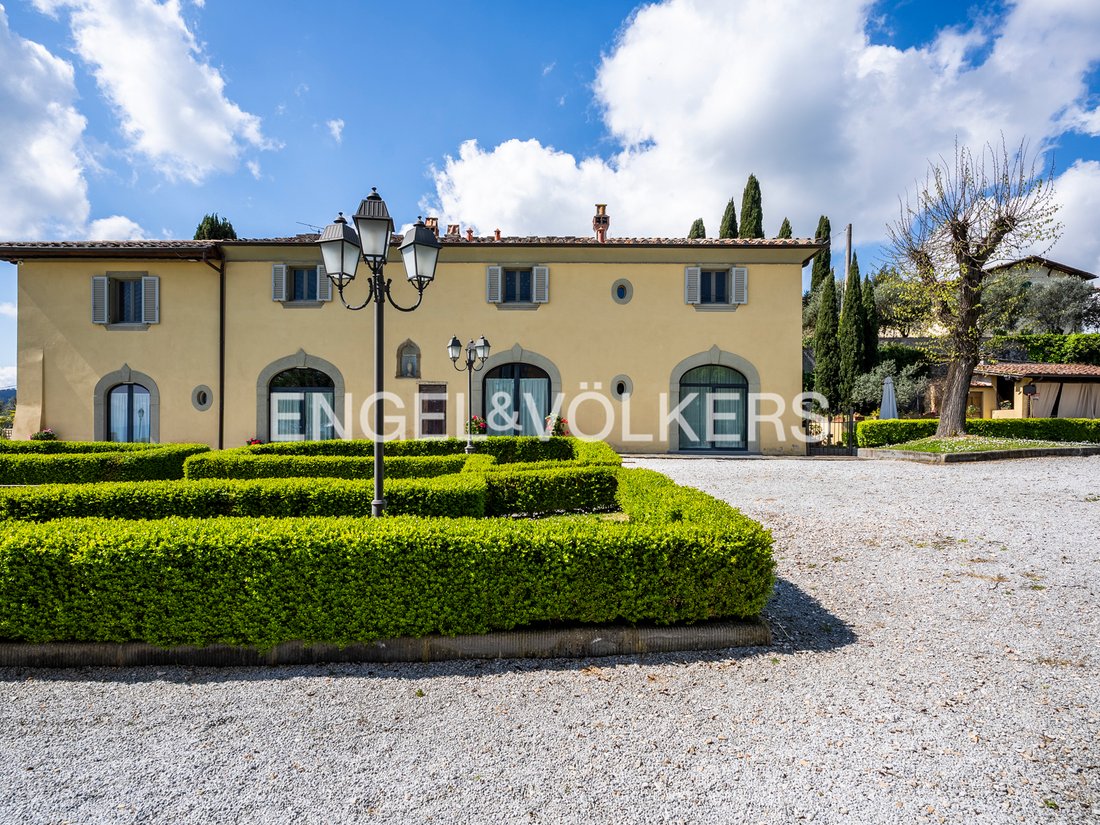
Parte del complejo que se desarrolló alrededor de la histórica villa es el alargado edificio señorial que aún conserva las formas del siglo XVI, con una hermosa fachada de finales del siglo XVI, con marcos de piedra de pietra serena en la planta principal y ventanas típicas «arrodilladas» en la planta baja.
A principios del siglo XIX, con el establecimiento de la granja, se añadieron las alas laterales a la estructura del siglo XVI, que se utilizaban como bodegas para envejecer y almacenar el vino.
Las propiedades en cuestión, destinadas a uso residencial, son la parte lateral de la villa que también incluye un anexo del siglo XV, utilizado inicialmente como establos y más tarde como molino de aceite. Están dispuestas en dos plantas sobre rasante divididas en cuatro partes inmobiliarias, de las cuales las tres principales tienen un sótano.
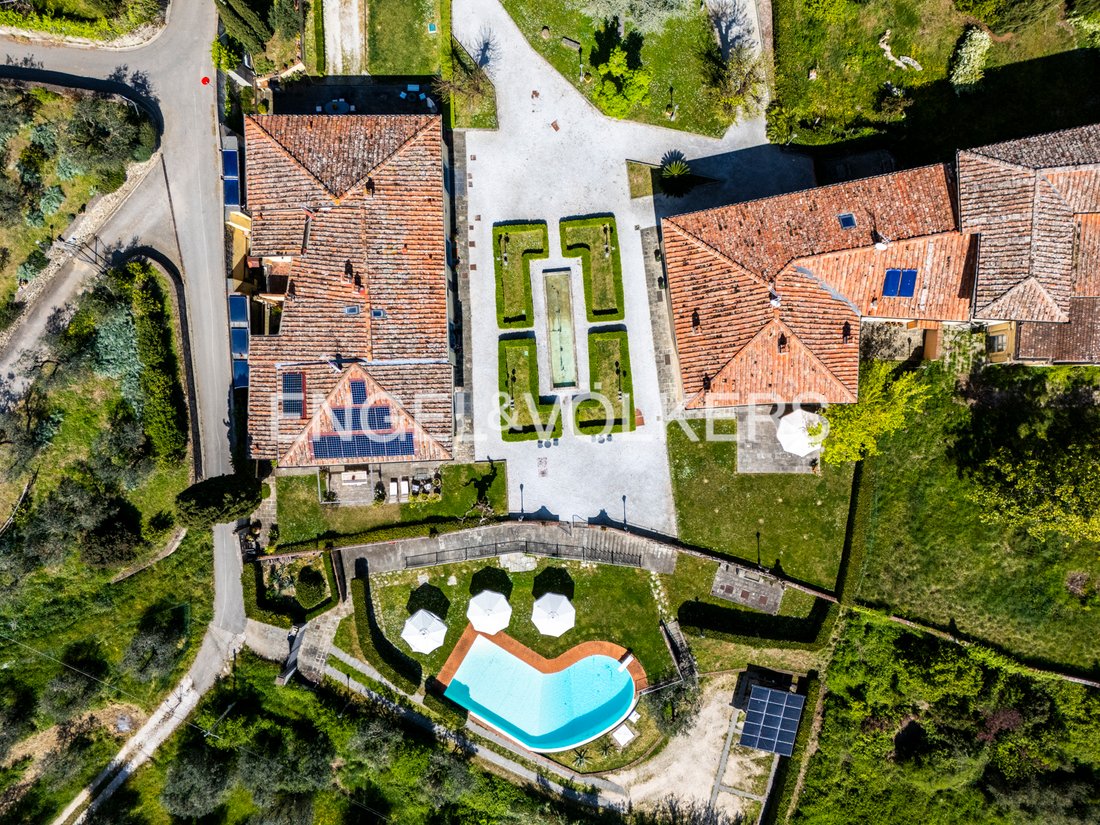
El complejo disfruta de una vista extraordinaria de las áreas de Florencia, Prato y Pistoia, y está ubicado en un elegante parque de 3.500 metros cuadrados en tres niveles: el área común en la entrada está configurada con un jardín italiano con una fuente central, pero cada unidad tiene su propio jardín; en el segundo nivel, el jardín alberga la piscina panorámica, y en el tercer nivel, el área reservada para el estacionamiento de automóviles está oculta y no es visible desde las casas.
La restauración de los edificios, llevada a cabo por los actuales propietarios, duró más de dos años, fue radical y rigurosa, y está documentada en cada etapa. La restauración conservadora apostó por materiales típicamente toscanos de la más alta calidad, como la terracota y la piedra pietra serena, con parquet de madera en las habitaciones, accesorios modernos...
Las cuatro partes inmobiliarias están en excelentes condiciones y son inmediatamente habitables, manteniendo el diseño actual, pero con pocas intervenciones, se pueden combinar en una sola parte.
Dos de ellas son villas independientes con su propio jardín y un área interna de unos 450 metros cuadrados.
La tercera, sin embargo, es una villa también de 450 metros cuadrados, pero dividida internamente en dos apartamentos, cada uno de los cuales consta de dos dormitorios, conectados por una escalera interior.
La cuarta parte, la más pequeña, se divide en dos apartamentos con un total de unos 250 metros cuadrados y un patio correspondiente.
En general, dentro del complejo inmobiliario, encontramos, divididos entre las distintas partes, 15 dormitorios y 15 baños.
Esta importante villa es potencialmente perfecta para aquellos que necesitan una propiedad única en el corazón de las colinas toscanas, con espacios grandes y bien divididos perfectamente utilizables tanto para uso hotelero como residencial.
Los verdaderos puntos fuertes de esta exclusiva residencia son, sin duda, la cuidadosa y hábil renovación, la piscina, los espléndidos jardines y las impresionantes vistas.
Una prestigiosa villa lista para experimentar lo mejor que este magnífico territorio puede ofrecer.
La colina de Carmignano, una altura panorámica dominante, situada entre la llanura que conecta Florencia con Prato y Pistoia y el valle inferior del Arno, con vistas que se extienden a los Apeninos y los Alpes Apuanos, siempre ha desempeñado un papel importante en la historia de la Toscana y ha sido una encrucijada de historia, arte y agricultura innovadora a lo largo de los siglos.
Una vasta área, inmersa en la vegetación de las colinas de Montalbano, es muy apreciada tanto desde el punto de vista vitícola como de considerable importancia histórica, que hoy también se considera muy valiosa, desde el punto de vista residencial, por su «naturalidad» y su proximidad a las ciudades de Prato y Florencia, de las que está a solo unas decenas de minutos.
Fue precisamente la posición logística de este territorio lo que atrajo a los primeros asentamientos etruscos y luego romanos —cuyos vestigios aún se encuentran en la antigua Fortaleza—, pero fue en la Edad Media, como puesto avanzado para controlar el paso de ejércitos hacia y desde el norte de Italia, cuando se convirtió en una zona de feroces disputas entre los condados de Pistoia y Florencia, pasando definitivamente al dominio de estos últimos en el siglo XV.
La familia Medici, y su red de fincas nobles que abastecían a la corte, pero que también eran agradables lugares de residencia, estudio y cuidado del paisaje, dieron un gran impulso a la zona con la construcción de la fascinante Villa de Artimino (también conocida como la «Villa de las 100 Chimeneas» y hoy declarada Patrimonio de la Humanidad por la UNESCO) y la creación de la monumental «Bandita del Barco Reale», una finca de caza de más de 4000 hectáreas rodeada por un perímetro muro de piedra de más de 50 km., con acceso protegido por puertas y portones para proteger el juego y separar el área del campos cultivados adyacentes.
En 1716, un ilustrado Cosme III de Medici estableció normas restrictivas —con el objetivo de mejorar su calidad— para la producción de vino en manos de la bandada: este es el primer y más antiguo ejemplo del mundo de una regulación DOC, incluso un siglo antes que la aplicación francesa «AOC»Gelation d’Origine Controlée».
Hoy en día, el territorio de Carmignano es una zona muy apreciada para la producción de vinos certificados con DOC y DOCG, con viñedos panorámicos que cubren las laderas de sus colinas.
Fue en 1792 cuando el gran duque Pedro Leopoldo de Lorena declaró la «sbandita», desmantelando la reserva y asignando las tierras de la zona a otros usos.
La fortaleza de Carmignano, que originalmente formaba parte de una fortificación más grande que dominaba el vasto territorio, es propiedad del municipio desde 1990, que ha destinado las instalaciones a espacios de exposición y lugares para eventos culturales.
Distancias
Autopista A1 21 km - 28’
Aeropuerto de Florencia: 20 km — 28’
Hospital 15 km — 23’
Centro de Prato: 13 km - 25 minutos
Centro de Florencia: 27 km - 45 minutos
Aeropuerto de Pisa: 66 km — 56’
Centro de Pisa: 75 km - 60 minutos
*La presente información y los planos de planta son meramente indicativos y no constituyen elementos contractuales.
Parte del complejo que se desarrolló alrededor de la histórica villa es el alargado edificio señorial que aún conserva las formas del siglo XVI, con una hermosa fachada de finales del siglo XVI, con marcos de piedra de pietra serena en la planta principal y ventanas típicas «arrodilladas» en la planta baja.
A principios del siglo XIX, con el establecimiento de la granja, se añadieron las alas laterales a la estructura del siglo XVI, que se utilizaban como bodegas para envejecer y almacenar el vino.
Las propiedades en cuestión, destinadas a uso residencial, son la parte lateral de la villa que también incluye un anexo del siglo XV, utilizado inicialmente como establos y más tarde como molino de aceite. Están dispuestas en dos plantas sobre rasante divididas en cuatro partes inmobiliarias, de las cuales las tres principales tienen un sótano.
El complejo disfruta de una vista extraordinaria de las áreas de Florencia, Prato y Pistoia, y está ubicado en un elegante parque de 3.500 metros cuadrados en tres niveles: el área común en la entrada está configurada con un jardín italiano con una fuente central, pero cada unidad tiene su propio jardín; en el segundo nivel, el jardín alberga la piscina panorámica, y en el tercer nivel, el área reservada para el estacionamiento de automóviles está oculta y no es visible desde las casas.
La restauración de los edificios, llevada a cabo por los actuales propietarios, duró más de dos años, fue radical y rigurosa, y está documentada en cada etapa. La restauración conservadora apostó por materiales típicamente toscanos de la más alta calidad, como la terracota y la piedra pietra serena, con parquet de madera en las habitaciones, accesorios modernos...
Las cuatro partes inmobiliarias están en excelentes condiciones y son inmediatamente habitables, manteniendo el diseño actual, pero con pocas intervenciones, se pueden combinar en una sola parte.
Dos de ellas son villas independientes con su propio jardín y un área interna de unos 450 metros cuadrados.
La tercera, sin embargo, es una villa también de 450 metros cuadrados, pero dividida internamente en dos apartamentos, cada uno de los cuales consta de dos dormitorios, conectados por una escalera interior.
La cuarta parte, la más pequeña, se divide en dos apartamentos con un total de unos 250 metros cuadrados y un patio correspondiente.
En general, dentro del complejo inmobiliario, encontramos, divididos entre las distintas partes, 15 dormitorios y 15 baños.
Esta importante villa es potencialmente perfecta para aquellos que necesitan una propiedad única en el corazón de las colinas toscanas, con espacios grandes y bien divididos perfectamente utilizables tanto para uso hotelero como residencial.
Los verdaderos puntos fuertes de esta exclusiva residencia son, sin duda, la cuidadosa y hábil renovación, la piscina, los espléndidos jardines y las impresionantes vistas.
Una prestigiosa villa lista para experimentar lo mejor que este magnífico territorio puede ofrecer.
La colina de Carmignano, una altura panorámica dominante, situada entre la llanura que conecta Florencia con Prato y Pistoia y el valle inferior del Arno, con vistas que se extienden a los Apeninos y los Alpes Apuanos, siempre ha desempeñado un papel importante en la historia de la Toscana y ha sido una encrucijada de historia, arte y agricultura innovadora a lo largo de los siglos.
Una vasta área, inmersa en la vegetación de las colinas de Montalbano, es muy apreciada tanto desde el punto de vista vitícola como de considerable importancia histórica, que hoy también se considera muy valiosa, desde el punto de vista residencial, por su «naturalidad» y su proximidad a las ciudades de Prato y Florencia, de las que está a solo unas decenas de minutos.
Fue precisamente la posición logística de este territorio lo que atrajo a los primeros asentamientos etruscos y luego romanos —cuyos vestigios aún se encuentran en la antigua Fortaleza—, pero fue en la Edad Media, como puesto avanzado para controlar el paso de ejércitos hacia y desde el norte de Italia, cuando se convirtió en una zona de feroces disputas entre los condados de Pistoia y Florencia, pasando definitivamente al dominio de estos últimos en el siglo XV.
La familia Medici, y su red de fincas nobles que abastecían a la corte, pero que también eran agradables lugares de residencia, estudio y cuidado del paisaje, dieron un gran impulso a la zona con la construcción de la fascinante Villa de Artimino (también conocida como la «Villa de las 100 Chimeneas» y hoy declarada Patrimonio de la Humanidad por la UNESCO) y la creación de la monumental «Bandita del Barco Reale», una finca de caza de más de 4000 hectáreas rodeada por un perímetro muro de piedra de más de 50 km., con acceso protegido por puertas y portones para proteger el juego y separar el área del campos cultivados adyacentes.
En 1716, un ilustrado Cosme III de Medici estableció normas restrictivas —con el objetivo de mejorar su calidad— para la producción de vino en manos de la bandada: este es el primer y más antiguo ejemplo del mundo de una regulación DOC, incluso un siglo antes que la aplicación francesa «AOC»Gelation d’Origine Controlée».
Hoy en día, el territorio de Carmignano es una zona muy apreciada para la producción de vinos certificados con DOC y DOCG, con viñedos panorámicos que cubren las laderas de sus colinas.
Fue en 1792 cuando el gran duque Pedro Leopoldo de Lorena declaró la «sbandita», desmantelando la reserva y asignando las tierras de la zona a otros usos.
La fortaleza de Carmignano, que originalmente formaba parte de una fortificación más grande que dominaba el vasto territorio, es propiedad del municipio desde 1990, que ha destinado las instalaciones a espacios de exposición y lugares para eventos culturales.
Distancias
Autopista A1 21 km - 28’
Aeropuerto de Florencia: 20 km — 28’
Hospital 15 km — 23’
Centro de Prato: 13 km - 25 minutos
Centro de Florencia: 27 km - 45 minutos
Aeropuerto de Pisa: 66 km — 56’
Centro de Pisa: 75 km - 60 minutos
*La presente información y los planos de planta son meramente indicativos y no constituyen elementos contractuales.
The property in question is located on the hill called ”Castello,” where the fortified medieval village of Carmignano once stood.
Part of the complex developed around the historic Villa is the elongated manor building that still retains sixteenth-century forms with a beautiful late sixteenth-century facade, featuring pietra serena stone frames on the main floor and typical ”kneeling” windows on the ground floor.
In the early 1800s, with the establishment of the farm, the lateral wings were added to the sixteenth-century structure, which were used as cellars for aging and storing wine.
The properties in question, intended for residential use, are the lateral portion of the villa that also includes a fifteenth-century annex, initially used as stables and later as an oil mill. They are arranged on two above-ground floors divided into four real estate portions, of which the three main ones have a basement.
The complex enjoys an extraordinary view of the areas of Florence, Prato, and Pistoia, and is set in an elegant 3,500 square meter park over three levels: the common area at the entrance is set up with an Italian garden with a central fountain, but each unit has its own garden; at the second level, the garden hosts the panoramic swimming pool, and at the third level, the area reserved for car parking is hidden and not visible from the houses.
The restoration of the buildings, carried out by the current owners, lasted over two years, was radical and rigorous, and is documented at every stage. The conservative restoration favored typically Tuscan materials of the highest quality such as terracotta and pietra serena stone, with wooden parquet in the bedrooms, modern fixtures....
The four real estate portions are in excellent condition and immediately habitable while maintaining the current layout, but with few interventions, they can be combined into a single portion.
Two of them are independent villas with their own garden and an internal area of about 450 square meters.
The third, however, is a villa also of 450 square meters but internally divided into two apartments each consisting of two bedrooms, connected by an internal staircase.
The fourth portion, the smallest, is divided into two apartments with a total of about 250 square meters and a pertinent courtyard.
Overall, within the real estate complex, we find, divided among the various portions, 15 bedrooms and 15 bathrooms.
This important villa is potentially perfect for those who need a unique property in the heart of the Tuscan hills, with large, well-divided spaces perfectly usable for both hospitality and residential use.
The real strengths of this exclusive residence are undoubtedly the careful and skillful renovation, the pool, the splendid gardens, and the breathtaking view.
A prestigious villa ready to experience the best that this magnificent territory can offer.
The hill of Carmignano – a panoramic dominant height, located between the plain that connects Florence with Prato and Pistoia and the lower Arno valley, with views extending to the Apennines and the Apuan Alps - has always played a significant role in the history of Tuscany and has been a crossroads of History, Art, and innovative Agriculture over the centuries.
A vast area, immersed in the greenery of the Montalbano hills, is highly esteemed both from a viticulture perspective and of considerable historical importance, which today is also considered very valuable – from a residential point of view – for its “naturalness” and proximity to the cities of Prato and Florence, from which it is just a few tens of minutes away.
It was precisely the logistical position of this territory that attracted the first Etruscan and then Roman settlements – traces of which are still found in the ancient Fortress - but it was in the Middle Ages, as an outpost for controlling the passage of armies, to and from northern Italy, that it became an area of fierce disputes between the Pistoian and Florentine counties, eventually passing definitively under the dominion of the latter in the 15th century.
The Medici family – and its network of noble Villa-Farms that supplied the court, but were also pleasant places of residence and study and landscape care - gave a great impulse to the area with the construction of the fascinating Villa of Artimino (also known as the “Villa of the 100 Chimneys” and today a UNESCO heritage site) and the creation of the monumental “Bandita del Barco Reale,” a hunting estate of over 4000 hectares enclosed by a perimeter stone wall of over 50 km., with access protected by doors and gates to guard the game and separate the area from the adjacent cultivated fields.
In 1716, an enlightened Cosimo III de’ Medici established restrictive rules – aimed at improving its quality - for wine production within the bandita: this is the world’s first and oldest example of a DOC regulation, even a century before the French “AOC - Appellation d’Origine Contrôlée.”
Today, the territory of Carmignano is a prized area for the production of certified . DOC and DOCG wines, with panoramic vineyards covering the slopes of its hills.
It was in 1792 that the Grand Duke Peter Leopold of Lorraine declared the “sbandita,” decommissioning the reserve and allocating the land of the area to other uses.
The Fortress of Carmignano, originally part of the larger fortification overlooking the vast territory, has been owned by the Municipality since 1990, which has allocated the premises to exhibition spaces and venues for cultural events.
Distances
Highway A1 21 km - 28’
Florence Airport 20 km – 28‘
Hospital 15 km – 23‘
Prato center 13 km - 25’
Florence center 27 km - 45’
Pisa Airport 66 km – 56‘
Pisa center 75 km - 60’
*The present information and floor plans are merely indicative and do not constitute contractual elements.
Part of the complex developed around the historic Villa is the elongated manor building that still retains sixteenth-century forms with a beautiful late sixteenth-century facade, featuring pietra serena stone frames on the main floor and typical ”kneeling” windows on the ground floor.
In the early 1800s, with the establishment of the farm, the lateral wings were added to the sixteenth-century structure, which were used as cellars for aging and storing wine.
The properties in question, intended for residential use, are the lateral portion of the villa that also includes a fifteenth-century annex, initially used as stables and later as an oil mill. They are arranged on two above-ground floors divided into four real estate portions, of which the three main ones have a basement.
The complex enjoys an extraordinary view of the areas of Florence, Prato, and Pistoia, and is set in an elegant 3,500 square meter park over three levels: the common area at the entrance is set up with an Italian garden with a central fountain, but each unit has its own garden; at the second level, the garden hosts the panoramic swimming pool, and at the third level, the area reserved for car parking is hidden and not visible from the houses.
The restoration of the buildings, carried out by the current owners, lasted over two years, was radical and rigorous, and is documented at every stage. The conservative restoration favored typically Tuscan materials of the highest quality such as terracotta and pietra serena stone, with wooden parquet in the bedrooms, modern fixtures....
The four real estate portions are in excellent condition and immediately habitable while maintaining the current layout, but with few interventions, they can be combined into a single portion.
Two of them are independent villas with their own garden and an internal area of about 450 square meters.
The third, however, is a villa also of 450 square meters but internally divided into two apartments each consisting of two bedrooms, connected by an internal staircase.
The fourth portion, the smallest, is divided into two apartments with a total of about 250 square meters and a pertinent courtyard.
Overall, within the real estate complex, we find, divided among the various portions, 15 bedrooms and 15 bathrooms.
This important villa is potentially perfect for those who need a unique property in the heart of the Tuscan hills, with large, well-divided spaces perfectly usable for both hospitality and residential use.
The real strengths of this exclusive residence are undoubtedly the careful and skillful renovation, the pool, the splendid gardens, and the breathtaking view.
A prestigious villa ready to experience the best that this magnificent territory can offer.
The hill of Carmignano – a panoramic dominant height, located between the plain that connects Florence with Prato and Pistoia and the lower Arno valley, with views extending to the Apennines and the Apuan Alps - has always played a significant role in the history of Tuscany and has been a crossroads of History, Art, and innovative Agriculture over the centuries.
A vast area, immersed in the greenery of the Montalbano hills, is highly esteemed both from a viticulture perspective and of considerable historical importance, which today is also considered very valuable – from a residential point of view – for its “naturalness” and proximity to the cities of Prato and Florence, from which it is just a few tens of minutes away.
It was precisely the logistical position of this territory that attracted the first Etruscan and then Roman settlements – traces of which are still found in the ancient Fortress - but it was in the Middle Ages, as an outpost for controlling the passage of armies, to and from northern Italy, that it became an area of fierce disputes between the Pistoian and Florentine counties, eventually passing definitively under the dominion of the latter in the 15th century.
The Medici family – and its network of noble Villa-Farms that supplied the court, but were also pleasant places of residence and study and landscape care - gave a great impulse to the area with the construction of the fascinating Villa of Artimino (also known as the “Villa of the 100 Chimneys” and today a UNESCO heritage site) and the creation of the monumental “Bandita del Barco Reale,” a hunting estate of over 4000 hectares enclosed by a perimeter stone wall of over 50 km., with access protected by doors and gates to guard the game and separate the area from the adjacent cultivated fields.
In 1716, an enlightened Cosimo III de’ Medici established restrictive rules – aimed at improving its quality - for wine production within the bandita: this is the world’s first and oldest example of a DOC regulation, even a century before the French “AOC - Appellation d’Origine Contrôlée.”
Today, the territory of Carmignano is a prized area for the production of certified . DOC and DOCG wines, with panoramic vineyards covering the slopes of its hills.
It was in 1792 that the Grand Duke Peter Leopold of Lorraine declared the “sbandita,” decommissioning the reserve and allocating the land of the area to other uses.
The Fortress of Carmignano, originally part of the larger fortification overlooking the vast territory, has been owned by the Municipality since 1990, which has allocated the premises to exhibition spaces and venues for cultural events.
Distances
Highway A1 21 km - 28’
Florence Airport 20 km – 28‘
Hospital 15 km – 23‘
Prato center 13 km - 25’
Florence center 27 km - 45’
Pisa Airport 66 km – 56‘
Pisa center 75 km - 60’
*The present information and floor plans are merely indicative and do not constitute contractual elements.
-
Tipo de propiedad
Villa
-
Pisos
2
-
Año de construcción
1500
-
Precio/pie²
$385
-
Emisiones
D
-
Consumo
D
Características
Características
Lote
Interior
- Techo alto
- Chimenea
- Aire Acondicionado
- Ascensor
- Cocina abierta
Outdoor
Explorar la zona
Via del Castello, 59015 Carmignano PO, Italy, Centro - La Rocca, Toscana
Ver en Google Maps
Precio por sqft
Bajo
Alto
Ubicada en el encantador pueblo toscano de Carmignano, esta exquisita propiedad ofrece un estilo de vida idílico. Rodeada de colinas pintorescas de viñedos y olivares, promete tranquilidad y belleza escénica. Con Florencia a solo 30 minutos, sumérjase en arte, cultura y experiencias gastronómicas de renombre. La cercana región de Chianti realza aún más la atracción con sus vinos finos y tradiciones culinarias.
Ver lugares cercanos
Atracciones
Escuelas
Aeropuerto de Florencia
Aeropuerto
28 min
Estación de tren Prato Centrale
Estación de Tren
20 min
Centro histórico de Florencia
Cultura & Patrimonio
40 min
Región vinícola de Chianti
Exteriores & Naturaleza
30 min
Escuela Internacional de Florencia
Escuela Internacional
45 min
Liceo Clásico Cicognini
Escuela pública
18 min
Usted ha preguntado por esta propiedad
El agente se comunicará con usted pronto por
Publicado por
52
Anuncios
2025
Se unió
Reserva una visita con Engel & Völkers
Elija una fecha y si prefiere una visita virtual o presencial con el agente.
Fecha preferida
Tipo de tour

Engel & Völkers Firenze
Lungarno Guicciardini 25R, 50125, Firenze, Firenze, Italy
Ver perfil de la agencia
Última actualización
Marzo 27
Primera publicación
Mayo 21, 2025
Referencia del anuncio
W-02Z325
Propiedades similares cercanas
Nuevos anuncios en Centro - La Rocca


Explorar más viviendas en venta
Centro - La Rocca, Carmignano, Toscana tipos de propiedad
- Villas en venta en Centro - La Rocca, Carmignano, Toscana
- Casas de campo en venta en Centro - La Rocca, Carmignano, Toscana
- Apartamentos en venta en Centro - La Rocca, Carmignano, Toscana
- Ranchos en venta en Centro - La Rocca, Carmignano, Toscana
- Casas en venta en Centro - La Rocca, Carmignano, Toscana
Centro - La Rocca, Carmignano, Toscana búsquedas populares
- Propiedades Vista Panorámica en Centro - La Rocca, Carmignano, Toscana
- Propiedades con Terraza en Centro - La Rocca, Carmignano, Toscana
- Propiedades con Bar en Centro - La Rocca, Carmignano, Toscana
- Propiedades con Sala de juegos en Centro - La Rocca, Carmignano, Toscana
- Propiedades con Oficina en Centro - La Rocca, Carmignano, Toscana
- Propiedades con Ascensor en Centro - La Rocca, Carmignano, Toscana
- Propiedades Vista a la Montaña en Centro - La Rocca, Carmignano, Toscana
- Propiedades con Jardín en Centro - La Rocca, Carmignano, Toscana
- Propiedades Comunidad Cerrada en Centro - La Rocca, Carmignano, Toscana
- Propiedades Privacidad en Centro - La Rocca, Carmignano, Toscana
- Propiedades Cima de una colina en Centro - La Rocca, Carmignano, Toscana
- Propiedades Propiedad de Inversión en Centro - La Rocca, Carmignano, Toscana
- Propiedades con Gimnasio en Centro - La Rocca, Carmignano, Toscana
- Propiedades con Biblioteca en Centro - La Rocca, Carmignano, Toscana
- Propiedades con Aire Acondicionado en Centro - La Rocca, Carmignano, Toscana
- Propiedades con Bodega en Centro - La Rocca, Carmignano, Toscana
- Propiedades con Jacuzzi en Centro - La Rocca, Carmignano, Toscana
- Propiedades con Chimenea en Centro - La Rocca, Carmignano, Toscana
- Propiedades con Piscina en Centro - La Rocca, Carmignano, Toscana
- Propiedades con Garaje en Centro - La Rocca, Carmignano, Toscana
- Propiedades con Balcón en Centro - La Rocca, Carmignano, Toscana
- Propiedades Mansión en Centro - La Rocca, Carmignano, Toscana
- Propiedades con Cocina abierta en Centro - La Rocca, Carmignano, Toscana
- Propiedades Renovado en Centro - La Rocca, Carmignano, Toscana
- Propiedades Vista al Agua en Centro - La Rocca, Carmignano, Toscana
Guías e historias relacionadas
La confianza de los mejores brokers del mundo
Los agentes tras las propiedades más excepcionales del mundo publican en JamesEdition.
- Anuncios de Sotheby's, Christie's, BARNES y Engel & Völkers
- Cada anuncio se revisa antes de publicarse
- Conecte directamente con agentes verificados
Al continuar, acepta nuestros Términos y la Política de Privacidad.